

There was always a warning buried in plain sight.
In Infantino’s FIFA Has Chosen Sides, I argued that football’s governing body had abandoned even the pretence of neutrality. In FIFA’s New Peace Prize, I described a governing class more interested in optics than ethics. And in The Führer’s Playbook, I warned that the fusion of spectacle and strongman politics was no longer creeping - it was accelerating.
Now it’s here.
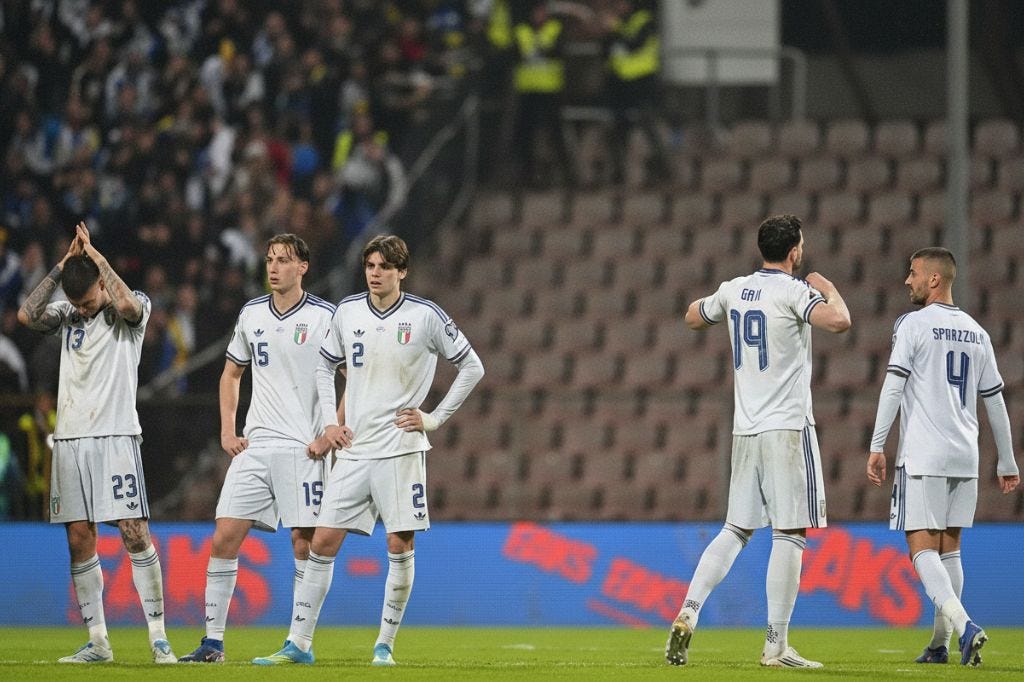
The attempt by members of Donald Trump’s administration to pressure FIFA into replacing Iran with Italy at the 2026 World Cup is not an aberration. It is the logical conclusion of everything we have already seen - the erosion of sporting merit, the normalisation of political interference, and the quiet acceptance that football can be bent to serve those in power.
Fronted by US special envoy Paolo Zampolli - an Italian-American - the proposal is as crude as it is revealing. Italy, we are told, “deserves” to be there. Not because they qualified. They didn’t. Not because of injustice. There was none. But because they have history, status, and, crucially, proximity to influence.
This is not football governance. It is patronage.
And it arrives in the shadow of something far more serious, a US-led war on Iran - an unprovoked attack on a sovereign nation, carried out in partnership with Israel - now bleeding directly into the sporting arena.
That alone should set alarm bells ringing.
Instead, FIFA’s response has been entirely consistent with its recent trajectory - vague assurances, strategic ambiguity, and a carefully preserved loophole. Yes, Iran “must” play, says Infantino. But also - conveniently - FIFA retains “sole discretion” to replace any team.
We’ve seen how that discretion works.
Inter Miami didn’t qualify for the Club World Cup either. They were invited anyway. Because Lionel Messi sells. Because commercial logic overrides competitive integrity. Because FIFA, under Infantino, no longer governs the game - it curates it.
Now apply that same logic to geopolitics.
If Messi can be inserted for money, why can’t Italy be inserted for diplomacy?
If qualification can be bypassed for commercial gain, why not for political favour?
This is the slippery slope we were told didn’t exist. And yet here we are.
The Italy dimension only deepens the cynicism. This is not just about football - it is about repairing relations between Trump and Italian Prime Minister Giorgia Meloni after a very public falling-out. A World Cup place, in this context, becomes a bargaining chip. A diplomatic olive branch dressed up as sporting logic.
It is transactional. Nakedly so. And it forces a far more uncomfortable question than whether Iran will actually be replaced.
If they are willing to try this - what else is on the table?
After all, Zampolli is the same man who used his connections and influence within the Trump administration to use ICE to detain the mother of his child during a custody battle.
Would a Trump-hosted tournament weaponise immigration enforcement, with players, journalists, or fans from “undesirable” nations subjected to intimidation under the banner of security?
Would economic pressure - tariffs, sanctions, trade leverage - be quietly applied to nations whose success on the pitch becomes politically inconvenient?
Would referees and officials operate in an environment where influence is no longer whispered, but structurally embedded?
Would corruption evolve from an undercurrent into an operating system?
These are not hypotheticals pulled from thin air. They are entirely consistent with a worldview that treats institutions as instruments, rules as obstacles, and power as something to be exercised, not restrained.
And FIFA, crucially, has shown it will not resist.
This is the same organisation that has “chosen sides,” that has wrapped itself in the language of unity while enabling division, that has rebranded political compliance as global harmony. The same organisation that has already demonstrated its willingness to bend formats, rewrite criteria, and selectively enforce its own rules depending on who is asking - and what is being offered.
So when Infantino says Iran will be there “for sure,” it lands less as a guarantee and more as a placeholder. A position held only until something more expedient presents itself.
Because that is the new reality of football governance.
Conditional participation. Negotiable legitimacy. Flexible principles.
And Iran - whatever one thinks of its regime - is reduced to a test case. A qualified team whose place is no longer secured by performance, but by political convenience.
That should concern everyone. Because once qualification becomes optional, everything else follows. Today it is Iran. Tomorrow it is any nation that falls out of favour, refuses cooperation, or simply stands in the way of a more “useful” narrative.
And in that world, the World Cup ceases to be a competition. It becomes a stage-managed production where entrants are selected, outcomes are influenced, and the illusion of sport masks the reality of control.
This was always the endgame. A tournament not defined by who earns their place, but by who is allowed to keep it. And if FIFA permits even the discussion of this proposal to carry weight, then we are no longer watching football’s governing body lose control. We are watching it hand control over - willingly. To power. To politics. To men who believe the rules do not apply to them. And increasingly, don’t.
JUST IN: 🇮🇹 Italy rejects proposal from President Trump's envoy to replace Iran at the World Cup.
This is whats called the thin edge of the wedge.
What happens when, not if, there's a dodgy call from a real honest mistake, does the ref check which colour card he shows to the perpetrator or which shirt he wears.
This WILL BE the most corrupt sporting games since the 1936 Berlin Olympic games, all for what? To keep a senile old clown who doesnt know if it's new year or New York happy?
Infantino is a disgrace to world sport, obviously the USA dished out the brown envelopes to members of FIFA and IOC who decided they'd get both World Cup and Olympics.
No doubt the embarrassing cringeworthy FIFA peace prize was for the 🍊💩 to boast and brag to his lickspittle mealy mouthed hangers on.