

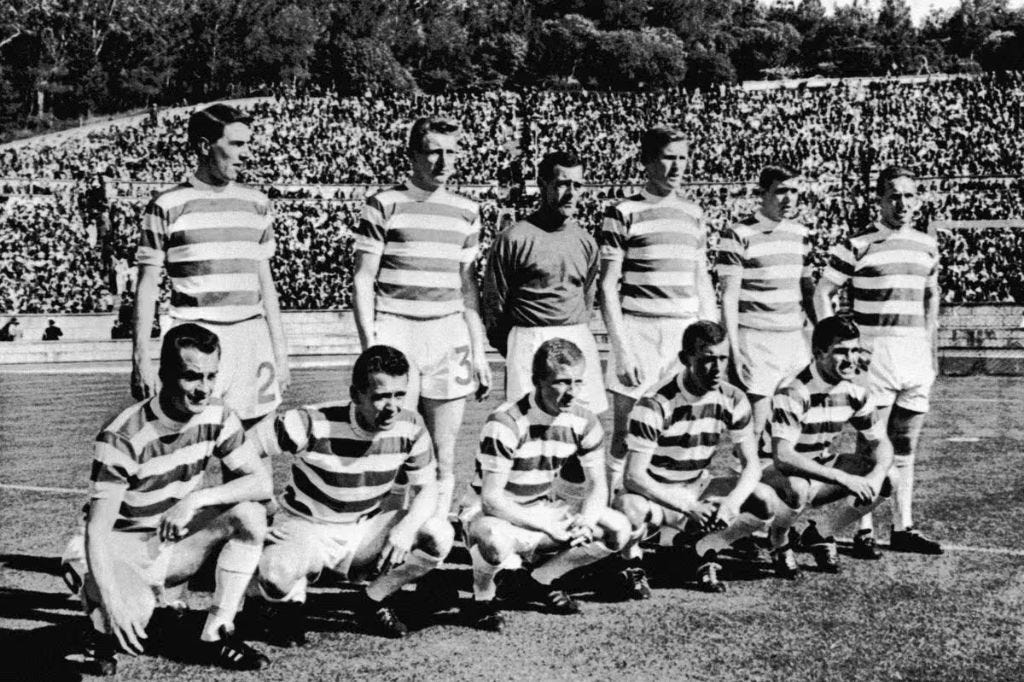
There is a fine line between honouring history and hiding behind it. Celtic Football Club, perhaps more than any other institution in world football, walks that line every single day. The Lisbon Lions’ European Cup triumph in 1967 is one of the most extraordinary achievements in sporting history, a team of local lads, all born within 30 miles of Celtic Park, conquering Europe with attacking football, swagger, and a sense of identity that still resonates across generations to this day.
But in 2026, the club’s relationship with that legacy has drifted from reverence into something far more cynical. The Lisbon Lions have become a brand asset, a marketing motif, a season‑ticket sales pitch, a kit‑launch aesthetic, a tile pattern, a retro font, a limited‑edition drop, a commemorative scarf, a corporate hospitality theme, a museum‑tour centrepiece, and a YouTube content series. They have become everything except what they should be - an inspiration for Celtic to once again compete seriously in Europe.
The club’s hierarchy have turned the Lisbon Lions into a shield. A shield against criticism, a shield against ambition, a shield against the uncomfortable truth that Celtic, a club with global reach and enormous potential, has not won a knockout tie in the Champions League since the competition was rebranded. And the fans know it.
The Lisbon Lions Deserve Better Than Being Reduced to a Kit Concept
This season’s third kit launch “inspired by the tiles of the Estádio Nacional” is the latest example of the club’s commercial department strip‑mining Lisbon for commercial greed. The tiles are beautiful, yes. The stadium is iconic. The symbolism is powerful. But symbolism without substance is just marketing.

The club’s hierarchy has become addicted to nostalgia monetisation. Every year brings a new Lisbon‑themed product line, a new anniversary celebration, a new “storytelling” campaign that uses the Lions’ memory to sell shirts rather than to set standards.
The problem is not the celebration of history. Celtic should absolutely celebrate the Lisbon Lions. They should be proud of them. They should tell their story to every new generation of fans in Glasgow, the rest of Scotland, Ireland, North America, Australia, Japan, and beyond. The Lions are the club’s greatest treasure. The problem is that the club has stopped using that history as a benchmark and instead use it as nothing more than a brand identity. The Lisbon Lions were not a marketing strategy. They were a footballing revolution.
Celtic’s Board Lives in the Past Because It Has No Vision for the Future
The club’s hierarchy has mastered the art of historical distraction. When European results disappoint the club pivots back to Lisbon. When fans question the lack of investment, the lack of ambition, the lack of a coherent footballing strategy, the club releases another heritage‑themed campaign.

It is easier to sell the past than to build the future. It is easier to celebrate 1967 than to plan for 2027. It is easier to design a kit inspired by Lisbon than to build a squad capable of reaching a Champions League last‑16. It is easier to commission a documentary about Jock Stein than to hire a modern sporting director with a long‑term plan.
The Lisbon Lions are not the problem. The memory of the Lisbon Lions is not the problem. Celebrating the Lisbon Lions is not the problem. The problem is the Celtic board’s dependency on them.
Europe Has Moved On - Celtic Has Not
Football has changed beyond recognition since 1967. The European Cup is now a multi‑billion‑euro industry dominated by superclubs, sovereign wealth funds, and global commercial machines. But that does not excuse Celtic’s stagnation.
Clubs with smaller budgets, smaller stadiums, and smaller global fanbases have achieved far more in Europe in the last 20 years:
Ajax reached a Champions League semi‑final.
Porto won the Champions League and Europa League.
Benfica reached multiple European finals.
Atalanta reached a Champions League quarter‑final.
Basel, Shakhtar, and Villarreal have all had deep European runs.
Even clubs like Malmö, APOEL, and BATE Borisov have reached the Champions League knockout stages.
Celtic, meanwhile, have become perennial group‑stage participants present, but not competitive.

The club’s hierarchy has accepted this as the natural order of things. They point to financial disparities, market realities, and structural disadvantages. But those excuses ring hollow when clubs with fewer resources consistently outperform Celtic in Europe.
The truth is simple, Celtic have not built a footballing structure capable of competing. They have relied on domestic dominance as a substitute for European ambition. They have prioritised balance sheets over footballing progress. They have treated Champions League qualification as a financial objective, not a sporting one. And through it all, they have used Lisbon as a comfort blanket of what the club once was and a convenient distraction from what it has failed to become.
The Fans Are Not Asking for Miracles They Are Asking for a Long-Term Strategy
Celtic supporters are among the most loyal and passionate fans in world football. They do not demand that the club win the Champions League. They do not expect Celtic to compete with PSG or Real Madrid financially.
What they want is something far more reasonable:
A coherent recruitment strategy.
A modern football department.
A sporting director with authority.
A manager backed properly and consistently.
A squad built for Europe, not just for domestic dominance.
A long‑term plan that survives beyond one transfer window.
They want Celtic to act like a club that believes it belongs in Europe, not one that treats European nights as nostalgic occasions rather than competitive opportunities. They want the Lisbon Lions to be a standard, not a souvenir.

The Commercialisation of Lisbon Has Become a Symptom of a Deeper Problem
The relentless Lisbon‑themed marketing is not the disease it is the symptom. The real issue is that Celtic’s hierarchy has become comfortable. Too comfortable. Domestic success is predictable. Revenue is stable. Season tickets sell out. Merchandise flies off the shelves. The club is financially healthy.
But football is not just a business. It is a sporting competition. And Celtic, for all their commercial success, have failed to compete where it matters most, Europe. The Lisbon Lions were pioneers. Innovators. Risk‑takers. They played with courage, creativity, and ambition. They were not afraid of anyone. Today’s Celtic board is afraid of risk. Afraid of ambition. Afraid of spending. Afraid of change. They cling to Lisbon because Lisbon is safe. Lisbon is comforting. Lisbon is profitable. But Lisbon is also 59 years ago.
Celtic Must Celebrate Its History And Stop Living Inside It
Celtic’s history is a gift. An unbroken one at that. It is a story that deserves to be told, shared, and celebrated. The club should absolutely honour the Lisbon Lions. They should educate new fans about them. They should preserve their legacy. But history should be a foundation, not a fortress.
The club must stop using Lisbon as a marketing crutch and start using it as a footballing blueprint. The Lisbon Lions were not just a great team, they were a symbol of what Celtic can be when the club is bold, ambitious, and united behind a vision.
Celtic must rediscover that spirit.
The Lisbon Lions Would Expect Better
If the Lisbon Lions walked into Celtic Park today, what would they see? They would see their faces on banners. Their names on merchandise. Their story in every marketing campaign. Their legacy used to sell shirts, tickets, and sponsorships.
But would they see a club striving to emulate their achievement? Would they see a club building a team capable of competing in Europe? Would they see a club with the ambition, courage, and vision that defined their era? Or would they see a club content to live off their memory?
The Lions Lions were not content. They were not complacent. They were not nostalgic. They were winners. And winners do not settle.
A football club cannot build its future on anniversaries, commemorative kits, and heritage campaigns. The Lisbon Lions should be celebrated, but they should also be surpassed.
Not in achievement, perhaps. Not in romance. Not in mythology. But in ambition. Celtic must aim to create new European memories. New heroes. New stories. New nights that future generations will celebrate and remember for decades to come.
The club cannot keep milking the past while starving the future. The board must choose Lisbon as a memory or Lisbon as a mission.
The club can and almost certainly will continue down the path of commercial nostalgia, where Lisbon is a marketing asset and European football is a financial objective. But the club can choose a different path, one where Lisbon is a mission statement.
A reminder that Celtic, when bold and united, can achieve the extraordinary. A reminder that the club’s destiny is not to be a museum, but a competitor. A reminder that the Lisbon Lions were not the end of Celtic’s story, they were the beginning.
Celtic supporters will always honour the Lisbon Lions. They will always cherish that triumph. They will always celebrate the club’s history. But they also want a future. They want a Celtic that competes. A Celtic that grows. A Celtic that evolves. A Celtic that believes it belongs on the European stage.
The board must stop hiding behind Lisbon and start building toward something worthy of it. Because the Lisbon Lions did not win the European Cup so that Celtic could spend the next 60 years selling shirts inspired by them. They won it to show what Celtic could be. And it is long past time for the club to live up to that legacy.
You're on fire this past few days Andy!
The mindset of the Celtic hierarchy reminds me of that great philosopher Homer Simpson....
"We tried our best. We failed miserably. The lesson is - never try!"
Great breakdown Andy on the malaise at Parkhead under the current absentee landlord Desmond and his bunch of yes men, directors. You quite rightly point out, that the current board lacks vision, and as the great King Solomon once said " Without vision, the people perish ".