

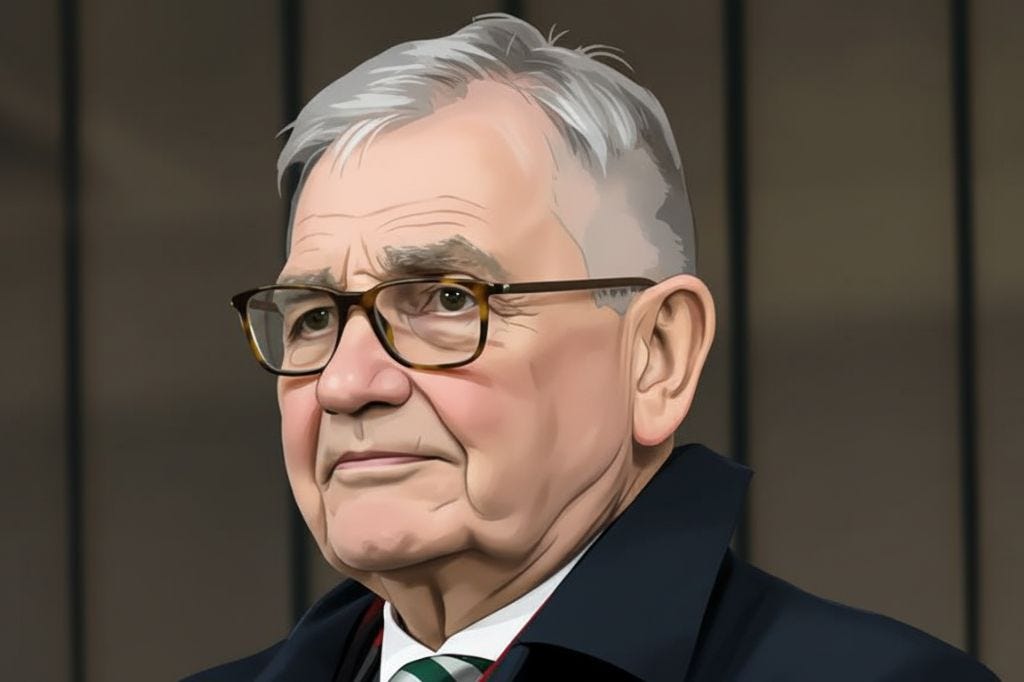
Brian Wilson’s words were designed to soothe. They were meant to reset the mood, to draw a line under a season that had been as fractious off the pitch as it was ultimately successful on it. “Very active,” he said. “Stronger squad.” “Unity.” It was all there - the language of renewal, of lessons learned, of a club ready to move forward together.
But weeks after Celtic lifted their 56th league title, those words ring hollow. Not because supporters are unwilling to believe them, but because they have heard them all before. And more importantly, because there is no evidence, none, that this board is capable of delivering on them.
Strip away the rhetoric and Celtic right now is not a club building on success. It is a club drifting in place, clinging to past achievements while failing to address the structural weaknesses that undermine everything it claims to stand for.
The most glaring issue is leadership or rather, the absence of it. Six months on from Peter Lawwell’s dramatic exit following shareholder unrest at the AGM, Celtic still operates with an interim chairman. Interim. Temporary. Placeholder. It is a word that might be acceptable in the immediate aftermath of upheaval, but becomes increasingly absurd the longer it lingers.
What does it say about Celtic’s strategic direction that one of the most important roles in the club remains unresolved half a year later? What message does it send to supporters, to players, to potential signings, to shareholders and investors? Stability matters in football. Leadership matters. Yet here Celtic are, still treading water at boardroom level while expecting fans to buy into a vision that has not even been properly defined.
And it does not stop there.
Five months after removing the Head of Football Operations - a role central to any modern club’s recruitment and long-term planning - there is still no replacement. No announcement. No indication of a coherent structure being put in place. Nothing.
Yet, curiously, when it came to appointing a Head of Business Operations, the club moved swiftly and decisively. That position was filled “quick sharpish”. The contrast is stark and deeply revealing. It speaks to priorities. It tells you where the urgency lies and where it does not. Celtic, for all their talk of ambition, continues to behave like a business first and a football club second.
On the pitch, the consequences of that imbalance are already clear. It has been a year and a half since Celtic sold their first-choice striker. A year and a half and still no replacement. A few stopgaps, but no long-term solution, not even a clear attempt to address the gap.
You cannot compete, domestically or in Europe, while leaving holes like that unfilled. It is not just negligence; it is a failure of basic squad planning.
The same pattern repeats across the club’s footballing infrastructure. Seven months have passed since the Head of Scouting departed for Swansea City. Seven months without a successor. Seven months without any visible effort to modernise or rebuild a scouting network that, in today’s game, should be driven by data, analytics, and global reach. Instead, Celtic are stuck in a bygone era, reactive rather than proactive, opportunistic rather than strategic.
And then there is the managerial situation. Martin O’Neill’s return carries emotional weight. It taps into memory, into nostalgia, into a period when Celtic felt formidable and fearless. It is a reward for securing the league and cup double last season. There is no questioning his legacy; it is secure. But football is not a museum, and sentiment cannot substitute for structure.
Even here, the lack of planning is evident. Nearly a week after his official appointment, there is still uncertainty surrounding his backroom staff. The futures of key assistants remain unresolved. Assistants that helped O’Neill win the league and cup double - while another coach, Gavin Strachan, is already heading out the door.
This is not how serious clubs operate. This is not how you prepare for a new season. It is improvisation dressed up as continuity.
Meanwhile, the transfer window ticks on. It has been over four weeks since Celtic lifted the Scottish Cup and brought the season to a close. Four weeks of opportunity. Four weeks to begin the rebuild that everyone, from the manager to the supporters, knows is necessary. And yet, not a single signing. Not one.
This, despite the fact that the scale of the task is obvious. A first-choice goalkeeper gone. Six loan players returning to parent clubs. Two player contracts expired. 6 first team players potentially on their way out. Injuries to contend with. Weaknesses that were evident long before the season started last season let alone when it ended last month.
Celtic did not stumble into this situation. They had months to prepare. And still, there is silence. There is no movement.
Supporters are not frustrated and angry because they expect instant gratification. They are frustrated and angry because there is no visible plan. No sense of urgency. No indication that the club understands the scale of what needs to be done. Instead, what they see is a familiar pattern - delay, deflect, and distract.
The unveiling of a new kit becomes a new headline. A marketing push filling the vacuum left by footballing inaction. It is business as usual, quite literally. At the centre of it all sits Dermot Desmond.
For nearly two decades, Desmond has been the dominant figure in Celtic’s power structure. His influence is unquestioned, his position unchallenged. And in that time, the club has achieved domestic success, but has it evolved?
That is the real question.
Because modern football does not stand still. It moves quickly, relentlessly, and often ruthlessly. Clubs that fail to innovate, to invest, to adapt are left behind - not always immediately, but inevitably. Celtic, under the current regime, have stagnated.
There has been no significant personal investment from Desmond since 2007. The board is populated not by football specialists, but by financiers, lawyers, and accountants whose expertise lies outside the game itself. Decisions are made through the lens of risk management rather than competitive ambition.
And when supporters voice concern, when they protest, question, demand better, they are dismissed and patronised. The presence of Desmond’s nepo baby of a son at the AGM, speaking down to shareholders, only reinforces the perception of a club that has grown detached from its own support.
This is not just about transfers or appointments. It is about culture. It is about whether Celtic sees itself as a club striving for excellence or one content to do just enough to maintain its position.
The uncomfortable truth is that success can mask decline. Winning the league on the final day of the season should have been a moment of pure celebration. Instead, it now risks becoming something else entirely - a convenient cover for deeper issues.
Had Celtic fallen short, there would have been pressure. Real pressure. Questions that could not be ignored. Changes that might have been forced. Instead, victory has allowed the board to present continuity as stability, to frame inaction as prudence, to suggest that all is well when clearly it is not. This is the danger of success without scrutiny. It breeds complacency. And complacency, in football, is fatal.
The idea that unity can be demanded without accountability is particularly galling. Supporters are told to come together, to back the team, to avoid division. But unity is not something that can be imposed from above. It has to be earned.
It comes from trust. From transparency. From evidence that those in charge are acting in the best interests of the club. Right now, that trust is well and truly broken.
Fans are not asking for the impossible. They are not demanding reckless spending or unrealistic promises. They are asking for competence. For planning. For a structure that reflects the realities of modern football. They are asking for a club that matches their ambition. Instead, they are given soundbites or told to sit down and shut up.
The harsh reality is that meaningful change is unlikely to come from within. The current power structure is too entrenched, too comfortable, too insulated from the consequences of its own decisions.
Boycotts of merchandise or symbolic protests may generate headlines, but they do not shift the balance of power. Season ticket boycotts are equally unrealistic, given the demand waiting in the wings. The board knows this. It understands the limits of supporter leverage. And so, the status quo persists.
For Celtic to truly evolve, something more fundamental has to change. Whether that is new investment, new leadership, or a complete restructuring of the club’s governance, it cannot be cosmetic. It cannot be another reshuffle of titles and responsibilities. It has to be real.
Because without it, the cycle will continue. Promises will be made. Expectations will be raised. And, inevitably, they will be shelved. Celtic will win games. They will win more trophies. But they will do so despite their structure, not because of it. And that is the most frustrating part of all.
Celtic is a club with enormous potential on and off the pitch. A global fanbase. A storied history. The resources to compete, to grow, to become something more than it currently is. Yet it remains constrained by a leadership model that prioritises control over creativity, caution over courage.
Brian Wilson spoke of unity. Of learning from mistakes. Of building something stronger. Fine words. Necessary words. But words are all they are.
Until Celtic begins to act with the urgency, clarity, and ambition that its supporters demand, those words will continue to echo into the void another set of empty promises made, and another opportunity wasted. And the longer that continues, the harder it becomes to ignore a simple, uncomfortable truth - Celtic are not standing still by accident. They are standing still by design.
Fine article, Andy. Totally nailed it.
The fans are "asking"? Time for tugging the forelock are long consigned to history, and though the term "torches and pitchforks" may be gone, it's that time NOW.
THE CELTIC FANS DEMANDS MUST BE HEARD AND ACTIONED, THE BOARD LIE ANNUALLY, THE FANS SWALLOW IT AND PROGRESS NEVER ARRIVES.
FUCK OUR BOARD