

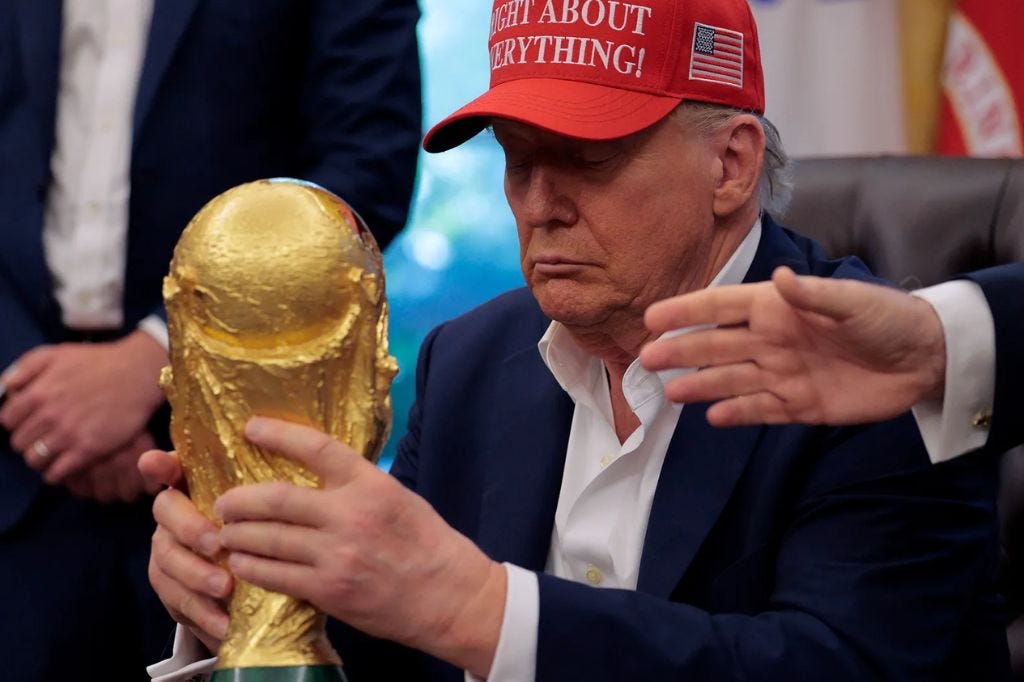
The 2026 FIFA World Cup was supposed to be the great North American spectacle - a sprawling, glittering, modern tournament staged across the United States, Canada and Mexico, sold as the biggest and boldest World Cup ever. Instead, with kickoff looming, it already feels less like a celebration of football and more like a warning label. FIFA and Donald Trump have managed to wrap the competition in a fog of ego, grievance, money, spectacle and political theatre so dense that the sport itself risks becoming the supporting act.
That is quite an achievement, in the worst possible way.
Because what should the world be talking about a week out from the opening match? The squads. The tactics. The stars. The underdogs. The atmosphere in the stands. The first proper signs of who might go far and who might not make it out of the group stages. Instead, the conversation is being dominated by Trump, Gianni Infantino, immigration fears, absurd ticket prices, hotel chaos, heat warnings, pitch concerns and the growing sense that FIFA has sold the soul of its own event to the Tangerine toddler.
And at the centre of it all is the strange, sycophantic relationship between Trump and Infantino - a bromance that has turned football’s biggest tournament into a vanity project with global consequences.

Let’s start with the most ridiculous symbol of all as I have covered previously - Trump being awarded FIFA’s inaugural Peace Prize. Even by FIFA standards, that was a staggering piece of image laundering. This was not a neutral sporting honour handed out in a spirit of international goodwill. It looked like what it was a gilded political prop designed to flatter a man who thrives on flattery, at a moment when Infantino and FIFA wanted access, attention and influence.
It was theatre. It was performance. It was also laughably cringeworthy.
Trump did not need the prize. FIFA did not need to invent the prize. Yet there they were, grinning together as if football had suddenly become a branch of presidential pageantry. Infantino, who has spent years behaving less like the steward of the game and more like a man desperate to stand in the warmest possible spotlight, looked every inch the willing sidekick - the court jester if you will. Trump, unsurprisingly, looked delighted to have another shiny object handed to him.
And that is the problem. The World Cup should not be an ego-soothing device for politicians. It should not be used as a stage for the American president to project power, dominate attention and make himself the centre of every frame. Yet here we are, with growing fears that Trump will attempt exactly that, that he will insert himself into the tournament as if it were one long campaign rally dressed up in football shirts and patriotic MAGA slogans.
Would anyone be genuinely shocked if he turned up for some theatrical kick-off moment in a presidential-style USA football kit, all gold trim and national pomp? Would it be surprising if the spectacle somehow ended with him presenting himself with a winner’s medal, the World Cup trophy itself or some other symbolic trophy cabinet addition of his own making? At this point, the only thing that would be surprising is restraint.
This is the danger Infantino has helped create. FIFA has spent years insisting that football can transcend politics, while simultaneously handing the keys to whichever political heavyweight can help FIFA protect and further its interests. In practice, that means the game gets used as a backdrop for power. It means the World Cup becomes less a football event than a political bargaining chip.

And nowhere is that clearer than in the Iran issue. Iran qualifying for the World Cup should have been a straightforward football story. Instead it has become yet another diplomatic headache, with questions over visas, travel access, security and the basic ability of players and staff to move freely. The federation has had to insist on participation and demand guarantees simply to ensure that the team can function properly in the tournament environment.
That should alarm anyone who still believes the World Cup is meant to be above this sort of mess.
Because this is not just about Iran. It is about the atmosphere FIFA has allowed to grow around the competition. If teams are arriving unsure about whether their travel documents will be honoured, whether security policy will change without warning, or whether the host nation’s political climate could make their participation awkward or hostile, then the tournament has already failed one of its most basic duties to provide fairness and certainty.
That uncertainty does not just affect Iran. It affects every team, every federation, every fan, every journalist and every supporter trying to plan a once-in-a-lifetime trip. The United States should have been selling accessibility, ease and scale. Instead, it is selling anxiety and fear.
Then there is the money.
World Cups have always been expensive, but this one is threatening to become something closer to a luxury cartel. Ticket prices are outrageous. Resale prices are grotesque. FIFA’s own marketplace has been associated with eye-watering figures that make the whole competition feel engineered for the rich, not the ordinary fan. That is a disastrous look for a tournament that constantly wraps itself in the language of global unity and football for all.
A World Cup should not feel like a corporate summit with corner flags.

Supporters are being squeezed from every direction. First comes the tickets. Then the flights. Then the hotels. Then the transport. Then the food and drink. Then the security hassle. Then the uncertainty over what the journey will actually look like once they arrive. The result is obvious, ordinary fans are being priced out, turned away or forced to accept the idea that football’s biggest party is no longer for them.
And the hotel picture is just as ugly. Reports of mass cancellations, weak demand in some host cities and the general confusion around room blocks point to a tournament that is still struggling. A mega-event this size relies on confidence. Right now, the confidence seems to be leaking out of the event in every direction.
That matters, because when supporters start doubting whether the trip is worth the expense, the atmosphere suffers before the first ball is even kicked. Empty rooms, nervous vendors, and a feeling that the whole thing has been overbuilt and under-thought is not the build-up FIFA wanted. But it is the build-up they have helped to manufacture.
Then come the football problems, which should have been the easiest ones to avoid. The pitches are already a concern. Reports from other FIFA events have shown surfaces that are patchy, uneven or too hard, with players and coaches openly criticising the quality. If the world’s biggest tournament is being played on surfaces that compromise the flow and safety of matches and the players themselves, then FIFA’s credibility takes another battering.
And over all of it hangs the heat.
This is not a minor inconvenience. This is a tournament taking place in the northern summer across a vast continent, with warnings already flagging heat, player safety and recovery concerns. If your competition requires constant discussion of whether players are at risk of dangerous temperatures, hydration failures or compromised performance, then the planning has already gone badly wrong. Football at this level should be about ability, not survival.
The issue is not only the heat itself. It is FIFA’s willingness to wave it away until the warning signs become impossible to ignore. That has become a pattern - ignore, minimise, reframe, deny, then act surprised when the obvious problems become headlines. The result is a governing body that looks permanently reactive, permanently defensive and permanently one step behind reality.
This is what makes the Trump-Infantino axis so corrosive. It is not just that they like each other or see mutual advantage. It is that together they embody a style of leadership that prizes image over substance, access over accountability and spectacle over governance. Infantino gets the attention he craves. Trump gets the grand stage he loves. FIFA gets a temporary political shield. And football gets dragged along behind them, whether it wants to or not.
That is why this tournament now feels so vulnerable to being remembered for all the wrong reasons.
If the matches are brilliant, the goals spectacular and the football irresistible, then the sport may eventually rescue the narrative. It often does. Fans forgive a lot when the football is extraordinary. A great tournament can paper over many sins. But not all of them. Not when the off-field narrative is this loud, this cynical and this persistent.
Because if the game itself is good enough, the football will still matter. But the question is whether it will matter more than the circus around it.
At the moment, that seems unlikely.
Already, the broader story of this World Cup is not who might win it. It is who is controlling it. Already, it is not about the teams. It is about the political choreography. It is not about the players. It is about the power brokers. It is not about the pitch. It is about the people standing above it trying to be bigger than the event itself.
That is how Infantino and Trump have managed to take a tournament that should have united the world and make it feel like an extension of the culture war, the ego war and the money war all at once.
With a week to go, the real fear is not just that the World Cup will be messy. It is that it has been hijacked before it even starts. That the football will be buried under the noise. That Trump will dominate the headlines, Infantino will enable him, and the tournament will become remembered as a giant, self-inflicted clusterfuck with a ball attached.
And if that happens, the shame will not belong to the players. It will belong to the men who turned the world’s game into their personal stage.
For me, every single aspect of joy and anticipation has been sucked out of this once unmissable football festival by the grasping behaviour of Infantino, Trump and FIFA.
I honestly fear that this is a tipping point for the world game....I've already made my peace in deciding not to watch or consume a single minute of this grotesque farce..
Totally agree with everything you have written, trump and Infantino have seen this as a money making scheme, and I can guarantee that some of that money ends up in their own pockets.
I have followed Scotland all over Europe for the last 30 plus years I would have been going to this competition had Scotland played in Canada or Mexico, but refuse to put a cent into the American economy whilst the orange man is in the white house.
It is also worth mentioning that Infantino has an office in Trump Tower, courtesy of Don the Con.
Another thing that puzzles me is that I have never seen the list of nominees for the 2025 FIFA peace prize award and they never announced the runner up.