

Donald Trump’s boast to the press that he had “got the Balogun red card suspended” was not the triumph for America he craved. It was not a win for the US national team. It was not even a win for Trump himself.
Instead, it became a grotesque distraction that overshadowed the squad’s preparations for the Belgium knockout match, it handed the Belgians a perfect pre-match narrative to fire themselves up, and turned a football game into a battle over the integrity of the whole tournament. The US still lost. And now, the scandal will live alongside their World Cup exit as a permanent stain on how they are remembered as a host nation.
Not a win for Trump, not a win for America
On the surface, Trump’s intervention looked like a classic “I fixed it” moment. Folarin Balogun, the US forward who had been shown a straight red card for a reckless challenge on Bosnia‑Herzegovina, suddenly found himself available for the round‑of‑16 against Belgium. Trump told the press he had spoken to FIFA president Gianni Infantino, that he had asked FIFA to review the ban, and that he considered the referee’s decision “horrible” and “a little bit suspect”.
The result was that the automatic one‑match suspension was suspended for a 12‑month probationary period under article 27 of FIFA’s disciplinary code. The red card itself was not rescinded; the punishment was simply put on hold.
That might have been framed as a procedural victory. But it was not. Because the whole thing was not about a fair disciplinary process. It was about a sitting US president using his political weight to influence a decision in a World Cup match.
Trump wanted to be seen as the man who could bend institutions to his will. In football terms, he wanted to be the man who got results. But the outcome was not a clean victory. It was like everything else that Trump touches - a messy, controversial decision that drew outrage from Belgium, UEFA, criticism from other nations, and calls of corruption from fans. The US team did not go on to win the match losing 4-1 to the Belgians, in what can only be seen as a win for football, and are now eliminated from the competition. Yet every mention of Balogun going forward for the rest of his professional career will be tied to the story of presidential interference and FIFA corruption.
That is not a legacy Trump wants - and it is certainly not what Balogun wanted as a legacy as a footballer. It is not the kind of chapter that ends with “Mission accomplished.” It ends with “What did we just do to our own player and team’s reputation?”
Overshadowed US preparations
The knockout phase of a World Cup is about focus - not that a Scot would know about that mind you! Teams prepare in bursts, measured in hours, with video analysis, tactical briefings, and mental preparation all carefully managed. They would have already finalised their preparations without Balogun as an option. Into this came a political storm and it would have completed messed up the US game plan.
Every press conference was shadowed by queries about whether the decision had been influenced by presidential pressure. Every training session photo was taken against the backdrop of a controversy that had dominated global headlines for days.
The US coaching staff did not just have to prepare for Belgium. They had to prepare for the media, the fans, the politicians, and the international football community. They had to explain why their best attacker was in the match despite a straight red card. They had to deal with the accusation that the team had benefited from special treatment.
That is not a distraction US Football could afford, especially in a tournament they are hosting. The US team wanted to be seen as a credible competitor, a side that had beaten Bosnia in the last 32, and were ready to challenge Belgium on merit. Instead, they were constantly linked to a story about political interference.
For the players, that is destructive. No one wants to be told that their opportunity to play is not purely about their performance, but about whether a president happened to think the foul looked wrong. No coach wants to be asked whether he fought the appeal or whether he simply waited for a phone call from the White House.
The scandal did not just distract from preparations. It poisoned the atmosphere. It turned a football match into a political spectacle. And further poisoned the US in the eyes of the world.
Belgium got everything they needed to fire themselves up
Belgium did not need to invent a reason to feel aggrieved. They had a legitimate complaint, their opponent had an extra player available who, under normal interpretation of the rules, should not have been there. That complaint was amplified by UEFA’s outspoken criticism, by the Belgian FA’s criticism and subsequent appeal, and by public statements from the Belgian side that the decision was “astonishing”.
Trump’s refusal to back down and his insistence that he had “got the red card suspended” turned what might have been a behind‑the‑scenes administrative dispute into a public declaration of advantage. He told the world, openly, that the US team had benefited from his personal interference and that he was proud of it. That is not a boast another national team wants to face.
Inside the Belgian camp, the story was simple - the US had been given an unfair advantage, and the only way to respond now was to prove themselves on the pitch. That galvanises a team. It adds an extra layer of purpose to the game. When players feel they are not just fighting for qualification but also defending the integrity of the competition, that can sharpen their focus and raise their intensity.
Externally, the story was even more useful. Belgium could frame the match as a test of whether football could survive in the face of political interference. Every pre‑match interview could reference the controversy without sounding petty, because the controversy had already been created by Trump himself.
In the end, Belgium won the match 4-1 and eliminated the US. It is impossible to say exactly how much the Balogun dispute influenced the result, but it certainly shaped the context. The US were not just playing Belgium; they were playing a team that had been provoked by the perception that they had been unfairly favoured. They were also playing against a global audience of football fans supporting the Belgians.
Not the last we see of Trump at the World Cup
This will not be the last time we see Trump at the World Cup. He is already scheduled to be at the final to present the trophy to the eventual winners. And we will see once again, as we saw at the Club World Cup, that Trump will make it all about him.
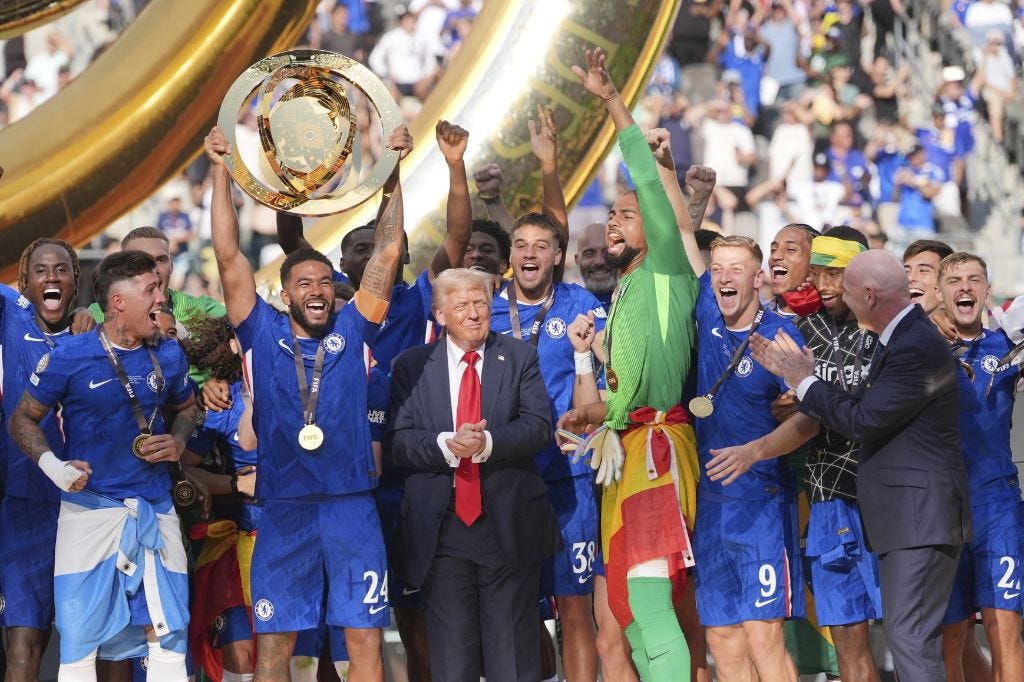
From standing on the podium as the winners celebrate as if he is part of the winning team, to pocketing a medal himself, Trump will turn the final ceremony into another personal branding boost. He will not be content to simply hand over the trophy and step back out of the limelight. He will be front and centre, making sure that the moment is all about him, not the winning team.
It wouldn’t be surprising at all if Infantino has actually commissioned a golden replica of the trophy for Trump to lift himself on his own little podium. A separate podium, a separate trophy, a separate moment. All so that the president can be seen as the man who “delivered” the World Cup, even though bone spurs would have prevented him from taking to the playing field in his ‘prime’ as it did when he dodged the draft for the Vietnam War.
That is the pattern. Trump does not want to be a guest. He wants to be the centre of the event. He wants to be the reason people talk about the final, not just the winning team.
The scandal will live alongside the US in the World Cup
The US team’s future participation and potential future hosting of the World Cup will now no longer be about their footballing legacy, but as a tournament host and participating team that has been defined by scandal. The red card saga will live long as a permanent stain on how the US are remembered as a sporting nation.
Fans in the US, and around the world, will be left with a choice - either accept that the president of their country can influence disciplinary decisions in a World Cup, or reject the legitimacy of that decision. Both options are damaging. The first erodes trust in the competition; the second erodes trust in the team. And that is before the country is seen as a pariah in the sporting world.
For a tournament that is already under scrutiny for its commercialisation, its scheduling, and political interference on the likes of Iran, this was a blow that could have been avoided. The US Football Federation could have pursued a formal appeal. If that had been rejected, the team would have accepted the outcome and moved on. There would have been no global spectacle, no presidential boast, no narrative of preferential treatment.
By letting Trump turn it into a personal project, the US team lost control of its own narrative and they will forever be tarred by the scandal.
No one will forgive or forget.
1) If the US team had a problem with the decision, they should have appealed or even objected immediately after the game where Balogun was given the red card. They didn't.
2) After Trump's meddling, the US coach Pochettino should have refused to play Balogun and stated that they would abide by the rules. He didn't.
3) Balogun should have done the right thing and told his team/coach that he wouldn't play since the coach didn't do the right thing. He didn't.
This is what happens when the rules are ignored. Shame on Pochettino. Shame on Balogun.
No point in trying to Shame Trump or Infantino - they have none.
tRump’s intervention leaves another scar on an already shredded FIFA.