

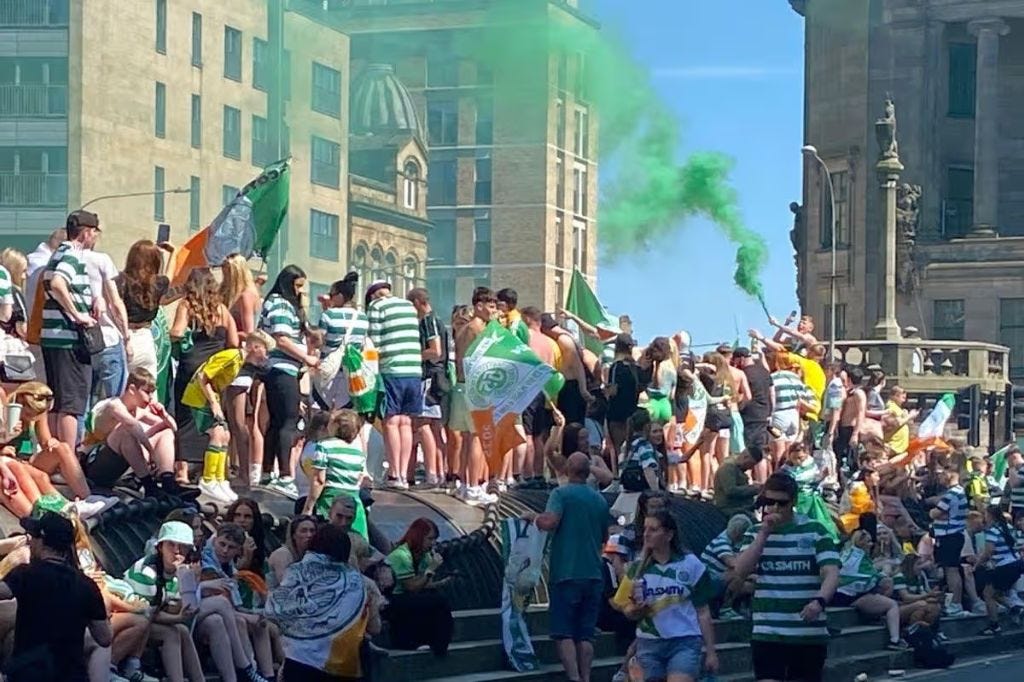
When a few thousand Celtic fans flooded Glasgow’s Trongate after last season’s title win over Hearts, some of the scenes that followed were ugly. Bottles were thrown. A couple of Police officers were injured. Residents and businesses disrupted. No one should pretend otherwise.
But the narrative now being pushed by at least one senior officer in Police Scotland – and dutifully recycled by willing elements of the Scottish press – is not just wrong. It is a dangerous misstatement of who is actually responsible for public order on the streets of Scotland’s cities. And it looks increasingly like an attempt to deflect from a Police force that has already been found wanting in its duties at the highest-profile fixture in Scottish football.
The Incident They Keep Talking About
On 16 May, after Celtic beat Hearts to clinch the Premiership, an estimated 3,000 supporters gathered in the Trongate and Glasgow Cross area. Officers in riot gear were deployed after missiles, including glass bottles, were thrown at police as they assisted with a medical emergency. Two officers sustained injuries; multiple arrests were made; CCTV is still being reviewed; and Police are now issuing photos of fans they want to speak to in relation to the disorder on the day.
Police Scotland’s own statements acknowledge the essential fact - the disorder occurred outside the stadium, on public streets, where the club’s operational control ends and the police’s begins.
The “Fanzone” Excuse
Yet Assistant Chief Constable Mark Sutherland has repeatedly insisted that Celtic FC must be “more accountable” and take “greater responsibility” for what happens when fans gather in the city centre. He has called for “urgent discussions” with the club, football authorities and Glasgow City Council to “achieve a solution that improves public safety”, suggesting the club “failed to plan” a safe celebration.
The implication is clear, if only Celtic had organised an official fanzone or title party, the scenes in Trongate would not have happened.
This argument does not survive contact with reality.
Celtic’s legal and practical duty is to stadium safety. Match-day planning, crowd control inside the ground, the stadium’s footprint, and cooperation with police on stadium operations are the club’s domain. Streets, squares and pavements are not.
Police Scotland’s statutory role is to prevent and stop crime on public thoroughfares. If fans behave criminally in the Trongate, it is the police – not the football club – who are charged with preventing it, intervening, and making arrests.
An “official fanzone” is not a legal requirement for any football club. Clubs are not obliged to create alternative party venues to absorb spontaneous gatherings. Even if they did, there is no guarantee it would stop fans from congregating elsewhere, nor does it transfer policing responsibility from the state to the club.
Police Scotland and Mark Sutherland cannot credibly argue that a football club’s failure to host a street party absolves the police of their duty to police the streets. Even if they try to do so.
The SFA’s Damning Verdict on Police Scotland
This latest attempt to scapegoat Celtic takes on a different colour when set against the recent independent SFA review into the disorder at the Scottish Cup quarter-final between Celtic and Rangers at Ibrox in March. That report did not hold back.
Its findings were stark:
Pre-match planning failures. The review identified a 10-day delay in finalising the 8,042 away-ticket allocation, only one multi-agency meeting, and inadequate deployment of officers. There was no plan for ticketless fans attempting entry by doubling-up, forgery or forcing gates.
Inadequate policing levels and risk assessment. The report noted that “neither Rangers FC nor Police Scotland had key leads on the ground with experience of managing an away allocation of 8,000 Celtic supporters at Ibrox”. Institutional knowledge had not been maintained.
Police “petrified” and officers left exposed. The review described officers as “petrified” of policing another game at Ibrox, and highlighted a “near miss” that could have escalated into life-threatening violence.

In short, the independent review found that Police Scotland failed in its duties pre-match, during the match, and in the immediate aftermath.
Yet, despite the report now being published in full, Police Scotland has still not issued a substantive public statement accepting those findings or outlining how it will implement the report’s recommendations. But it was quick to pin the finger of blame within hours demanding urgent action against the football clubs - getting that out there before the review hung the blame rightfully around those stakeholders responsible and the individuals responsible for their own misconduct.
The timing is conspicuous. As scrutiny grows over Police Scotland’s handling of high-risk fixtures, the narrative shifts from “what went wrong at Ibrox?” to “why didn’t Celtic organise a fanzone in the Trongate?”
The Herald’s “Exclusive” That Wasn’t
Into this mix steps the Herald’s Political Editor, Andrew Learmonth, with an article suggesting Celtic “failed to offer a viable alternative” to a street party – framed as a fresh revelation, an exclusive, based on a newly released Freedom of Information request.
Except we all heard this exact same script back in May. The same ACC Mark Sutherland, the same complaints about Celtic and Glasgow City Council, the same “fanzone” narrative.
So why resurface it now? A few uncomfortable questions arise:
Is this genuinely new information, or a repackaged version of May’s statements? The substance matches what was already widely reported at the time.
Is the Herald’s circulation so challenged that it needs to re-run two-month-old police criticism as a “recent” FOI-driven exclusive? If so, it’s a thin news hook masquerading as investigative journalism.
Does repeatedly framing Celtic as culpable for street disorder serve a narrative more than it serves public understanding? The effect is to normalise the idea that a club is responsible for policing its fans miles away in the city, which is simply not how accountability works.
None of this excuses the behaviour of those who committed criminal acts. But it does demand honesty about who is responsible for preventing it.
Mark Hargreaves and the Silence from Celtic Park
There is another silence that deserves to be named. Mark Hargreaves, Celtic’s Head of Safety, Security and Operations, is a former Chief Superintendent of Police Scotland and Assistant Inspector of Constabulary for Scotland. He knows the inner workings of Police Scotland and their Football Operations better than almost anyone in Scottish football currently.
So why has he not spoken out?
Why has he not publicly defended Celtic’s operations on the day of the title win, clarifying where the club’s responsibility begins and ends?
Why has he not highlighted the Scottish FA report’s findings on Police Scotland’s failures at Ibrox, and challenged the force’s attempt to shift blame onto Celtic for Trongate?
Why, in the face of his former employers bad-mouthing and trying to pin the blame on his current employers, is he remaining silent?
Why aren’t the Celtic board rolling him out in front of the media to defend the club and its operations?
His silence is not neutrality. It is complicity.
Hargreaves is uniquely placed to set the record straight, to explain that clubs are not responsible for policing city-centre streets; to challenge the “fanzone” narrative as a deflection from police failures; and to demand that Police Scotland be held to account for the shortcomings identified in the Ibrox review.
Instead, he allows his former colleagues to tar Celtic with the actions of a minority – many of whom, were probably not even at the match in the first place – while his own club absorbs the reputational damage.
The Bottom Line
Celtic FC’s responsibility ends at the stadium turnstiles and around the stadium footprint. What happens on Glasgow’s streets is a matter for Police Scotland and the city’s public authorities. Fans who commit crimes should be identified, charged and punished. But attempts to blame a club for not providing an “official” alternative to street disorder misstate the law, misallocate responsibility, and mislead the public.
And when the same story is wheeled out by the Herald’s Political Editor as if it’s new, it’s reasonable to ask - is this journalism, or just a tired narrative in search of a negative headline?
More urgently, when an independent Scottish FA review has already found Police Scotland wanting in its duties at Ibrox, the force’s latest attempt to scapegoat Celtic looks less like a genuine concern for public safety and more like a desperate distraction from its own failings.
Maybe they should look inwards before trying to pass the buck and point the finger of blame elsewhere first.
The responsibility for what happened at Ibrox and the Trongate lies with the fans involved. The behaviour of fans in general over the past few years has taken a downward turn. There's a sense of entitlement and the behaviour of recent years hasn't been replicated by fans of other sports. It's about time fans took responsibility for their behaviour and conducted themselves like civilised human beings rather than ignorant louts. We'd do well to follow the example of the Scottish fans at the world cup. They were a credit to the country. The ones that caused issues at Ibrox and the Trongate are a complete embarrassment.