

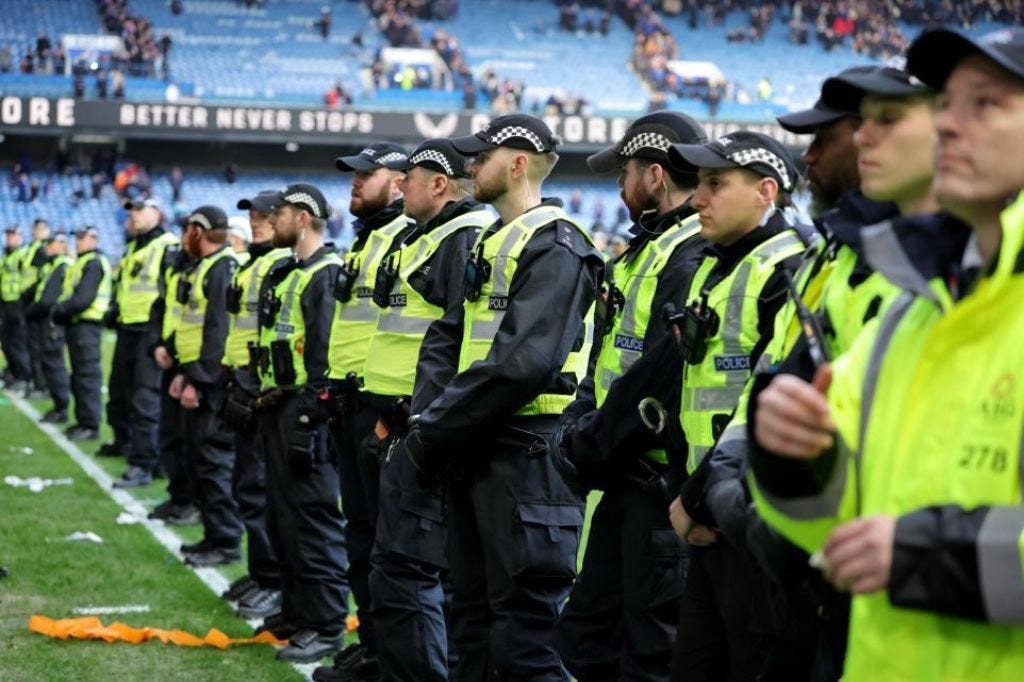
The Scottish Cup Quarter-Final tie between Rangers and Celtic on 8 March 2026 was not, in the final analysis, a football match. It was a near-disaster dressed in sporting colours - a catastrophic convergence of institutional complacency, operational incompetence, and a breathtaking abdication of duty by those charged with keeping 51,215 supporters safe.
The Independent Review, led by Mark Blackbourne, has delivered a damning assessment of what transpired at Ibrox that day. Yet in the hours following the disorder, while the smoke from flares still hung in the Glasgow air, senior figures at Police Scotland rushed to the press to lay blame at the feet of supporters solely. Now, four months later, with a report that systematically dismantles their operational planning, they have fallen conspicuously silent. The hypocrisy is as staggering as the failures it seeks to obscure.
Rangers FC: A Catalogue of Negligence
Let me be unequivocal, primary responsibility for what occurred on 8 March rests with Rangers Football Club. As the host club, they bore the legal obligation for safety and security at Ibrox Stadium. The evidence presented in the review reveals a culture of complacency so deeply embedded that it borders on institutional negligence.
The Risk Assessment prepared by Rangers for the match was, in the review’s own words, “near-identical” to that used for the league fixture just seven days earlier. This despite the fact that the Cup tie involved 5,600 additional away supporters, the jeopardy of extra time and penalties, and the possibility of Celtic winning a cup tie at Ibrox. Police Scotland added 34 police officers to their match day team for the Cup game, despite the rise in 5600 additional away supporters!
The host club’s safety team rated the risk of a pitch incursion as “Unlikely” - a prediction that proved spectacularly wrong within minutes of the final whistle.
This was not a failure of foresight; it was a failure to exercise basic professional judgement. The review noted that “a number of interviewees independently used the word: complacency.” That word should haunt every executive at Ibrox who signed off on planning that treated the most significant fixture of the season as a logistical afterthought.
The ingress plan devised by Rangers and Police Scotland for Celtic’s 8,042 supporters was, by the admission of the Event Police Lead, “aspirational.” Let that phrase sink in. The plan for getting 8,000 people safely into a stadium was described by its own architects as aspirational. No fan-flow calculations were carried out. Five search lanes were deployed for 8,042 supporters, while seven lanes had been used for 5,600 fewer supporters at the previous fixture a week before. This was not planning; it was guesswork dressed up as operational strategy.
Perhaps most tellingly, Rangers’ Safety Officer did not consult his Celtic counterpart on the away ingress plan, a plan that would affect the safety of thousands of Celtic supporters. When concerns were raised, they were dismissed. The Celtic Safety Officer was “not consulted in the planning stage.” This is not merely poor practice and unprofessional; it is a fundamental failure of the duty of care owed to visiting supporters - whatever club they support.
The review also highlighted that Rangers’ mascot was twice observed “provoking the away support,” with the Safety Officer personally warning the individual concerned. In a high-risk fixture, when tensions are already at boiling point, such behaviour is not harmless banter - it is a preventable provocation. The club’s music was also audible throughout the stadium from 10:30am, when only Celtic supporters were present. These may seem like minor details, but in the context of a powder-keg fixture, they represent a failure by Rangers to manage the environment.
Police Scotland: Command Failures and Convenient Silence
If Rangers’ failures were operational, Police Scotland’s were strategic and, in some respects, more concerning. The review reveals that 590 officers were deployed on matchday, of which only 111 were located inside the stadium. When the pitch invasion began, additional Public Order officers were delayed in reaching the scene because they had to negotiate CBRN barriers before entering the stadium - barriers that were placed there as part of Police Scotland’s own security planning.
The delay in response, however brief, occurred during “a period in which life-threatening violence was possible.” The review assesses that on two fronts - inside the stadium and outside at the Broomloan Road search lanes - the match was a “near miss.” This is not hyperbole. This is a professional assessment that lives were put at risk.
When the incursion occurred, it took four minutes and twenty-eight seconds for police to establish control. In that time, masked Rangers fans armed with poles and reinforced gloves came within a “very small margin of a violent mass confrontation” as they tried to attack Celtic fans celebrating on the pitch after their penalty shootout win. A flare was launched by a Rangers supporter before it was thrown between groups of supporters six times, striking a Rangers security operative and a CCTV operator. A Stand Manager was hospitalised after being assaulted by a masked Rangers supporter. A Celtic supporter was seriously assaulted after being attacked by three Rangers fans and left severely injured and unconscious on Helen Street, requiring emergency hospital treatment.
The most disturbing revelation, however, concerns the culture within Police Scotland itself. The review records that at a post-match Glasgow City Council Special SAG meeting, “time-served Police Scotland officers are described as ‘petrified’ of policing another match at Ibrox Stadium.” Let us read that again, police officers - seasoned professionals - were described as petrified. This is not a reflection on the courage of individual officers, many of whom stood shoulder to shoulder with colleagues in holding the line against violent, organised disorder. It is an indictment of the operational environment that their leadership allowed to develop.
Yet it was these same leaders who, within hours of the disorder, briefed the press to blame the fans. The narrative was swift and convenient - hooligans, Ultras, an entitled generation with no consequences. And there was truth in that characterisation - the behaviour of certain supporters was inexcusable. But the rush to judgment, the eagerness to deflect attention from their own institutional failures, reveals a Police Scotland leadership more concerned with protecting its own reputation than with honest transparency and accountability. Which further highlights why they refused to answer any of my freedom of information requests citing operational security concerns.
Now, with the publication of this Independent Review, Police Scotland’s senior figures are notably absent from the public conversation. Where are the mea culpas? Where is the acknowledgement that their operational planning was as flawed as any other stakeholder’s? The silence is deafening, and it speaks volumes about a culture that prioritises self-preservation over genuine reform.
The Stewarding Crisis: A Workforce on the Brink
The review’s findings on stewarding are equally alarming. Rangers engaged five separate steward agencies to deploy 655 stewards - an indication of the chronic shortage of qualified personnel. Post-Brexit and post-COVID, the pool of qualified stewards has “reduced,” with it now being “commonplace for personnel to be brought in from south of the border.” Many of whom are unqualified, not trained, and ill-equipped to deal with such a fixture.
More troubling still, the review notes that “it is not uncommon for stewards to be working at the stadium for the first time” at fixtures between the two Glasgow clubs. The Stand Managers’ post-match debrief recorded that “some of the stewards will be sufficiently unnerved to decline future role at Ibrox.”
Consider this, men and women are being deployed to manage crowds of thousands -in one of the most hostile, high-tension environments in football - with no prior experience of the stadium or the game itself. They are being paid national minimum wage to face the threat of violence, the risk of being hospitalised (as one Stand Manager was), and the psychological toll of working in conditions that would be unacceptable in any other industry.
This is not a criticism of the stewards themselves, it is a damning indictment of the system that treats their safety as an afterthought. The review found that “there is an obvious challenge to the Safety Officer and the Stand Managers each matchday to position stewards in best fit locations.” This is not a challenge; it is a failure of workforce planning that puts both stewards and supporters at risk.
And further solidifies my past comments on stewarding, that they should not be given a job without the proper training, qualifications, and experience - when it risks their own safety as well as the safety of thousands of fans around them.
At Gate 31, a steward was arrested for accepting payments and directing supporters to turnstiles and fire exits. The review does not dwell on this, but it should. A steward - a person entrusted with the safety of thousands - willingly compromised that safety for personal gain. This is not merely a failure of integrity; it is a failure of the recruitment and vetting processes by private security firms hired by Rangers that allowed such an individual to be placed in a position of trust.
Deflecting Blame: The Easy Out
In the days following the match, the public narrative was dominated by condemnation of the fans. And rightly so, the behaviour of certain individuals and groups was wholly inexcusable. The Green Brigade members who forced their way through search lanes, the Union Bears who rushed the pitch to attack Celtic supporters, the individuals who threw coins and flares and bottles - they bear direct responsibility for their actions.
But the rush to blame the fans served a convenient purpose, it deflected attention from those whose job it was to prevent such disorder from occurring. It allowed Police Scotland to portray themselves as heroic first responders rather than as architects of a flawed operational plan. It allowed Rangers to avoid scrutiny of their role in creating the conditions for chaos. It allowed the football authorities to distance themselves from a regulatory framework that is manifestly failing.
Now, with the publication of the Independent Review, the truth is undeniable. The fans were not the only ones who failed on 8 March. The institutions that were supposed to protect them failed as well. And the failure was not one of individual incompetence but of systemic dysfunction, culture, and leadership.
A Path Forward: Honesty and Action
The review contains 30 recommendations, ranging from legislative change to operational reforms. They are detailed, practical, and in many cases, urgent. But recommendations are only as good as the willingness to implement them. And we all know how much Police Scotland, the SPFL, and the Scottish FA love to implement recommendations from reviews into their handling of issues.
What is required now is not more reports, more meetings, more expressions of regret. What is required is honesty, honesty from Police Scotland about their operational failures, honesty from Rangers about their complacency, honesty from the football authorities about the inadequacy of their disciplinary frameworks.
And above all, what is required is accountability. The review notes that “the majority of stewards and police officers present that day faced the highest level of non-compliance, intimidation, threats and violence from individuals with disorderly and criminal intent and they held the line.” Their actions deserves praise. Their leadership, however, deserves scrutiny and they must be held accountable.
The senior figures who briefed the press within hours of the disorder, blaming the fans while remaining silent on their own failures, should reflect on their own conduct. The Scottish public and the football community deserve better. The ordinary officers and stewards who put themselves in the middle of those scenes we witnessed deserve better. And the genuine majority of supporters, who came to watch a football match and instead witnessed scenes of chaos and danger, deserve better.
Mark Blackbourne concludes his review with a stark assessment: “This is Scottish Football’s ‘Wembley 2021,’ a watershed season, where action is greater than words - greater than a report.”
He is right. The words are now on the page. The question is whether Scotland’s football institutions, and the police who support them, have the courage to act. If they do not, the next near-miss may not be a miss at all.
First article in a series of Three in relation to the Independent Review.
Can a review ever be truly independent when it is commissioned and paid for by the very organisation that will later rely upon its findings?
In the SFA’s review concerning Celtic and Rangers supporters, independence cannot simply be asserted - it must be structurally guaranteed, transparent and beyond reasonable question. Otherwise, it risks becoming validation dressed up as scrutiny.
I’m also soon due to be appearing in the Court of Session as I bring a Judicial Review against the SFA - interestingly, one of my five complaints/concerns is… funnily enough…. around similar matters.
I used to work at Celtic park in a senior matchday stewarding role. Police from all over Europe used to come to watch the police operation on matchdays when Celtic and Rangers played and Celtic park and Ibrox.
Now ,the only reason any police would look at Police Scotland and their matchday operation is to point out what not to do on the day of a game.
The police spend so much time and money politically policing the Green Brigade while ignoring the greater threat across the city from the right wing mobs who have spent the summer being mobilised against asylum seekers, immigrants and Scottish people who are not white.
Even watching the game I could see the problems coming, the lack of stewards trackside, the obvious lack of police trackside during the penalty shootout, the failure of Rangers to deal with their out of control right wing mob. The music and singing from the ibrox stands fostered an atmosphere of absolute hatred based in race and religion.
No one will want to touch these issues , Celtic have at least tried to rein in the worst impulses of the Celtic ultras, usually for the wrong reasons, but it certainly is time for the ultras in Scotland to admit that they are not above the law and that the same rules apply to them as to every other supporter.
This could be a watershed moment but knowing the Scottish football authorities and the police they will frame it as a Celtic problem and double down on the Green Brigade harassment while continuing to ignore the problems that led to such a vicious, racist, sectarian atmosphere. Greater accountability must be considered, closure of stands and deduction of points from offending teams must be on the cards, especially for racism and sectarianism. For the record Rangers, Celtic and Hearts all voted against strict liability in dealing with the problems caused by their fans.