

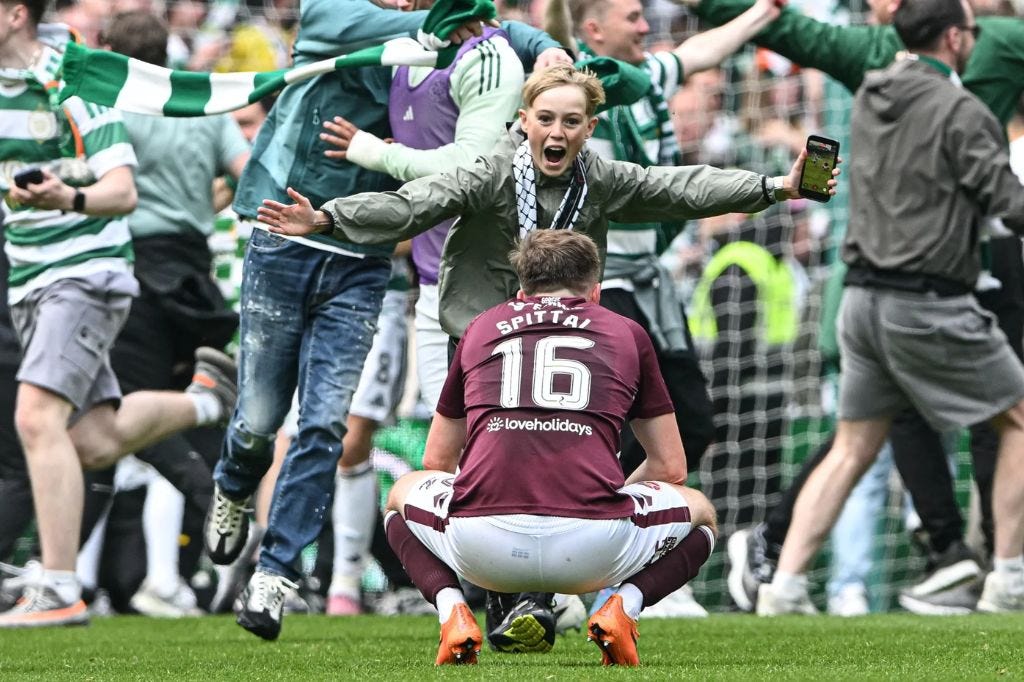
Celtic Park on title day was a scene of pure, unfiltered joy and, yes, a scene that careened into disorder when a minority of supporters flooded the turf to celebrate a moment they had waited for all season and thought was out of their reach only months earlier. No serious supporter worth their salt excuses that.
But the story that has been spun in the 48 hours since the final whistle, that Hearts players were “seriously assaulted” by a rampaging fanbase and that Celtic’s entire fanbase should be denounced, investigated, and punished to the fullest extent - is a different thing entirely. It is a narrative in search of facts, and the facts so far do not support the worst of the claims being thrown around.
Let’s be blunt about the evidence. Forty-eight hours on, with hundreds of hours of phone footage, broadcast coverage and social video floating around the internet, there remains no footage that shows Hearts players being physically assaulted in the way the Hearts-coined phrase “serious physical abuse” implies. There is, however, footage of Celtic fans swarming the pitch, goading opposition players, jostling, and - in the chaos of people surging forward and around - a mobile phone being knocked from the hands of a Celtic fan and stamped on by a Hearts player. There are clips of players reacting, pushing away, clearing space, and in at least one widely-discussed moment, Lawrence Shankland being forcibly removed from the pitch by club officials, team-mates and stewards as he looked like he wanted a fight after initially hitting out at a number of Celtic fans goading him. That is not a neat fit with “assault” on the balance of the public evidence; it looks more like provocation met with poor judgement and heated reactions.
That matters. Words shape law. When Hearts’ own statement referred to “reports” of serious physical and verbal abuse it was within their rights to seek an investigation and to protect their players. But it’s also a fact that once broadcasters and pundits - on live air and social platforms - adopt a line as the default truth, the claim becomes a headline which is then amplified by every grievance ecosystem hungry for confirmation bias. Sky Sports’ Eilidh Barbour’s early post-match commentary carried the “assault” framing to millions, and from there the story metastasised as right-wing clickbait merchants in Northern Ireland and England gleefully fed on the outrage.
It’s worth noting the sequence here, Celtic score late, fans erupt, supporters spill onto the turf, rookie-level crowd control fails to prevent the incursion, players react to being goaded at the edge of the melee - media provides a tidy, outraged narrative - political actors and online trolls weaponise that narrative. The real story should be the first three parts; instead we were rushed to the last two and told to accept the whole package as gospel without evidence.
Make no mistake, fans should never have entered the pitch. It is a breach of safety, of common sense, and doesn’t paint the club in a great light at one of its greatest moments in recent memories. The club has publicly apologised, and that apology is the right thing to do. The SPFL has the authority to investigate and to sanction where it finds failings - fines, ticket reductions, suspended sanctions, partial stand closures - these are in the domestic disciplinary toolkit and have been used before. Celtic should expect to be held accountable for stewarding failures and be required to demonstrate concrete steps to tighten perimeter security, and entry control going forward. That is the narrow, targeted response a legitimate football regulator should be pursuing.
But accountability is not the same thing as moral condemnation for crimes that have not been proven. Hearts’ statement understandably sought to protect their players and push for investigation, but there is a critical difference between “verbal abuse and intimidation” (which the footage supports) and the kind of violent, sustained assault that many pundits and political commentators were quick to allege. If the SPFL, the Scottish FA, or Police Scotland find evidence of assault, those responsible should be prosecuted; if they do not, it is irresponsible to let the “assault” narrative calcify into accepted fact.

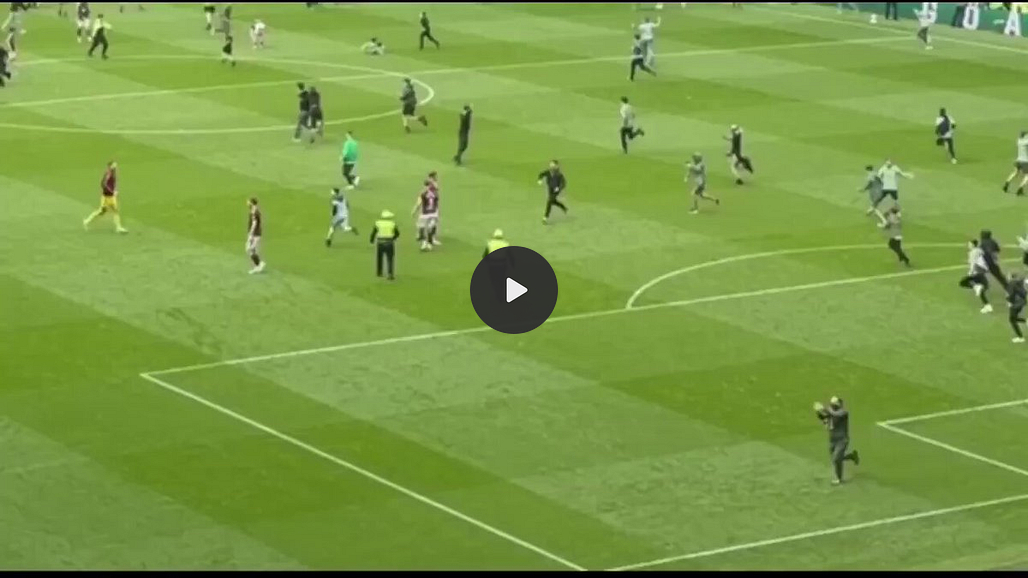
The Shankland episode is worth unpicking because it encapsulates the complex truth. On the footage available, Shankland is rattled and confrontational after Celtic’s second goal as he targeted Saracchi and especially Maeda who he kicked out at, tried to bully, and even grab him by the throat. Arguably, his conduct in that moment not only merited a yellow and another yellow would have seen him sent off; that is an on-field discipline matter, separate from post-match disorder. But it also highlights an enduring truth in modern football - players are human beings, they can be goaded, and we should not pretend they are models of restraint in a situation engineered to provoke them. Shankland looked as if he wanted to be part of the fight; that does not justify the invasion, but it complicates the simplistic “players were helpless victims” story that has been spun. He had to be physically dragged off the pitch by club officials, teammates, and stewards as Celtic fans goaded him and stick their fingers up, and made wanker gestures. The smart play from Shankland was to run off the pitch and not look back, he chose to stay on that pitch looking for a fight.
We then saw the Hearts team leaving Celtic Park due to the ‘menacing and threatening atmosphere’ forcing their quick exit. Yet, video footage showed the Hearts players calmly getting onto their team bus, none with physical signs of assault, some even reacting to Celtic fans laughing at them for blowing the title on the final day. The pitch invasion, in my opinion, played into Derek McInnes’ hands - he knew he blew it. He knew the public scrutiny from the press would be immense and knowing how much of a bitter loser he is when it comes to Celtic, he did a runner as he spat the dummy.
And let us not ignore how the aftermath has been weaponised. For days prior, the usual suspects had been peddling narratives about corruption and cheating in Scottish football. When you have a large audience primed to believe the worst about Celtic, any chaotic scene can be retold as evidence for the pre-existing theory. A line that begins life on a pundit’s microphone suddenly becomes “proof” on message boards, then “evidence” in newspaper columns, and finally a talking point for politicians who have an appetite for headlines more than for the messy patience of an organised public enquiry.
Which brings us to jurisdiction and the reasonable course of action. The SPFL is the appropriate body to assess whether Celtic breached domestic rules on stewarding and supporter control, and the Scottish FA and Police Scotland have roles for disciplinary and criminal matters respectively. Yet we have a hurting Hearts supporting unelected Labour politician running to FIFA, because he didn’t get the answers that he liked from the SPFL. FIFA’s remit covers international governance, not routine club-level crowd issues, and nor for that matter can UEFA - which George Foulkes bypassed completely in his raging stupor. The sensible path is that the SPFL investigates for rule breaches and sanctions as appropriate within their own remit; Police review footage and evidence for criminality; the club impose bans on identified offenders; and the game takes a cold, practical look at stewarding and stadium safety protocols. That is how you get real outcomes - punish proven wrongdoing, plug the holes that allowed it, and stop turning ambiguity into a moral panic.
Now a candid opinion about the bodies who get the most attention after these incidents - broadcasters, pundits and politicians. Too often they act like prosecutors and judges without the evidentiary burden those roles actually require. In this instance, the “serious assault” framing served as a shortcut to outrage - it is media catnip, and it gets clicks and soundbites. But it does a disservice to justice and to the truth. The responsible route is to distinguish between the emotional truth (Celtic fans were ecstatic and a minority took it too far), the factual truth (there is evidence of goading and naughty hand signs aimed at players) and the legal truth (is there proof of assault that would sustain criminal charges?). Those are three separate things and we should treat them as such.
An uncomfortable home-truth for Celtic fans - the invasion was avoidable and indefensible. We should own that and stop denying any wrongdoing in that respect. A pitch invasion, by definition, is a failure of stewardship, policing, crowd management and fan self-control. Celtic have apologised and they must now show they have learned; that will be the cleanest route to avoiding heavier sanctions down the line. But being accountable does not mean accepting a false, inflated narrative that paints tens of thousands of celebrating fans as violent thugs. That is lazy, it is vindictive, but it gets clicks.
Which leads to a systemic reform suggestion I want to see in Scottish football - ditch the cheap steward model and professionalise in-stadia crowd management. Relying on part-time, low-paid stewards - often students or casual workers with no training - to stop a pitch invasion is asking the unaskable. These aren’t policemen; they don’t have police powers, nor the training for volatile interventions. Asking a private contractor’s handful of stewards to physically repel surging crowds is not a public-safety strategy, it’s a gesture, it’s paying lip service to it. If we want to prevent future pitch invasions, the solution is not more rhetoric from politicians, media hacks, or football officials; it is proper investment in trained, professional security personnel, better entry controls, CCTV coverage throughout that actually protects players and identifiable sanctions that hit offenders where it hurts - season tickets, travel access, and lifetime bans for repeat violent offenders. If Scottish football is serious about safety, it will stop outsourcing the job to whoever is cheapest on a zero-hours contract.
And don’t forget, this incident isn’t a one-off, we have seen Rangers fans rampaging across the Ibrox pitch trying to attack Celtic players, officials, and fans after they were knocked out of the Scottish Cup on penalties and Celtic fans took to the field to celebrate. We are still to hear anything from investigations into the disorder from the Scottish FA and Police Scotland - as they both look to circle the wagons and pass the buck onto others. Yet this wasn’t an isolated incident either, we can go all the way back to Celtic manager Neil Lennon being attacked at the side of the pitch at Tynecastle by a Hearts fan who took exception to the Northern Irishman celebrating his side scoring a goal. We also had Celtic players attacked on the pitch, a Celtic physio bottled and needing medical attention, and then we saw Joe Hart calling match officials over in a derby match after he spotted broken bits of bottle around his six yard box risking his safety, and all players safety whether they are Rangers or Celtic fans. We have heard that Police Scotland had arrested a number of Union Bears members prior to a Glasgow derby match as they had been caught with weapons inside Ibrox as they were setting up displays. Yet we didn’t see the media scrutiny or outrage over these incidents, as we have seen the past 48 hours, over a pitch invasion with no evidence backing the assault allegation narrative.
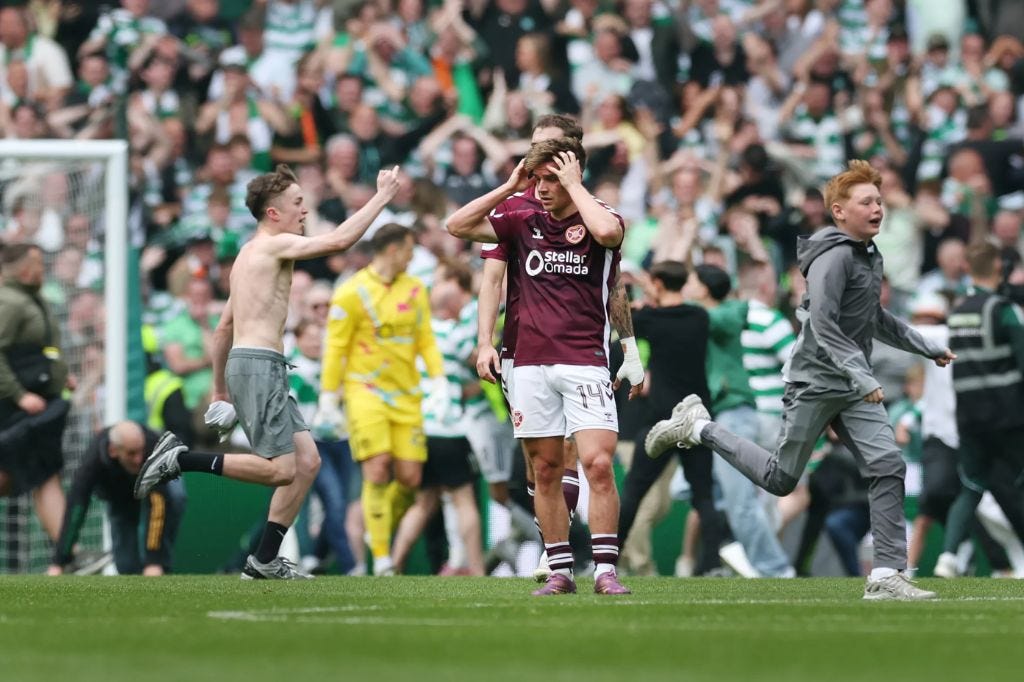
There is also a cultural problem. We see it across the sport - pyrotechnics and pitch invasions are romanticised as passion rather than treated as criminal conduct - and I have to admit that I do love a good natured pitch invasion. Clubs, authorities and fans need to align on the principle that passion ends where another person’s safety begins. That principle should be non-negotiable.
Finally, I will say this as plainly as I can, Celtic do not need patronising treatment and faux outrage from people whose real agenda is to see them fail, to be stripped of the league title that they fought hard to win, just because their club(s) failed to win. There’s a political dimension to the outrage that can’t be ignored. When the first version of events suits a pre-existing bias - “Celtic are cheats,” “the league is corrupt,” “the refs are biased” - those voices will push the most extreme version of events because it fits their broader narrative. That’s not journalism; it’s campaigning. And when professional commentators and columnists like Gary Linekar, Simon Jordan, and Jeff Stelling indulge that, they weaken the case for real accountability.
The proper course now is simple and proportionate, let the SPFL carry out a clear, evidence-led investigation and apply what sanctions they can do where rule-breaking is proven; let Police Scotland follow the criminal angle where there is credible video evidence or eyewitness testimony of assault; and let Celtic do the hard, often invisible work of internal discipline, ban enforcement and security reform. In parallel, the media should dial back inflammatory language until legal or disciplinary bodies have reached conclusions. Fans, for their part, should know their club loves them and expects better behaviour.
I also have to further add that the SPFL is controlled by the clubs, the clubs agree on the rules, they then expect the likes of SPFL chief executive Neil Doncaster to administer and manage the league governing body. If the clubs are so protective of their players from fan misconduct - why did all but three vote against Strict Liability in 2019? Hearts voted against it, Celtic voted against it, Rangers voted against it - only Partick Thistle, Queen of the South, and Annan Athletic voted in favour of introducing it in relation to fan misconduct. The same rules that UEFA enforce in European competitions, has seen significant fines dished out to Celtic and Rangers, while Rangers have seen fans banned for sectarian and racist singing, and suspended stadium bans. Yet domestically, no club wants to even consider the idea. So maybe look at another vote on strict liability, and this time vote in favour of it, rather than run to trusted mouthpieces in the press to get your faux outrage and narrative out there while refusing to give the league actual powers to deal with it in the first place.
Celtic won the league. To every Celtic fan who stormed that pitch in an ecstatic, foolish rush - your moment mattered, but your actions had and will have consequences. To the wider public, the pundits and the politicians who want to turn this incident into a moral crusade - wait for the evidence before you open your mouth and act against every incident not just the ones that get the most headlines for you in your latest bandwagon jumping escapade.
The best piece of writing on the events (so far)
Hibs faced even worse from the Glaswegian press after the 2016 win. When the dust was settled it was found that The Rangers fans had actually committed the most serious crimes.