

The loudest voices are often the least interested in the truth. In the days leading up to Celtic’s title-clinching 3-1 win over Hearts, Scottish football descended into a familiar frenzy. Referees were accused of bias. VAR was framed as a weapon. Pundits who should know better flirted with language like “corruption” and “cheating” as if these were reasonable interpretations of contentious decisions rather than serious allegations requiring serious proof.
Now, with Referees chief Willie Collum stepping forward on Friday night to publicly review those same flashpoints, the gap between fact and fiction has been laid bare. And it is not a flattering look for those who rushed to outrage.
Collum’s intervention on Sky Sports’ Scottish Football Review was not emotional. It was not tribal. It was methodical, technical, and grounded in process. In other words, it was everything the public discourse around these incidents has not been.
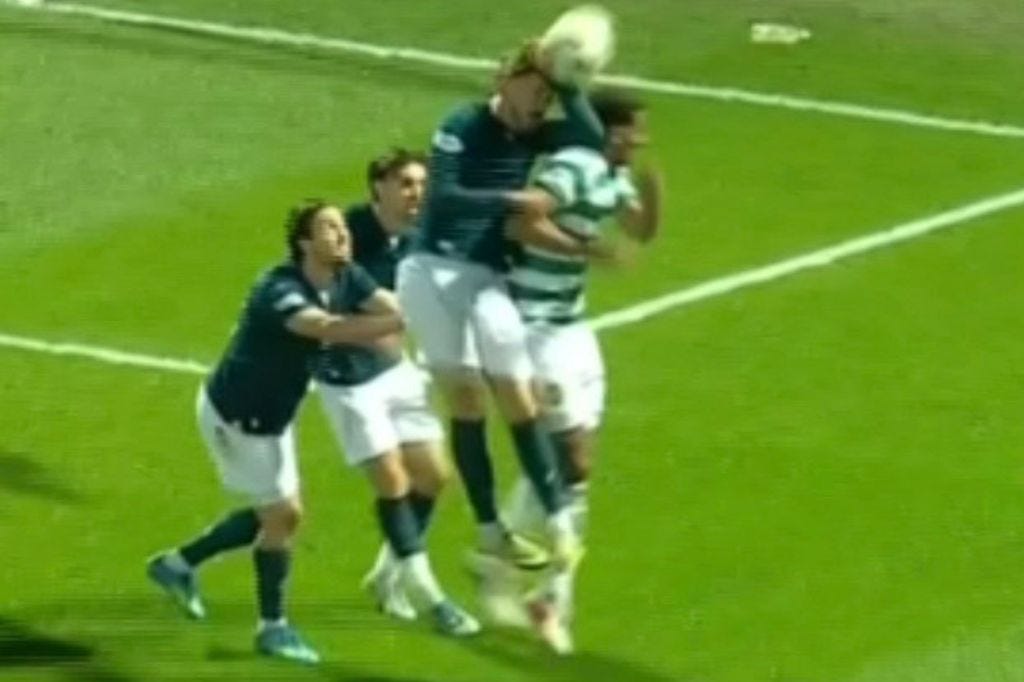
Take the much-debated penalty awarded to Celtic at Fir Park on May 13. Branded “disgusting” by Hearts manager Derek McInnes and loudly dismissed by sections of the media and rival fanbases, it quickly became Exhibit A in the case for supposed systemic corruption.
Collum dismantled that narrative with calm precision. There was, he explained, clear evidence. Not vague interpretation. Not guesswork. Clear evidence, supported by imagery, both photographic and video, showing the relationship between head, hand, and ball. The VAR team conducted a thorough check. The referee reviewed it at the monitor. All involved reached the same conclusion - it was handball, and it was punishable. That is not controversy. That is process working as intended.
But as well know the outrage that followed, was never really about the decision itself. It was about who benefited from it. Because when Collum pulled back the curtain further, the narrative began to collapse entirely.
In the same breath as defending that Celtic penalty, he admitted Hearts should have been awarded one of their own days earlier against Motherwell. VAR advised a review. The referee declined to overturn his on-field call. Collum’s view was clear - the expected outcome should have been a penalty.
So much for the idea of a system rigged in Celtic’s favour.
He went further. Celtic, he said, should have had a penalty against Hibs when Josh Campbell clearly shoved Benjamin Nygren. That one was missed both on the field and by VAR. Another decision that went against the eventual champions.
Again, where is the conspiracy?
Even in reviewing the much-discussed Alistair Johnston challenge, Collum backed the officials in not issuing a red card, explaining it did not meet the threshold for excessive force or endangering an opponent. A subjective call, yes, but one grounded in established criteria, not bias.
What emerges from Collum’s review is not a pattern of favouritism, but a pattern of human decision-making. Some calls right. Some wrong. Some benefiting Celtic. Others going against them. The exact same reality that exists in every league, in every season, in every sport. Yet that nuance was nowhere to be found in the days of hysteria that preceded it.
Instead, we were treated to a torrent of accusations, many of them reckless, some of them outright defamatory, suggesting that Scottish football’s integrity had been compromised to deliver Celtic a title. This is not analysis. It is grievance dressed up as insight. And it is made all the more absurd when viewed through the wider lens of the season.
Football titles are not decided by one decision, or two, or even five. They are shaped across 38 games, hundreds of incidents, and countless moments of fortune and misfortune. Hearts can point to one penalty they did not receive. Celtic can point to one they were denied. That is the game. But to isolate a handful of incidents in May and ignore everything that came before is not just intellectually dishonest, it is wilfully misleading.
Even if every single disputed call in those final weeks had gone the other way, the broader reality would remain unchanged - Celtic earned their title over the course of the season.

And that is what makes the cries of “corruption” so hollow.
Because if we are going to talk about cheating in Scottish football, then we should at least have the courage to talk about the one case where it has been definitively proven.
Rangers Football Club.
Not alleged. Not debated. Proven.
Through the use of Employee Benefit Trusts, Rangers systematically paid players in a way that ultimately breached tax rules and circumvented financial regulations. This was not a minor infraction. It was a sustained strategy over an 11 year period designed to secure players the club could not otherwise afford.
Former Rangers manager Alex McLeish admitted in a BBC interview, stating that their successes would not have been possible without those payments. Former Rangers owner David Murray was equally candid, acknowledging the system allowed them to sign players beyond their financial reach.
That is sporting advantage. By definition. And yet, the Nimmo Smith commission concluded there was none. A ruling that defies logic, evidence, and basic understanding of competitive sport to this day.
Even Hugh Keevins, hardly a fringe voice, acknowledged in a conversation with yours truly for my Scotzine podcast over a decade ago, that Rangers cheated. The highest courts later confirmed the tax breaches. The club was fined for failing to disclose payments. The evidence is overwhelming.
And still, their titles remain. Five league championships and a haul of domestic trophies won during that period sit untouched, despite being built on a foundation that would not have existed within the rules.
If ever there was a case of sporting integrity being compromised, this was it. The game was, for a decade, fundamentally distorted. And yet here we are, listening to supporters of that very institution lecture others about fairness, integrity, and corruption. Demanding Celtic’s title be stripped because of one refereeing decision and one pitch invasion.
It would be laughable if it were not so brazen.
Because while Rangers fans shout about conspiracies, the historical record tells a very different story - one of actual rule-breaking, actual financial doping, and actual competitive imbalance.
The irony is suffocating.
And then there is the selective memory. The same refereeing system now accused of favouring Celtic is the one that, for years, saw the phrase “Penalty to Rangers” become a standing joke in Scottish football. Decisions flowed. Patterns formed. Narratives emerged - not of conspiracy, but of consistency in who seemed to benefit.
Even Andrew Dallas, dragged into the current storm for his role in Celtic’s penalty against Motherwell, once awarded Rangers four penalties in a single match against St Mirren.
Four.
But that, apparently, does not fit the narrative of him being in Celtic’s pocket. Because narratives, once formed, are rarely concerned with facts. They are sustained by emotion, by rivalry, and by a refusal to engage with inconvenient truths.
Hearts, for their part, have every right to feel aggrieved about individual decisions. That is football. That is competition. But grievance is not evidence, and frustration is not proof of bias.
Rangers fans, however, would do well to sit this one out entirely. After finishing third, despite spending £40 million in an attempt to buy both the title and Champions League qualification, their instinct has always been to look outward rather than inward - just as they did when Rangers died in 2012. To blame referees rather than results. To question integrity rather than performance.
It is easier, certainly. But it is not credible. Because when you strip away the noise, the reality is simple. Referees made calls. Some were right. Some were wrong. Over the course of a season, those decisions balanced out in the way they always do - as fans have been told for decades.
Celtic won the title because they were the best team at the end of the day. Not because of a penalty at Fir Park. Not because of a missed call at Easter Road. Not because of some imagined grand corrupt conspiracy. But because across 38 games, they delivered when it mattered most.
We all know that Willie Collum’s review should be the end of the debate. It won’t be. Because for the usual suspects - including in the media - the truth is less appealing than the story they have already chosen to believe. But the facts remain, stubborn and unyielding. There is no evidence of corruption. No proof of systemic bias. No credible case that Celtic’s title was anything other than deserved. And until those shouting loudest can produce something more substantial than outrage and insinuation, their claims belong where they started.
In the realm of fiction.
I've always been of the view that Rangers and Hearts would have been quite happy to cut the league up between themselves, with arguably Rangers 1st and Hearts 2nd, and the roles reversed depending on actual results obtained. That would have benefited both Rohl and McInnes in that both fraternal Glasgow and Edinburgh clubs, would have had a financial pathway to the Champions League prestige and lucrative monies at hand. That the audacious, caretaker manager Martin O'Neil actually frustrated that theory against all the odds in the last seven league cliffhanger games, is what has reignited their fury and umbrage, at what they perceive to be refereeing bias towards Celtic, in short, a made up feeble excuse, which does not stand up to close scrutiny, to hide their patently obvious managerial and footballing failures on the field of play.
What we used to call Hard Cheese guys.
An excellent summary of the actual events. Of course we Celtic fans are as guilty as the others. However we have real evidence of bias and cheating as Ferguson McCann proved with Jim Farry and as you pointed out the Rangers use of Employee Benefit Trusts. Keep up the good work.