

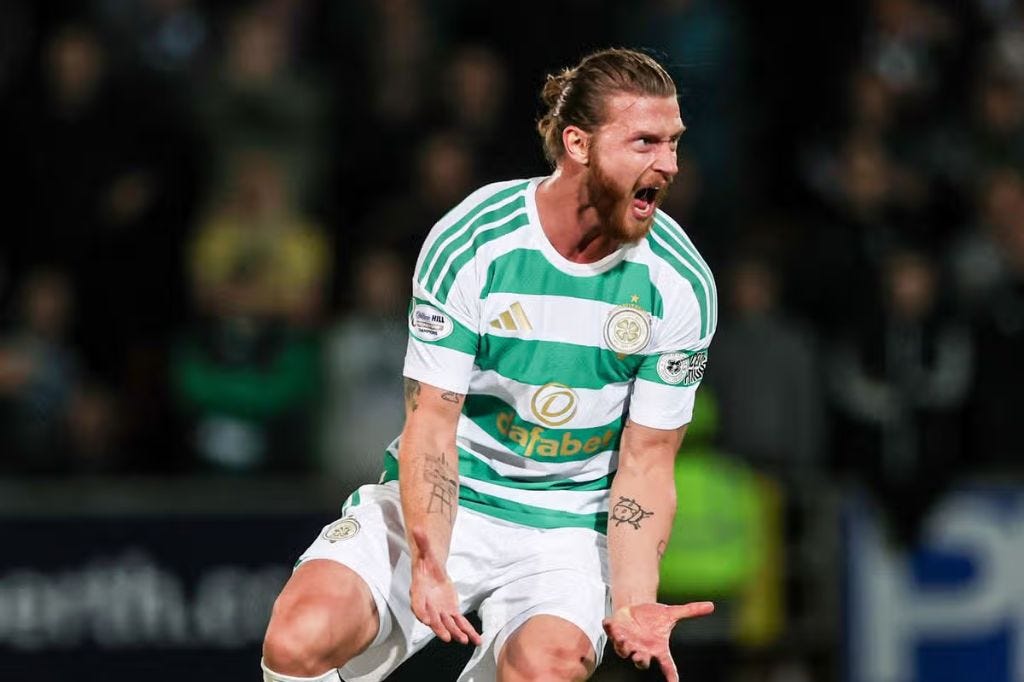
There is a particular cruelty in asking a player to be someone he is not, especially when the cost of that fantasy is measured in millions and the stakes are the hopes of a club.
At Celtic, Martin O’Neill has constructed a narrative around Kasper Høgh that ignores the very qualities that made the Dane valuable in Norway, while simultaneously distorting the roles of those around him. The result is a striker miscast as a modern day Chris Sutton, a striker stripped of his natural habitat forced out onto the wing, and an attack that feels less like a plan than a hope.
Høgh arrived from Bodø/Glimt as a penalty‑box predator, the product of Kjetil Knutsen’s meticulously drilled 4‑3‑3. In that system, the striker’s movement was rewarded by rehearsed patterns, late runs from advanced midfielders and quick combinations in the half‑spaces. He did not need to win every aerial duel or hold up play for minutes on end; he needed to time his runs, attack spaces and finish. That is the profile that delivered 54 goals and 22 assists in 103 appearances, and a return that translated to epic European nights against the cream of European opposition.
At Celtic, his script has been ripped up and rewritten as he has scored just three goals in seven appearances for Celtic - all three coming in the league tie against Kilmarnock at the start of August. O’Neill has deployed Høgh as a traditional target man, asking him to occupy centre‑backs, challenge for high balls and act as the focal point for wide deliveries. The hope, barely concealed in public remarks and private conversations, is that the Dane will evolve into the kind of complete forward Chris Sutton once was for Celtic - strong in the air, capable of linking play, and lethal inside the box. It is a romantic notion, but it ignores the reality that Høgh’s game is built on movement and timing, not prolonged physical battles or intricate hold‑up play. He is not Sutton, and asking him to become so is less a tactical adjustment than an act of wishful thinking.
The collateral damage of this misallocation is in the treatment of Camilo Durán. Signed as a striker with a reputation for ruthless finishing and proving just that in pre-season, the Colombian has been shunted out to the right wing to accommodate Høgh in the centre. It is a forced move that nullifies Durán’s greatest asset - his ability to attack spaces and finish chances in the box. On the right flank, he is asked to beat full‑backs, deliver crosses and track back, tasks that dilute his threat and distance him from the positions where he is most dangerous. The very presence of Høgh, intended to solve Celtic’s goal‑scoring issues, has inadvertently suppressed another potent source of goals.
O’Neill’s adherence to his version of the 4‑3‑3 structure compounds the problem. Although, it is equally considered that assistant Shaun Maloney is having a huge influence on Celtic’s tactics and style of play - with O’Neill the face of the management team to appease the fans. O’Neill’s formation demands width from the wide forwards, which pulls Durán away from central areas and leaves Høgh isolated as the lone striker. Without the automated combinations and central overloads that defined his time at Bodø/Glimt, the Dane is left to survive on whatever the wingers can provide. When those deliveries are inconsistent, as we saw against LASK and Rangers, the striker appears ineffective, even when his movement remains sharp. The system, not the player, is the problem.
There is also the matter of service. At Bodø/Glimt, Høgh benefited from quick, precise passes that exploited the spaces he created. At Celtic, the emphasis on crossing and sustained pressure means the final ball is often delayed, allowing defenders to recover and close down the gaps he has worked to open. Former striker Kris Boyd noted during match analysis that Høgh “never stops moving”, but Celtic’s wide players frequently take extra touches or slow down the play before delivering, by which time the opportunity has vanished. The striker is left feeding off scraps, his movement rendered futile by the timing of those around him.
The irony is that O’Neill has the components of a more fluid, dangerous attack, but his insistence on fitting them into a rigid framework has blunted their impact. Durán, deployed as a winger, is less a threat than a supplier. Høgh, cast as a target man, is less a finisher than a battering ram. The midfield, tasked with stability, offers limited support in advanced areas. What should be a multi‑faceted attack has become a series of compromises, each one eroding the strengths of the individuals involved.
To unlock Høgh, Celtic would need to abandon the fantasy of the modern-day Sutton and embrace the reality of the player they have. That means earlier service, more varied deliveries and better support from advanced midfielders. It might also mean a shift in formation, perhaps to a 3‑5‑2 or 4‑4‑2, where Durán can return to a central role and Høgh can operate with a partner, sharing the burden of goal‑scoring, and feeding off one another. Until then, the £11m striker will continue to look out of his depth, and Durán will remain a winger in name only, his finishing threat neutralised by a tactical decision that prioritises structure over substance.
The tragedy is not that Høgh has failed, but that he has been asked to fail. At Bodø/Glimt, he was the perfect piece in a perfectly fitted puzzle. At Celtic, he is being asked to be something he is not, while those around him are asked to do the same. The result is an attack that feels less like the sum of its parts than a collection of compromises, each one a reminder that the best intentions can sometimes produce the worst outcomes.
Spot on. O’Neill’s team is a mess. I don’t know which is worse, the tactics or the recruitment.
Nail on head Andy.
Someone should copy and paste this to Dermot Desmond and the Celtic Board of Directors.
We have assembled an expensive trio of strikers/wingers in Hogh, Hassan and Duran, and crazily O'Neil and Maloney are hammering them like square pegs into round holes.