

Stephen McGowan’s remarks to Graham Spiers this week carried more weight than the usual post-transfer window grumbling. The collapse of Celtic’s pursuit of Torino’s Gvidas Gineitis, he suggested, was not simply a case of a club failing to land its first-choice target. There had been another defensive midfielder. Celtic had identified him, watched him and, apparently, decided against making the move.
“It goes back to this point about the lack of a number six,” McGowan said. “They knew they needed one. I know for a fact they had one in their sights before the window closed. They decided not to sign him for whatever reason, and now he’s gone to the Middle East. So only they can answer why that was the case.”
McGowan did not name the player. It is important not to turn inference into fact. But the clues narrow the field - a proper holding midfielder, available during the closing days of the British window, within Celtic’s budget, and subsequently sold to a club in the Middle East.
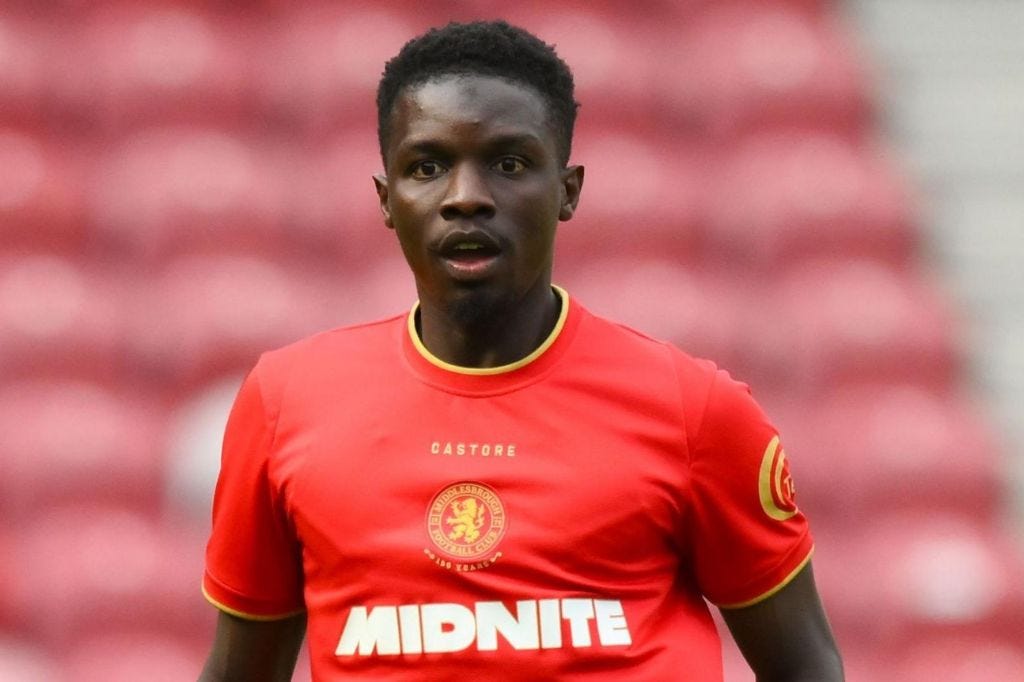
The obvious candidate is Middlesborough’s Abdoulaye Kanté.
Whether Kanté was definitively the player McGowan had in mind matters less, in one sense, than what his transfer represents. He is the kind of player Celtic say they seek - young, attainable, reasonably priced, physically suited to the role and carrying enough uncertainty to make him a realistic buy rather than an impossible one. And he went to Al-Ettifaq for about £3m.
For years, the club have cycled through variations of the same midfield problem. They have players who can pass, press, carry and create. They have had players who can play as an eight, players who can drift from wide areas, players who can control possession in comfortable domestic games. What they have lacked is a convincing screen in front of the defence. Someone who enjoys the ugly work, who can disrupt transitions and who does not require Callum McGregor to spend every major match trying to be a conductor telling players where to pass the ball to or drop back to pick the ball up.
Kanté came through at Troyes, where he established himself quickly enough to attract attention beyond France. Middlesbrough signed him in July 2025 on a five-and-a-half-year contract. He then spent the second half of last season on loan at Saint-Étienne, which is hardly a soft landing for a young defensive midfielder learning the demands of a demanding club with an equally demanding support. He had enough pedigree to be part of Ivory Coast’s under-23 picture and had received a senior international call-up in March this year.
Yet his time at Middlesbrough stalled almost immediately. He started the opening Championship game of the season against Lincoln City, played 63 minutes, and then barely featured. Across six appearances, he accumulated 143 minutes. By late August, he was not even routinely included in the squad for home matches.
Football has a way of making every departure sound inevitable after it happens. A player is omitted, therefore he must not be good enough. But recruitment is supposed to be about looking beyond the immediate judgement of one manager, one squad and one tactical situation. A 21-year-old who has slipped out of favour at a Championship club is not automatically damaged goods. Sometimes he is simply available.
Al-Ettifaq saw that availability and acted. Kanté left Middlesbrough on 30 August for an initial £3m, with the overall package potentially rising to about £3.75m. He signed a four-year deal to 2030, while Middlesbrough retained a sell-on clause.
That is not the price of an established Champions League midfielder. It is the price of a calculated gamble. But Celtic’s transfer model is built, in theory at least, on calculated gambles.
Their recruitment language has long revolved around development, resale and identification. They do not buy finished players in their peak years. Their financial model, league environment and place in the European hierarchy mean that the club’s most successful signings have often arrived with rough edges still visible. The value comes from identifying the right rough edges.
This summer’s targets make the point. Gineitis, 22, was seen as a midfield player with upside. Joel van den Berg fits the familiar youth-and-potential model whose appeal lay not only in immediate ability but in the possibility of growth and resale.
Kanté belongs in that same bracket. In some ways, he may fit it more neatly than Gineitis did. His valuation had fallen not because he had become too old or too expensive, but because he had stopped playing. The best recruitment departments look for that moment. They recognise the difference between a player whose career has genuinely plateaued and a player who is temporarily miscast, blocked by squad politics or simply caught in a coaching change.
Celtic have made reputations by finding players before the bigger leagues decide exactly what they are worth. The old model was not flawless, but it was coherent - buy a young player from France, Belgium, Scandinavia or a comparable market; give him a clear role; improve him in a demanding environment; sell when the numbers become impossible to refuse.
A 21-year-old defensive midfielder with first-team experience in France and England, international recognition at youth level and a price below £4m is precisely the sort of profile that ought to prompt serious due diligence.
The question is not whether Kanté would have been a guaranteed success. He would not have been. He has barely played competitive football over the past year. His lack of minutes at Middlesbrough would have been a legitimate concern, especially for Celtic who are needing more certainty rather than another developmental project.
But Celtic did not need Kanté to be a finished article. They needed someone capable of doing a specific job. They needed a midfielder able to compete, cover ground, win contact, intercept and give McGregor the freedom to play his own game rather than the game of two men.
That is the distinction the club appear to have lost sight of. A defensive midfielder does not need to be a marquee signing to be necessary.
The cost of waiting
The financial comparison is uncomfortable. Celtic spent £4.5m plus add-ons on Baur and about £3.4m on a 19-year-old arriving from PSV. Kanté cost Al-Ettifaq less than either initial outlay. Gineitis, by contrast, was reportedly valued at roughly £9m by Torino, a figure Celtic were unwilling or unable to meet in the end.
There is no criticism in refusing to overpay. In fact, Celtic’s inability to turn domestic dominance into more sophisticated European recruitment has often been worsened by reactive spending and the habit of treating a deadline as a strategy.
But the alternative to a £9m player cannot be nothing. Torino’s position on Gineitis was always vulnerable to change. They had their own squad planning to consider and, once their outgoing business altered the picture, Celtic’s preferred deal became more difficult to complete. Personal terms, according to Gineitis’s agent, were not even agreed before the move collapsed. That is not a failure of ambition. It is a failure of contingency planning.
Middlesbrough, by contrast, were not trying to keep Kanté. He had slipped out of their plans. They were prepared to sell, the fee was comprehensible and the player was already operating within the British football system. A move from Middlesbrough to Celtic would not have carried the same administrative complications as a late attempt to bring in a lightly capped player directly from overseas.
The idea that Celtic would have faced an insurmountable paperwork problem does not withstand much scrutiny. The club had already experienced the consequences of leaving the Gineitis deal until the final hours, with registration issues compounding a transfer that had already become uncertain.
Kanté was not an impossible deal. He was the kind of deal that a club should have ready to progress once the first option began to wobble. Instead, he moved to Saudi Arabia.
The point is not that Al-Ettifaq are a superior club to Celtic, or that the Saudi Pro League now offers a more compelling sporting project. Players have their own reasons for choosing where to work, and a four-year contract in the Gulf comes with financial terms Celtic cannot match.
But Al-Ettifaq did not need to possess Celtic’s history, support or European football to complete the transfer. They had to identify the opportunity, decide that the risk was acceptable and make the player an offer before the market closed. They did.
Sunday was not an accident
The consequences were visible at Ibrox. Rangers’ 3-0 Premier Sports Cup quarter-final victory over Celtic was not caused by the absence of one midfielder. Football is never that tidy. A signing cannot retrospectively be awarded the power to transform an entire performance, particularly in a Glasgow derby where intensity, preparation and collective nerve shape everything.
But the defeat exposed the problem Kanté’s profile would have addressed.
Celtic arrived with a perfect domestic record but were overwhelmed, losing control in the areas where control matters most - second balls, defensive transitions and the moments immediately after possession changes hands.
McGregor’s assessment afterwards was unusually stark. The Celtic captain described his side as “a team of individuals” and said the warning signs had been evident for weeks. That was not merely a captain performing disappointment for the cameras. It was an admission that the team’s structural problems had not appeared from nowhere on Sunday afternoon. They had been visible in the preceding games, in the lack of balance, in the strain placed on senior players and in the continuing assumption that technical quality alone can cover for missing physicality.
McGregor is part of the problem. He is being asked to dictate matches, protect the defence, offer leadership and compensate for the lack of a specialist beside or behind him. That is too much for any player, never mind one who has spent years carrying the central responsibility of the side.
The club signed 10 players in the summer, with six arriving in a late rush before the UEFA registration deadline. Oliver Sørensen came in from Parma, while Reo Hatate departed for Burnley. Yet the central weakness remained where it had been at the beginning of June.
A summer cannot be judged only by the number of bodies brought through the door. A recruitment window is supposed to improve the team in the places where it most obviously needs improvement. Celtic added players, but they did not adequately address the role around which so much of the past few seasons’ concerns had gathered.
The question Celtic must answer
Martin O’Neill is reported to have been dissatisfied with the handling of the Gineitis pursuit. He is entitled to be frustrated, if that account is accurate. A manager can accept that a primary target becomes unattainable. That happens at every club. What is harder to accept is being told, in effect, that a weakness identified at the start of summer will now be revisited in January. January is not a plan. It is the next opportunity to repair the consequences of a failed plan.
Perhaps Kanté was not McGowan’s unnamed midfielder. It could have been Lyon’s Mathys de Carvalho also. Perhaps Celtic’s scouts found a concern that does not appear in public reporting - an injury issue, a personality question, a tactical limitation, a wage demand or an assessment that he was not ready to contribute immediately. Those would be valid reasons to walk away.
The problem is that Celtic have left themselves in a position where supporters can reasonably make the case for a £3m Championship outcast heading to Saudi Arabia. The club’s failure was not necessarily in declining to sign Kanté. It was in failing to provide an alternative that made the decision look sound.
If Kanté was not good enough, then who was? If he was too raw, why was there no readier option? If the Gineitis fee was too high, why had Celtic not built a realistic second and third choice into their planning? If the club understood in June that it needed a defensive midfielder, why did the summer end with McGregor still carrying the same burden and the team still looking vulnerable in the same areas?
That is the real issue. Not the identity of one player, but the absence of a coherent answer.
Celtic may yet return for Gineitis in January. Reports suggest another attempt could be made. But no one at Celtic Park should present that as evidence of patience or discipline. Waiting 15 weeks to address a problem you correctly diagnosed at the beginning of summer is not prudence. It is delay dressed up as strategy.
Good points again thanks but… glad you mentioned one player in an ( outdated)
position is the fix.
Our press is the dm, our beating the press is our dm, working as a team, passing and moving, ( Maslov, Stein, Shankly, Michels )… cannot have the luxury of a limited ‘dm’ in the modern game.
In your next watch, look how few, if any, 50/50’s or opportunities to ‘patrol that area’ occur.
Few.
I'll tell you this Andy. This Gineitis must be one hell of a footballer for us to be chasing him all this time.