

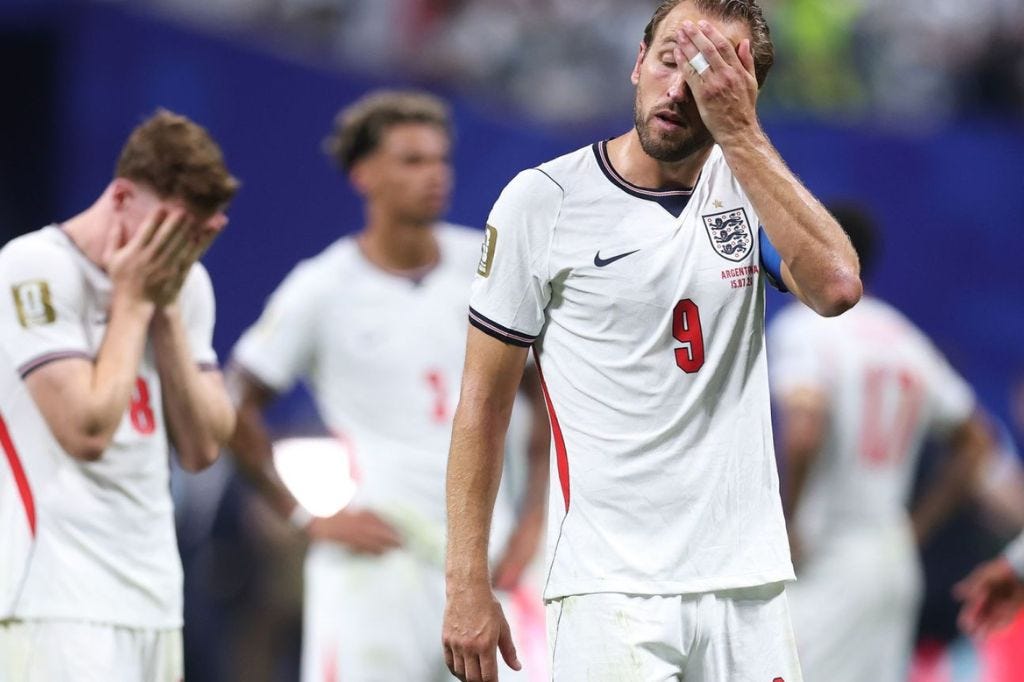
For a country that hasn’t lifted a World Cup since 1966, England carry themselves off at every major tournament like defending champions. The shirts may change, the managers may rotate, and the golden generations may come and go, but the narrative remains stubbornly the same - this is the year, football is coming home.
Except, of course, it never does.
As a Scotland fan, there is something quite amusing about England’s perpetual cycle of expectation and collapse. It is not merely the defeats themselves, but the scale of belief that precedes them, and the scale of fallout that follows. England do not just enter tournaments; they arrive with a coronation already planned. And when reality intervenes, as it invariably does, the reaction is seismic.
The 2026 World Cup campaign followed a script so familiar it could have been written decades ago. Comfortable early victories against poor opposition fuelled the usual wave of optimism despite the manner of results. The pundits swelled. The tabloids roared. The phrase “this could be the one” was rolled out with increasing conviction. Yet when England finally encountered elite opposition - Argentina in the semi-final, the only top-10 ranked side they faced - the illusion dissolved once again. Beaten, exposed, and ultimately outclassed, they exited the tournament with the same lingering question - how does this keep happening?
Part of the answer lies in the ecosystem that surrounds the England team. Nowhere else in world football does hype operate with such relentless intensity. From the terraces to television studios to back-page headlines, there is a collective insistence that England are not just contenders, but rightful winners. The “football’s coming home” mantra, born in irony and nostalgia, has mutated into something closer to entitlement. It resurfaces every tournament, draped around the neck of the national side like a millstone.
This belief is not entirely without foundation. England possess resources that most nations can only dream of - the richest domestic league in the world, elite training facilities, and a player pool drawn from one of the most competitive environments in club football. But therein lies the contradiction. For all the Premier League’s global dominance, English players themselves make up only around 28 to 32 percent of registered squads in the English Premier League. The league’s excellence is, in large part, imported.
Look at the managerial landscape and the pattern becomes even clearer. Since the Premier League’s inception, the title has been monopolised by foreign coaches - Italian, Spanish, German, French, Chilean - and, even, Scottish. Kenny Dalglish and Sir Alex Ferguson set the standard; others followed. The last Englishman to win the top flight was Howard Wilkinson in 1992, before the First Division was rebranded. That is not a coincidence. It is a reflection of a system that markets itself as the pinnacle of English football while relying heavily on foreign expertise to sustain that status.
Yet when it comes to the national team, this context is conveniently ignored. The assumption persists that English players, by virtue of competing in the Premier League, should naturally dominate international football. It is a seductive but flawed logic. Club football is a curated environment, populated by the world’s best talent. International football strips that away. It demands cohesion, tactical discipline, and resilience under pressure, qualities that England have too often lacked when it matters most.
There is also the issue of performance against top-tier opposition. England’s record in major tournaments against elite sides is, at best, inconsistent. Time and again, they navigate the early rounds convincingly against weaker opposition, only to falter when confronted with teams of comparable or superior quality. The pattern repeated in 2026. It repeated in 2022. It repeated before that, and it will likely repeat again.
This is where their Napoleon complex becomes most apparent. There is a deep-seated belief within English football culture that success is not just possible, but inevitable - that England should be world champions because of their history, their league, their influence on the game. But football does not operate on sentiment or legacy. It operates on execution. And in the decisive moments, England have repeatedly come up short.
The aftermath of these failures is almost as predictable as the failures themselves. The search for scapegoats begins immediately. Managers are dissected, players are scrutinised, and individuals are singled out for blame. Gareth Southgate experienced it. Thomas Tuchel is experiencing it. Players like Bukayo Saka have borne the brunt of public frustration, often in ways that cross the line from criticism into something far more sinister.
This culture of blame is corrosive. It creates an environment where fear can outweigh freedom, where the weight of expectation becomes a burden rather than a motivator. Contrast that with nations who consistently succeed on the international stage. They manage expectation differently. They build structures that prioritise collective strength over individual hype. They understand that winning tournaments is as much about mentality as it is about talent.
England, by contrast, often appear caught between two identities. On one hand, they are a modern footballing nation with access to world-class resources. On the other, they are tethered to a narrative that inflates their standing beyond what results justify. It is a disconnect that manifests every time they face genuine contenders.
For those of us in Scotland, there is an undeniable schadenfreude in watching this cycle unfold. The rivalry runs deep, and England’s struggles are rarely met with sympathy. But beneath the humour and the digs, there is also a broader observation about how football cultures shape outcomes. Scotland, for all its limitations, does not enter tournaments expecting to win them. The expectations are different, the narratives more grounded. That does not guarantee success, but it does create a more realistic framework for evaluating performances.
England’s challenge is not a lack of talent. It is a lack of alignment between perception and reality. Until that gap is addressed, the pattern will persist. The hype will build, the hopes will soar, and the inevitable fall will follow.
As the dust settles on another World Cup campaign that promised much and delivered very little, the familiar questions resurface. Will this be the moment England finally recalibrate? Will the conversation shift from entitlement to pragmatism? Or will the same old chorus return when the next tournament rolls around?
If history is any guide, we already know the answer. Football is always coming home. It just never quite gets there. And as a Scotsman it is a beautiful sight indeed when the England fans come back.
England have reached 2/3 World Cup semi finals and a Euros final.
Almost all England fans know we are not the best team in the world - but in knockout football the best team doesn’t always win and it’s not at all deluded to think that if you’re consistently in the top 4 in a competition it’s plausible you could win it.
In the case of the current World Cup if England had scored their goal 10 minutes later they might well be in the final now - football, being low scoring, is mostly a game of fine margins, which is what makes it compelling.
A balanced article that encapsulates the failings of the English national team.
They have useful players but within the premier league they are not the standout players within that league. Many are made to look better than they are by the quality of the foreign players in their teams.
The next few days will be interesting but with a German manager you know who’s going to take the flak. A manager who the game before had 5 moves in play is now seen as hopeless. Sums up English press and fans.
Interestingly I watch the final 20 minutes - there was a spell of around 12 minutes where England only managed 2 passes. One of the biggest culprits was Pickford who kept kicking long and handing back possession to Argentina. If you can’t pass the ball it doesn’t matter who the manager is.
So really good article that covers Englands shortfall.