

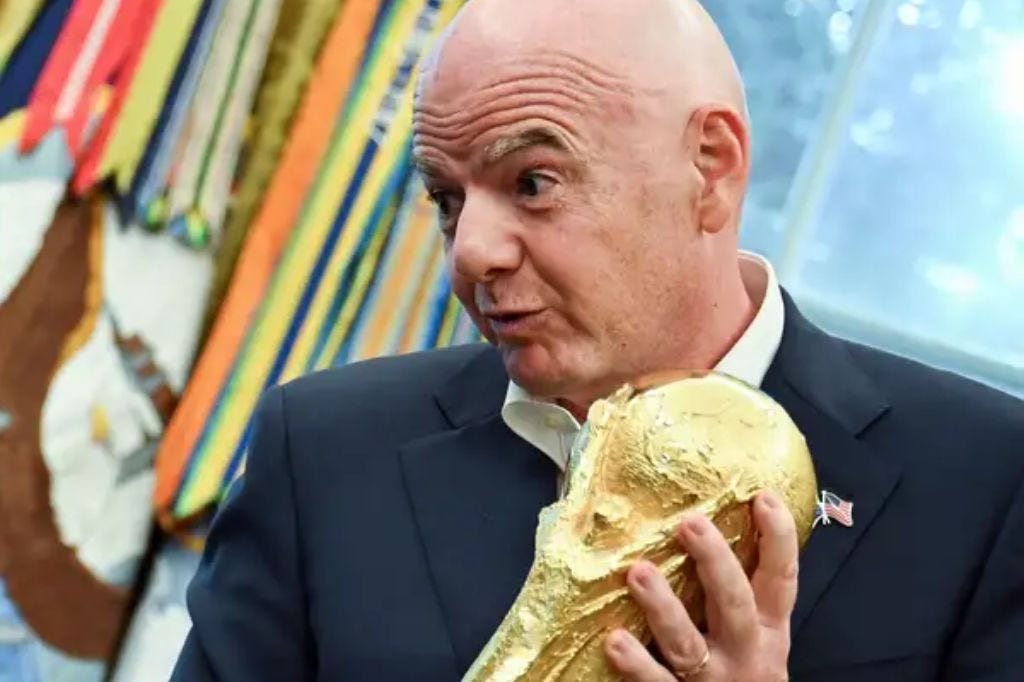
There is a scene that has become one of the defining images of the modern FIFA. December 2025, the Kennedy Center in Washington D.C., the glittering stage for the 2026 World Cup draw. And there, beaming with unconcealed pride, FIFA PresidentGianni Infantino presenting US President Donald Trump with the inaugural FIFA Peace Prize.
Let that sink in for a moment. A prize for peace. Handed to Donald Trump. By the president of world football. Because he wasn’t awarded the Nobel Peace Prize. And that was before the tournament drowned in further controversy, political interference, visa bans, immigration fears, and the spectre of a US war with a qualified participant.
This is what FIFA has become under Gianni Infantino. And this is why, when the final whistle blows at MetLife Stadium this summer, he must be removed from power.
The 2026 FIFA World Cup, spread across the United States, Canada, and Mexico, should by rights be the crowning achievement of Infantino’s tenure. The biggest tournament in World Cup history, expanded to 48 teams, hosted in three nations, touching a continent that had waited decades for its moment. Football’s grand opportunity to plant its flag in North America and declare itself the undisputed global sport.
Instead, it arrives weighed down by a cargo of self-inflicted wounds so heavy it is a miracle the tournament is still taking place. Political chaos, institutional cowardice, breathtaking hypocrisy, fiscal obscenity, and a governing president who has confused the role of football’s steward with that of a globe-trotting courtier to the powerful and the wealthy.
The case against Infantino’s continued leadership is not just the case against one man’s character or style. It is the case against a fundamental corruption of what football’s governing body is supposed to be. That case begins before 2026, in Qatar, runs through the gilded halls of Riyadh, and ends here, in the middle of a mess that, by any honest accounting, Infantino built himself.
Qatar 2022: The Original Sin

Any honest assessment of Infantino’s presidency must begin in Qatar. The 2022 World Cup, the first held in the Middle East, was supposed to represent football’s embrace of the world’s diversity. What it actually represented was the first fully formed expression of Infantino’s governing philosophy - money first, human rights second, and optics somewhere near the bottom.
The decision to award Qatar the 2022 tournament pre-dated Infantino’s tenure. But his defence of it, his management of it, and the moral framework - or lack of it - that he wrapped around it, were entirely his own. Qatar’s record on the treatment of migrant workers building the infrastructure needed for the tournament drew condemnation from human rights organisations worldwide. Estimates of migrant worker deaths linked to World Cup construction varied wildly depending, but even conservative figures were deeply disturbing. The kafala system, which tied workers to employers and made independent movement functionally impossible, was condemned by Amnesty International, Human Rights Watch, and trade unions across the world as nothing more than slave labour.
Infantino’s response was to defend the tournament as a force for positive change and to deliver one of the most extraordinary speeches in the history of the organisation, in which he compared his own childhood experiences as a red-haired immigrant boy in Switzerland to the suffering of migrant workers in Qatar, and suggested that critics of Qatar were engaging in a form of colonialist hypocrisy. It was the behaviour of a man utterly disconnected from the moral weight of the moment or cynically attempting to redirect it.
Then came the rainbow armband controversy, where European captains who had committed to wearing anti-discrimination armbands were threatened with yellow cards by FIFA if they did so, bowing to pressure from a host nation where homosexuality is criminalised. The contrast with FIFA’s usual declarations that it “stands against all forms of discrimination” was stark and immediate. The message was unmistakable - FIFA’s principles were negotiable based on who was paying and who was hosting.
The first tournament of Infantino’s presidency was widely regarded as one of the most controversial in World Cup history and he had been in charge throughout. That should have been the warning. It turned out to be the template.
Saudi Arabia 2034: The Process That Wasn’t
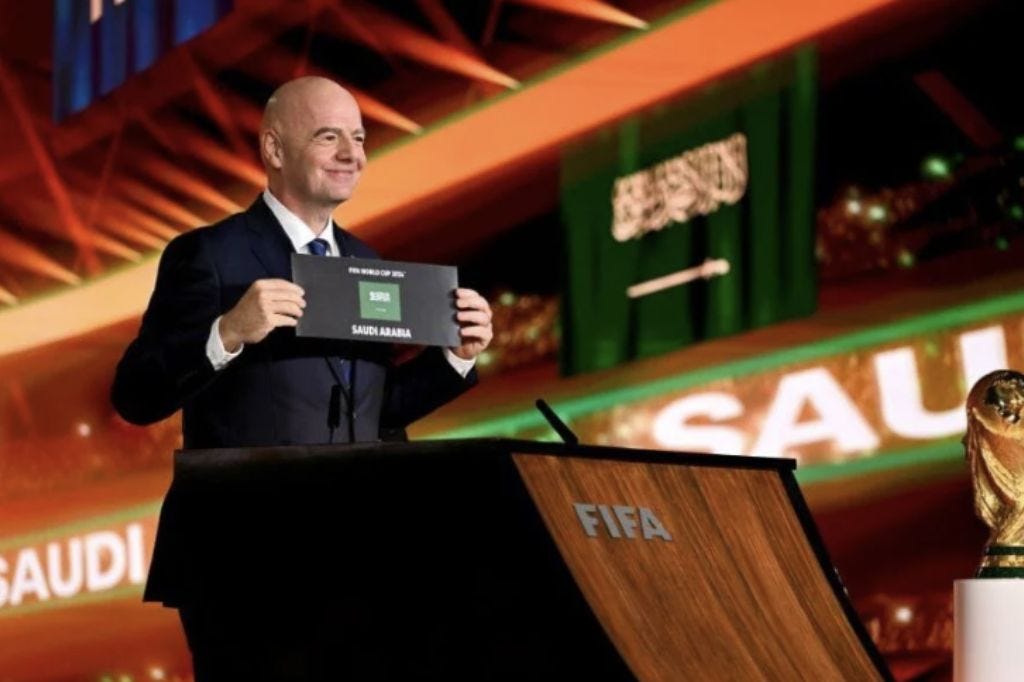
If Qatar represented the corruption of principle, Saudi Arabia 2034 represents the corruption of process.
The awarding of the 2034 World Cup to Saudi Arabia was, in the assessment of virtually everyone who watched it unfold, a sham from beginning to end. As one detailed account characterised it, human rights advocates described the process as “an elaborate fix.” FIFA officials, behind closed doors, structured the 2030 World Cup bidding to spread across six countries and three continents, a deal that then conveniently restricted the 2034 race to Asia and Oceania, precisely the zone that maximised Saudi Arabia’s chances. Australia, the only potential rival bidder with both the credentials and the will, withdrew citing the impossibly short timeframe for submissions.
Saudi Arabia was thus confirmed as 2034 host without a rival bidder at a virtual FIFA Congress. No competitive process. No genuine evaluation. No meaningful scrutiny. A result so predetermined that calling it a vote was an insult to the word.
What was being invited into football’s most prestigious event was not simply a country with a complicated human rights record. It was a regime presided over by Crown Prince Mohammed bin Salman, who personally ordered the assassination and dismemberment of Washington Post journalist Jamal Khashoggi at the Saudi consulate in Istanbul in 2018. Rights groups documented a pattern of torture of dissidents, mass executions, forced disappearances, and imprisonment of individuals - including women’s rights activists - for social media posts.
A complaint lodged with FIFA by lawyers representing human rights bodies in May 2025 was unambiguous in its assessment. In a 30-page document, the lawyers stated that “widespread human rights abuses continue to be perpetrated in Saudi Arabia, and no steps are being taken by FIFA to address these in the buildup to the World Cup.” Their earlier offers to advise FIFA on human rights compliance before the award was confirmed had been ignored. Gianni Infantino, for his part, branded the decision a “positive step.”
The parallels with Qatar were not coincidental. Saudi Arabia had begun a similarly massive construction programme requiring stadiums to be built from scratch and the same pool of migrant workers from South Asia and Africa who built Qatar’s eight stadiums would be called on again. Human Rights Watch, citing two years of research and 155 interviews, documented “dangerous” conditions, “rampant wage theft,” the kafala system still functioning to bind workers to employers, and “insufficient” investigations of worker deaths. These were not warnings about what might happen. They were documented accounts of what was already happening.
Infantino and FIFA knew all of this. The lawyers told them so. The rights organisations told them so. They awarded the tournament anyway. And then, in one of the more brazen pieces of political theatre of the entire saga, Infantino arrived late to a FIFA Congress meeting in Paraguay in May 2025 - the first annual congress since the Saudi hosting win - because he was accompanying Trump on a state visit to Saudi Arabia, leading UEFA delegates to walk out in protest.
This was not a president managing football. This was a president managing relationships with the powerful, and using football as the medium of exchange.
The Russia Standard and the Israel Exemption
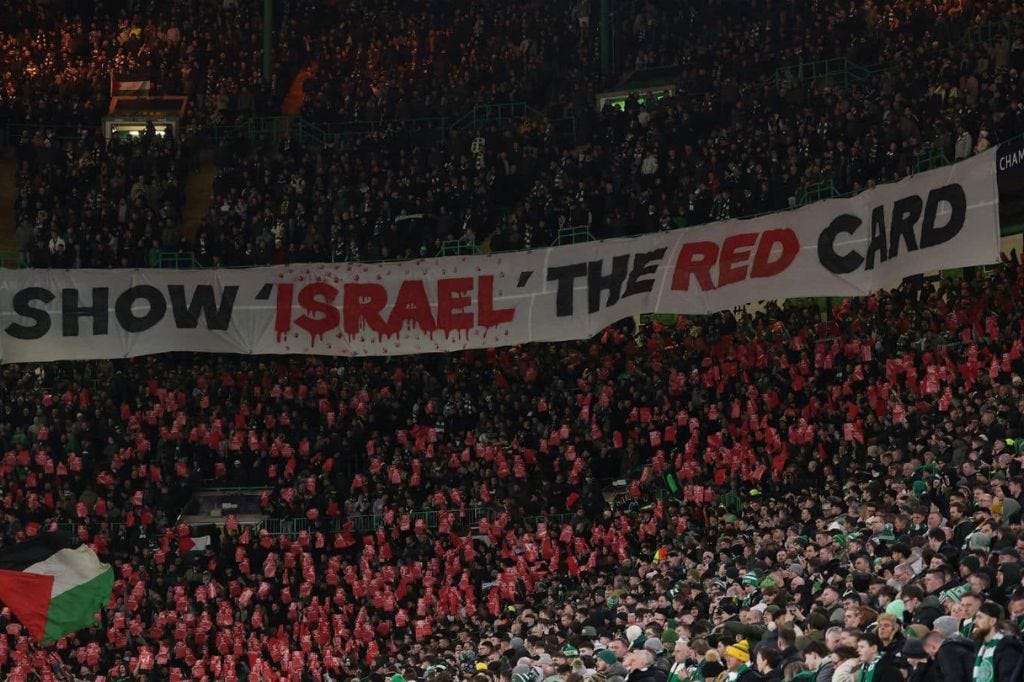
The most devastating charge against Infantino’s FIFA is not merely that it has made bad decisions. It is that it has made those decisions selectively, applying its own stated principles only against those who lack the financial or geopolitical power to resist them.
In 2022, when Russia invaded Ukraine, FIFA moved with startling speed. Russian clubs and the Russian national team were expelled from FIFA competitions, with the governing body declaring that Russia’s invasion “endangers the security and integrity of football.” UEFA acted in lockstep. Solidarity messages lit up stadium screens. Ukrainian flags were held aloft across pitches. The action was lauded internationally as a rare moment of principle from an organisation not known for them.
But here is the problem. FIFA’s statutes, which it invoked against Russia, state plainly that the organisation “is committed to respecting all internationally recognised human rights” and shall “strive to promote the protection of these rights.” They further declare that “discrimination of any kind” is “strictly prohibited and punishable by suspension or expulsion.”
By October 2023, with the Gaza conflict entering its most devastating phase and Palestinian footballer deaths mounting, the Palestinian Football Association formally demanded that Israel be suspended from FIFA membership. Their grounds were clear - Israel’s military actions in Gaza, the genocide they were committing, the documented killing of Palestinian athletes - by July 2024, the Palestinian FA confirmed that around 400 footballers have been murdered by the IDF, and Israel’s ongoing practice of allowing clubs based in illegal West Bank settlements to participate in the Israeli national league, a direct violation of FIFA’s own territorial jurisdiction statutes.
FIFA’s response, from the very beginning, was delay, deflection, and inaction.
In May 2024, Infantino announced at the FIFA Congress in Bangkok that the organisation would seek legal advice. In October 2025, with European federations mounting real pressure for a suspension and a UEFA vote on the matter widely expected to pass, Infantino convened a FIFA ruling council meeting at which Israel was not even formally on the agenda. “FIFA cannot solve geopolitical problems,” he said. The strongest push for Israeli suspension was subsequently paused after a peace proposal was made by Trump and Netanyahu in the White House, a development whose timing, given Infantino’s relationship with Trump, was noted by more than a few observers.
As one legal expert put it: “From day one, both [Infantino and UEFA president Ceferin] have been very fully aware of Israel’s violations but continued to turn a blind eye to them. That’s why we believe both are complicit in Israel’s war crimes and crimes against humanity.”
In March 2026, FIFA finally fined the Israeli Football Association a sum of 150,000 Swiss francs - less than $200,000 - for “discrimination, racist abuse and violations of fair play.” A fine barely larger than a week’s salary for a mid-level Premier League player, for a federation governing a country whose military actions had killed hundreds of footballers, destroyed entire communities, committed war crimes, and murdered tens of thousands of innocent men, women, and children. FIFA simultaneously announced it would take no action on the Palestinian request to suspend Israel’s membership.
Compare this to Russia, expelled within weeks for invading Ukraine. Compare it to what was done swiftly and decisively the moment European and American political capital was behind the action. The contrast does not merely reveal double standards. It reveals a system of governance in which moral principle is an instrument of convenience, deployed when it costs nothing, shelved when it costs something.
The Trump Embrace: FIFA’s Faustian Bargain
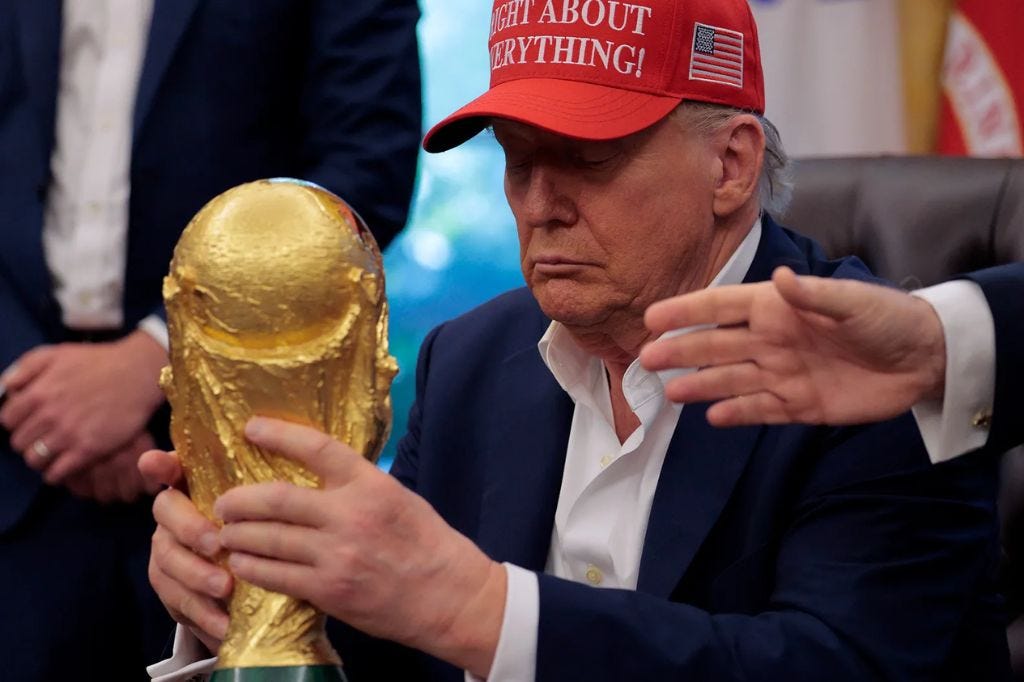
Nothing captures Infantino’s presidency more completely than his relationship with Donald Trump. What began as tactical necessity, the United States was the primary co-host of 2026, and Trump was its president, evolved into something far more troubling - a sycophantic, transactional embrace that has corrupted the integrity of the tournament and the institution simultaneously.
The FIFA Peace Prize was its most spectacular expression. Trump had lobbied, through himself and his allies, for the Nobel Peace Prize and been rejected and rightly so. FIFA’s response was to invent an entirely new prize, conjured into existence with the specific purpose of presenting it to Trump, and hand it to him at the World Cup draw ceremony in December 2025. As I have described previously, this was not a neutral sporting honour. It was a gilded political prop designed to flatter a man who thrives on flattery, at a moment when Infantino and FIFA wanted access, attention, and influence. A consolation trophy for a failed Nobel bid, dressed in football colours.
The practical cost of this flattery became apparent almost immediately. With the tournament weeks away, Trump posted on Truth Social that the Iranian national team was welcome to compete but that it would not be “appropriate” for their “own life and safety” - a statement by the host nation’s president that he could not guarantee the safety of a qualifying nation’s players. Iran, itself reeling from US and Israeli military strikes, demanded FIFA move its matches from the United States to Mexico. FIFA refused. Infantino, fresh from meeting Trump, said the tournament would proceed “as scheduled.”
This was not neutrality. This was a governing body telling a nation under attack to compete in the backyard of the man who had just attacked them - while simultaneously insisting that it was all about peace and football.
The deportation and immigration machinery operating parallel to the tournament has been equally damning. ICE enforcement operations in US cities intensified in the lead-up to the tournament. The Trump administration introduced a travel ban affecting citizens of 39 countries, including Haiti, Iran, Ivory Coast, and Senegal - four of which had qualified for the World Cup. Ordinary fans from those nations were effectively barred from attending. A separate visa bond policy requiring deposits of up to $15,000 from fans from five African nations targeted qualifying countries including Algeria, Cape Verde, Ivory Coast, Senegal and Tunisia.
At the Club World Cup in the United States in 2025, FIFA quietly stripped its own “No Racism” and “No Discrimination” campaigns from stadiums and social media, replacing them with the anodyne “Football Unites the World.” This was not editorial decision-making. It was a calculation that in Trump’s America, anti-racism messaging was politically inconvenient. FIFA chose to protect its host relationship rather than its own stated values.
When the anti-ICE protests erupted in Los Angeles in June 2025, Human Rights Watch and Amnesty International wrote to FIFA demanding action. Fan group Football Supporters Europe later described itself as “extremely concerned” by the militarisation of police forces operating around World Cup host cities. European political and football figures discussed a boycott following US threats against Greenland’s sovereignty. Germany’s football federation officially called for a boycott to be considered. Through all of it, Infantino smiled and said football was a bridge.
The Pattern: A Presidency That Chose Power Over Principle
When you place all of these events in sequence - Qatar, Russia, Israel, Saudi Arabia, Trump, the Peace Prize - a pattern emerges that is impossible to explain as a series of unfortunate misjudgements. It is a governing philosophy.
Infantino’s FIFA is not an apolitical organisation that occasionally gets caught in the crossfire of global events. It is an active political actor that repeatedly chooses power, profit, and proximity to authoritarians over the safety and dignity of the people its own statutes claim to protect. The red cards and the free passes, issued according to a logic that has nothing to do with football’s stated values and everything to do with who the powerful friends are.
Russia was expelled because expelling Russia didn’t cost FIFA - indeed, it was positively beneficial, aligning FIFA with Western governments and generating enormous positive coverage. Israel was protected because protecting Israel aligned FIFA with American political power, with the Trump administration that held the keys to 2026, and with Gulf states whose relationships Infantino has spent years cultivating. Saudi Arabia received the 2034 World Cup because Infantino’s relationship with Crown Prince Mohammed bin Salman had become FIFA’s most important financial partnership, and no principle - no human rights policy, no ethical code, no bidding process - was going to stand in the way of that.
This is not the conduct of a governing body. It is cronyism, and Infantino is its chief operator.
2026: The Culmination of a Failing Presidency
With the 2026 tournament days away from kicking off, each of these threads has woven itself into the fabric of the event. The tournament that should be football’s greatest celebration has arrived feeling, as I described in the days before its opening, “less like a celebration of football and more like a warning label.”
The ticket pricing scandal alone would have been enough to define a lesser presidency. FIFA deployed dynamic pricing for the first time in World Cup history, producing final ticket prices of $11,000 for a single seat at MetLife Stadium. House Democrats called on FIFA to lower prices and were ignored. New York Mayor Zohran Mamdani campaigned against the gouging and was dismissed. USMNT player Timothy Weah called the prices “too expensive” and Scotland captain John McGinn“It’s too expensive for a lot of people to come. Fifa are officially reselling tickets and I’ve never heard of that in my life.” When questioned, Infantino defended the prices by saying FIFA “had to apply market rates” - a remarkable statement from the president of a non-profit organisation whose statutes speak of making football accessible to all.
A halftime show at the World Cup final, featuring Madonna, Shakira, and BTS, was introduced over the objections of players, media, unions, and traditionalist fan groups who argued it would extend the break, disrupt recovery, and accelerate the “Americanisation” of the sport. Cartel violence in Mexico raised security fears around Guadalajara. A labour union accused FIFA of blocking a planned workers’ inspection at Estadio Azteca. Several major Fan Festivals were cancelled or scaled back due to funding disputes between FIFA and host cities that had been left to carry security costs independently. The town of Foxborough nearly lost its World Cup licence because it couldn’t get $7.8 million in security funding upfront from the federal government.
Iran’s participation remained in doubt until the very last weeks, with the country’s sports minister declaring at one point that “under no circumstances can we participate” before FIFA confirmed, in April, that the Iranian team was coming “for sure.” Trump’s envoy Paolo Zampolli - a man who had used his administration connections to weaponise ICE against the mother of his child in a custody dispute - attempted to pressure FIFA into replacing Iran with Italy. FIFA said no, but the very fact that the conversation happened at all was an indictment of the environment Infantino had created.
The Legacy: Blatter Without the Brown Envelopes
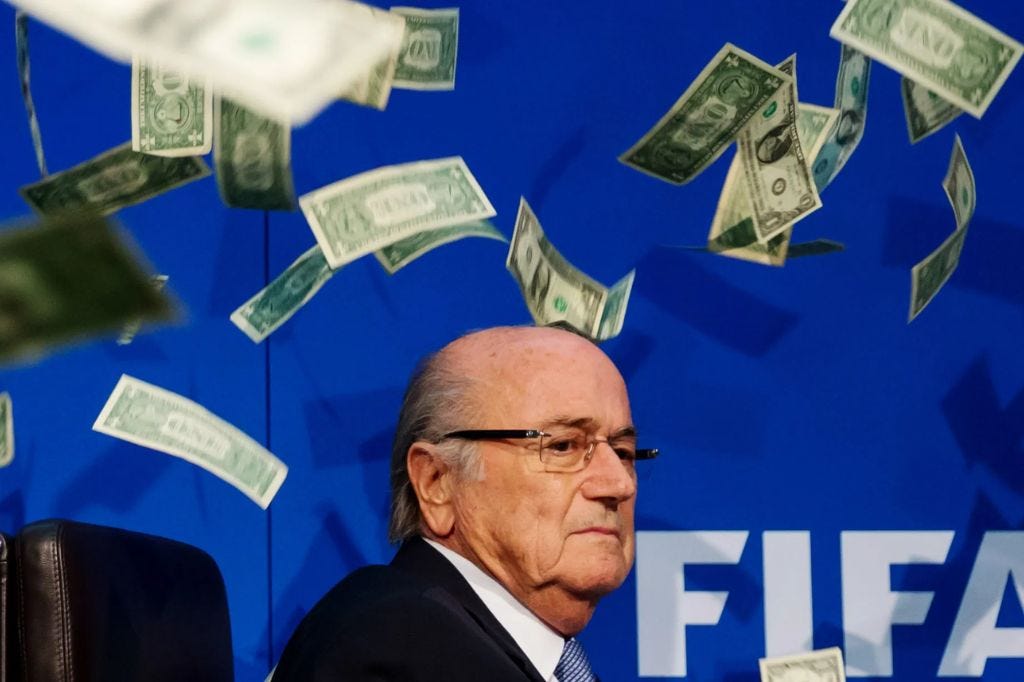
Infantino came to power in 2016 promising reform. Sepp Blatter’s era had ended in the FBI’s investigation into FIFA corruption, with officials pocketing millions in bribes, votes for World Cup hosting rights treated as commodities to be bought and sold. Infantino was the clean break, the European Football Administrator who would restore credibility.
He has not done so. What he has delivered instead is a different kind of corruption - not financial, in the main, but moral. FIFA’s statutes and human rights policies have become instruments of selective deployment, weapons aimed at geopolitical adversaries while shielding commercial partners. The Peace Prize gambit is the most grotesque symbol of this, where Blatter bribed individuals, Infantino bribes institutions - or rather, launders their reputations - using the currency of football itself.
One assessment of Infantino’s presidency nailed it precisely: “Blatter’s FIFA was a bazaar of backhanders; Infantino’s is a diplomatic court, where despots and strongmen receive footballing legitimacy in exchange for the access and revenue FIFA needs to feed its own expansion.”
He has expanded the World Cup to 48 teams, generating more games, more broadcast deals, more revenue and, inevitably, a more diluted product. He has overseen the expansion of the Club World Cup that player after player has called an imposition on an already overloaded calendar. He has moved FIFA’s administrative operations to Saudi Arabia. He has cultivated relationships with strongmen from Riyadh to Washington as a governing strategy. And he has done all of this while maintaining, with apparently unshakeable conviction, that FIFA is a neutral organisation devoted to the universal language of football.
Why 2026 Must Be His Last
The case for Infantino’s departure after 2026 is not merely about the catalogue of disasters that have defined this tournament’s run-up. It is about what continuing his presidency signals about what FIFA is prepared to accept as normal.
If Infantino survives the 2026 World Cup with his position intact - if the combination of the Peace Prize scandal, the Israel double standard, the Saudi Arabia capitulation, the immigration catastrophe, the ticket gouging, and the chronic moral inconsistency produces no consequence - then FIFA will have confirmed what its most cynical critics have long suspected, that the institution is unreformable, its stated values meaningless, and its governance permanently available to whoever holds sufficient financial and political power.
Football deserves better. The 211 member associations of FIFA, the vast majority of them from nations in the Global South that have watched their World Cups handed to the Gulf and their voices drowned out by the politics of those with the largest cheques, deserve better. The fans who have been priced out of attending the greatest tournament in the sport deserve better. The Palestinian footballers whose deaths went unacknowledged deserve better. The Iranian players asked to compete in a country whose president questioned their safety deserve better.
A new FIFA presidency must commit to several things that Infantino’s has conspicuously failed to deliver. A genuinely competitive, transparent World Cup hosting process, with real human rights due diligence. Consistent application of FIFA’s own statutes regardless of the political and financial power of the states involved. An end to the personal diplomacy of the president as a vehicle for awarding political legitimacy to autocrats and strongmen. A genuine relationship with players, unions, and fan organisations rather than the dismissive shrug that has greeted their concerns throughout 2025 and 2026.
None of this will be simple. FIFA has structural problems that predate Infantino and will outlast him. The concentration of power in the executive, the opacity of decision-making, the dependence on broadcast revenues that come disproportionately from a small number of wealthy markets - all of these create incentives that push any FIFA president toward the kinds of choices Infantino has made.
But leadership matters. The choices a president makes - about which principles to defend, which relationships to cultivate, which populations to protect, and which to ignore - define what an institution is in practice, whatever its statutes say. Infantino has defined FIFA as an institution that will sacrifice almost any principle in the pursuit of commercial expansion and political access. A different president, with different values, would make different choices.
Football, at its best, is genuinely universal. It is the game that can be played on any surface, with any ball, in any country, by any child regardless of wealth, status, or nationality. The World Cup is supposed to be the expression of that universality - the moment every four years when the whole planet watches the same thing and feels, however briefly, connected to something larger than itself.
Gianni Infantino has spent the last decade turning the World Cup into a commodity, that connection into a commercial transaction, and that aspiration toward something noble into a vehicle for the enrichment and legitimation of the powerful.
The 2026 World Cup will produce moments of joy. It will produce goals and upsets and stories that will be told for decades. The tournament itself, whatever the surrounding chaos, retains the capacity to move people in ways that politics never can.
But when it is over, the question of who governs football must be answered honestly. Not in the language of FIFA’s press releases, not in the glow of a half-time show at MetLife Stadium, but in the cold light of what has happened on Infantino’s watch.
Qatar’s dead workers. Palestinian footballers murdered with no condemnation. The Saudi Arabia deal stitched up behind closed doors. The Peace Prize handed to a demagogue. The anti-racism campaigns scrubbed from stadiums to avoid upsetting a host. The Israeli federation given a fine and a free pass while Russia was expelled. The Iranian team told to play in the lion’s den. The fans priced out by their tens of thousands.
This is not a record that deserves another term. It is a record that demands accountability.
The whistle must blow on Gianni Infantino.
Absolutely superb piece Andy, this world cup highlights everything that's wrong in the world, politically, ethically and morally and you've nailed it precisely here, you should be proud of what you've written here mate. In my opinion if a journalist had written it they'd be talking Pullitzer prize material, there's certainly nobody in the Scottish media with the balls to write something as good as this, just brilliant mate.
Excellent piece Andy.
There is also FIFA's partnership with Trump's discredited Board of Peace and Infantino's clown like stage appearances. It would be interesting to find out if FIFA paid the "entrance fee" to Trump. Also you have the banning by Trump of certain referees who don't happen to be the right colour with no real comment from FIFA.
FIFA is broken and it's time for the countries of the world to break ties and form a new federation with rules in place to stop anything like this happening again.