

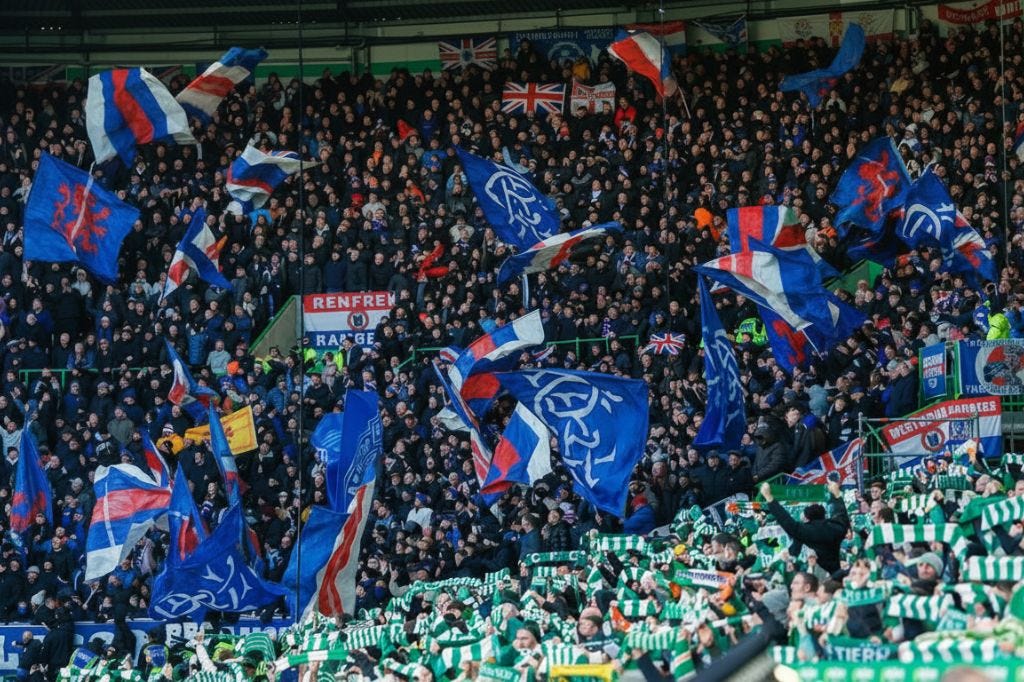
For all the noise, outrage, and performative indignation that followed from the usual suspects, the SPFL’s decision to back Celtic over the allocation of away tickets for the final Old Firm game of the season was never truly in doubt. Nor should it have been.
Once Celtic framed the issue around safety - of supporters, players, staff, and officials - the outcome was inevitable. Not because of bias or the perceived belief from bitter Rangers fans that Celtic runs Scottish Football, but because of responsibility.
Under SPFL Rule H36, the home club carries the legal and operational burden of ensuring matchday safety. That is not a symbolic duty. It is a binding obligation. And when Celtic presented a risk assessment tied directly to recent, very real disorder at Ibrox in March, the SPFL had little choice but to defer to it and side with Celtic.
That disorder wasn’t hypothetical. It wasn’t exaggerated. It was visible, documented, and deeply concerning.
The Scottish Cup quarter-final tie saw repeated breaches of security, most notably involving members of the Union Bears. These were not spontaneous moments of passion like what we saw from the celebrating Celtic fans after the penalty shoot-out win - they were escalations that endangered players, inflamed tensions, and put stewards and police in compromised positions. Celtic’s claim that this group “identifiably engaged in serious violence and disorder” is not rhetoric; it is rooted in what unfolded in front of a national audience - even if Rangers’ hierarchy have turned a blind eye to the Union Bears’ violent thuggery.
Given that context, Celtic’s request was not extreme. It was targeted. They did not seek to eliminate away fans entirely. They offered around 2,400 tickets in line with the 5% reciprocal agreement, on the condition that those tickets were not distributed to a violent hooligan group they believe pose a credible safety risk.
That is not discrimination. That is risk mitigation.
In a previous article, I argued that Celtic had to stand firm on this issue. Not out of rivalry, but out of duty. When a specific section of a support has crossed a line in such a public and dangerous manner, inaction is not neutrality it is negligence.
The SPFL sub-committee recognised exactly that. Their decision not to “overrule” Celtic’s risk assessment wasn’t a cop-out; it was an acknowledgment of where accountability lies. Without the benefit of the still-pending Scottish FA report into the Ibrox disorder, and with only 16 days before a high-stakes fixture, the league body opted for the only defensible position - trust the club responsible for safety on the day.
Rangers’ argument about “sporting imbalance” might sound good in statements and to their own supporters foaming at the mouth, but it collapses under scrutiny. Competitive fairness cannot supersede basic safety. A full away allocation means little if the conditions that accompany it introduce avoidable risk. Football matches are not played in a vacuum; they are live events with real-world consequences. Football doesn’t get to suspend responsibility for the sake of symmetry.
And crucially, Celtic have not shut the door on Rangers supporters - The only thing stopping Rangers supporters from being present is Rangers’ refusal to accept a condition tied directly to recent misconduct. That’s a choice. Not an injustice. The allocation remains on the table. The condition is clear. The choice now rests with Rangers.
There will, inevitably, be talk of escalation, of tit-for-tat measures, of the Green Brigade facing similar restrictions at Ibrox in the future. That may yet come to pass. But it is a separate issue, and it should be treated as such.
Because what happened in March is the crux of this matter.
This is not about abstract rivalry politics or fan culture point-scoring. It is about a specific incident, involving a specific group, that materially altered the risk profile of one of the most volatile fixtures in European football.
If Scottish football is serious about improving standards, protecting match-going supporters, and avoiding the kind of scenes that damage its reputation, then decisions like this cannot be controversial. They must be consistent.
Celtic assessed a risk. They acted on it. The SPFL didn’t make a bold decision here. They made the only decision available to them. And the fact it’s being framed as controversial says more about the tolerance for disorder in this fixture than it does about the ruling itself.
Good well written article Andy, which gets to the nub of the matter, that Rangers FC accept responsibility for the actions and misdeeds of their own supporters, i.e. the notorious Union Bears.
I think Rangers will climb down off their high horse, now that the SPL have refused to back them, and I expect some mealy mouthed statement from Rangers FC, saying they grudgingly accept the allocation now, but under protest.
It is beyond belief that sevcos board are supporting an organised group of hooligans who have caused trouble home and abroad it'll be interesting to see the outcome of the investigation into the trouble at the cup tie will the home club be fined