

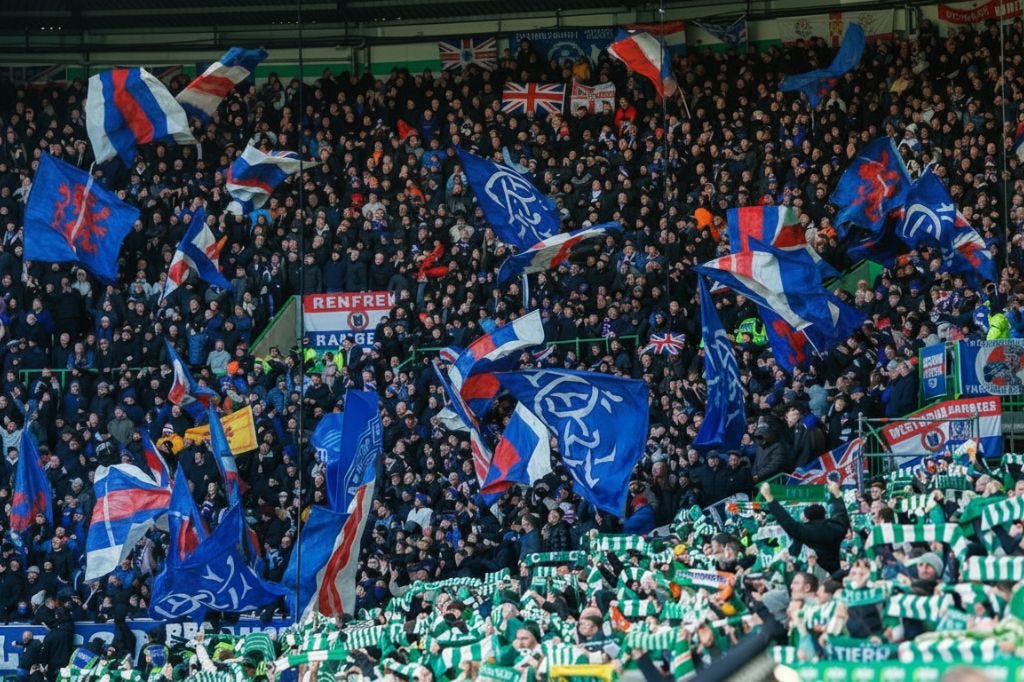
Celtic’s refusal to hand Rangers supporters tickets for the final Glasgow derby of the season unless Rangers ensured that the Union Bears did not receive any of the allocation is being framed in some quarters as provocative. That framing is convenient, but it is also backwards. The real provocation came first, the violent scenes at Ibrox, the pitch invasion, the missiles, the fireworks, the assaults on police and stewards, and the assaults and attempted assaults on Celtic players and club officials. That was not normal derby shenanigans; it was disorder that exposed a failure of control from Police Scotland, Rangers Football Club, and the Private Security firms hired by the Ibrox side.
Celtic’s position is best understood not as escalation, but as a response to disorder that has not been addressed at all by the Scottish FA or Police Scotland - the latter are clearly circling the wagons looking to protect themselves from public scrutiny.

Rangers condemned the incidents in general terms, but condemnation is not the same as control - and in fact, much of their focus was put on graffiti and seat damage than the violent hooliganism of their own supporters that day. If a club continues to permit the same ultra element to operate without meaningful restriction, then it should not be surprised when opponents decide that normal away-day arrangements can no longer be trusted.
The March Scottish Cup quarter-final was supposed to be another ding dong of a football match. Instead, it descended into scenes that forced police and stewards into damage limitation mode after Rangers lost another cup game to Celtic.
What matters here is not just that supporters entered the pitch. The wider issue is that the disorder did not stay contained as emotional celebration from Celtic fans celebrating their team’s victory. It spread into violent disorder when the Union Bears invaded the pitch endangering players, officials, match-day staff, and supporters. That makes the subsequent arguments over ticketing look strangely detached from reality.

Rangers’ refusal to confront the Union Bears in a serious, enforceable way sits at the heart of this dispute. Celtic are not objecting to ordinary Rangers supporters attending the game; they are objecting to Rangers freely distributing tickets to the Union Bears which creates a significant risk to the safety of those at Celtic Park. Celtic’s own statement made that distinction plainly by linking the refusal to a “particular section” that “very recently and identifiably engaged in serious violence and disorder.”
That is the crucial point Rangers would rather blur. Their argument leans on the idea that excluding away fans creates competitive imbalance, but balance is not a magic word that overrides a fresh safety concern. If one club cannot or in Rangers’ case will not prevent a violent subsection from getting access, the other club is entitled to decide that the risk is too high.

SPFL Rule I27 says the home club must provide a “reasonable number” of visiting supporters as agreed in advance, with the Board deciding if an agreement cannot be reached. But the same football ecosystem also repeatedly recognises that safety, stewarding, policing, and supporter behaviour are not side issues; they are central to whether fixtures can safely proceed. In this case, the dispute exists precisely because Celtic carried out a risk assessment and concluded that a specific distribution arrangement was unacceptable.
That is why Rangers’ appeal to the rule feels less like a principled defence of away supporters and more like an attempt to convert a governance provision into a shield against consequences. If a club’s only answer to a serious disorder problem is “the rule says so,” then it is treating safety as an afterthought. That is not how responsible football administration should work.
The bigger story is not simply Rangers versus Celtic. It is the absence of credible intervention from the wider game. The SPFL has acknowledged the dispute and moved it into its formal process, but formal process is not the same as immediate reassurance for supporters who now have reason to worry about what happens if the old arrangements continue unchanged.
Police Scotland, the SPFL, the Scottish FA, and the clubs all operate within a system that often reacts after the fact. That is not good enough when the warning signs are obvious and recent. The Ibrox disorder was not an abstract policy problem; it was a live demonstration of what happens when football tolerates organised aggression and then pretends the next fixture will be different by default.
Celtic’s critics want the club to behave as if away allocation is an entitlement that survives every breach of trust. It is not. It is a facility built on mutual confidence, proper control, and the expectation that both clubs can keep supporters safe. Once that confidence is damaged by serious disorder, the home club is not obliged to proceed as though nothing has happened.
That is especially true when the club taking the strongest line is the one that would bear the consequences if things went wrong. If Celtic let Rangers fans in, and the same element appears again, the home club would be blamed for ignoring the warning signs. If Celtic keep the door shut, they are accused of unfairness. Those are not equivalent risks. One is a reputational argument; the other is a safety issue.
There is a broader lesson here for Scottish football, clubs cannot keep romanticising “passion” while tolerating behaviour that is plainly violent, intimidating, and criminal. The sport has spent years normalising the idea that the most extreme fringes should be accommodated because they are loud, visible, and culturally embedded. That tolerance becomes complicity when the same groups repeatedly create danger and the response remains soft, vague, or delayed.
Celtic’s stance may be uncomfortable, but discomfort is not the same as being wrong. In fact, responsible governance often looks like discomfort to people who are used to getting their own way. Rangers can complain about precedent; the SPFL can hide behind procedure; pundits can wring their hands about optics and a lack of atmosphere. None of that answers the basic question - after Ibrox, who can honestly say the risk of further disorder has been removed?
Celtic must stand firm. The club has identified a specific risk, linked it to a recent outbreak of serious disorder, and acted to protect its own supporters, staff, players, and officials. That is not overreaction; it is prudence.
Rangers’ real task is not lobbying the SPFL. It is confronting the culture and factions that made this dispute inevitable. Until they do that, they cannot expect Celtic to pretend everything is normal.
If it were up to me, I would ban Rangers fans from Celtic Park for good.
Rabid dug bites someone in Tesco. Following week the owner complains when he is allowed in but dug is banned.
It's a Blue Do for all Ranger's fans ! The Union Bears are a para military group when you consider the scale of the previous violence and disorder they have been engaged in, these high powered flares and multi repeater fireworks are menacing weapons that they utilize. It would be highly dangerous and unconscionable to let these scum bags into Celtic park, for what is promising to be an extremely combustible and volatile fixture as it is, with the SPL title hanging in the balance.