

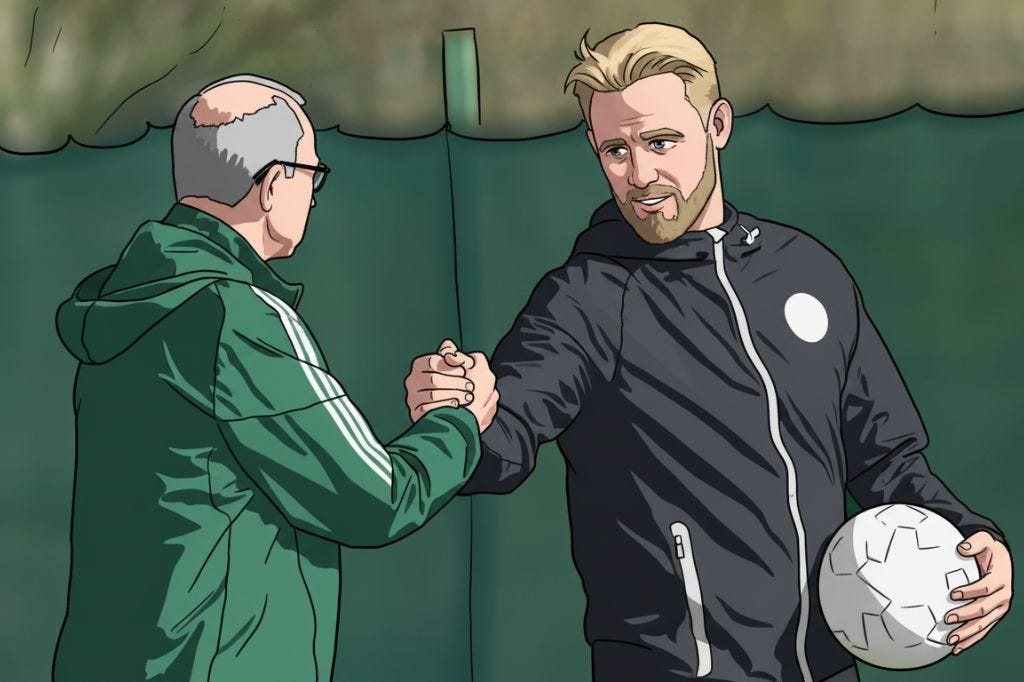
Celtic supporters have become grimly used to learning the biggest stories about their own club from anywhere but Celtic Park, but the Kasper Schmeichel saga still manages to feel like a new low. Being interviewed by his Dad for a CBS Champions League show in the United States, the Dane calmly told the world he might have played his last ever game – not just for Celtic, but in professional football. No statement from the club, no injury bulletin, no manager fronting up and explaining the situation to the fans. Just a clip from a foreign broadcaster pinging around social media, shared in disbelief by Celtic supporters asking the most basic question of all - what on earth is going on at our club?
In that CBS interview, alongside his father, Schmeichel laid bare the extent of the damage - a shoulder that has been dislocating, a torn bicep, serious rotator cuff issues and the stark verdict from a specialist that he requires two separate operations and could be out for 10 to 12 months. He admitted he has been playing through this for months, relying on pain‑killing injections to get on the park. It was an oddly serene conversation for a man effectively announcing that his career might be over – but for Celtic supporters, it landed like a grenade, not least because it was the first time they were hearing any of it.
Strip away the emotion and you are left with a brutal sporting reality, Schmeichel has been a complete failure as Celtic’s No.1 this season. Since that Scottish Cup final defeat last year, his form has been a mess – weak handling at big moments, poor decision‑making under pressure, and jittery, inaccurate distribution that has repeatedly put his defence in trouble. This has not been an ageing great bowing out gracefully; it has been a slow, painful unravelling in full view.
Now we know he was attempting to navigate all of that while his shoulder was falling apart, taped together and numbed by injections. If, as Martin O’Neill has since admitted, the manager only fully grasped the true severity of the injury after the CBS revelation, we are entitled to ask what sort of medical and internal communication structure exists at Celtic. But even before you get to the club, there is a question of personal responsibility.
There is a romanticised idea in football that playing through serious injury is somehow heroic, that the lad who takes injections to “get out there” is displaying old‑school bravery. The reality is more cynical, a professional who puts the team first does not cling on through a chronic shoulder injury that is already dislocating in games. A professional understands that turning up half‑fit, doped up to dull the pain, is a direct risk to the collective – that one flapped cross or mis‑hit pass out from the back in a tight title race can kill momentum and cost not just points but ultimately a title.
Schmeichel chose to keep going, knowing he was compromised, and now faces two surgeries and up to a year out, with the very real possibility that he has already played his last game. There has also been a clear subtext throughout this saga: the looming prospect of Denmark duty, of one last play‑off and one last tournament in a storied international career. If you are taking injections to preserve your national‑team place while churning out sub‑standard performances for the club that actually pays you, that is not noble, it is selfish. And when you go on American TV and discuss your injury, your rehab and your potential retirement without acknowledging Celtic, it only underlines how little the club has featured in your own narrative.
As bad as that looks for Schmeichel, the most damning aspect of this entire episode is Celtic’s handling of it. Supporters did not hear the news from the club, the manager, the medical staff or any form of official communication; they heard it second‑hand from a CBS Sports segment that fans in Scotland saw via social media. We are talking about a player whose injury fundamentally alters the shape of the season – ten to twelve months out, contract up in the summer, highly likely never to pull on the gloves in a competitive game for Celtic again – and yet the club has, still to this day, provided nothing resembling a detailed, candid update.
O’Neill has admitted he was “surprised” by the severity of the damage, conceding that he did not receive the bad news directly and that the club’s physio, not the manager, was the one who knew the seriousness of the scan results. At the same time, he confirms that the club knew Schmeichel had been taking injections to keep playing. That is a staggering combination for a club of Celtic’s size - key medical information withheld, the manager in the dark, and fans left to piece together their own understanding from foreign television.
Even now, there has been no statement from Celtic confirming that Schmeichel requires surgery, that he is definitively out for the season, or that his contractual situation means he has almost certainly played his last game. No timeline, no detail, no attempt to set out a plan or reassure a support already suspicious of how this club is being run. Independent Celtic fan outlets are left to ask the obvious question out loud - who is actually running Celtic, and is anyone in the building capable of handling a major situation with basic competence?
This is not about slick PR or “controlling the narrative”. This is rudimentary governance. When your number one goalkeeper suffers an injury he himself compares to an outfield player tearing both an ACL and an Achilles, you get ahead of it, you protect the player, you respect the support, and you demonstrate that there is a strategy. Instead, Celtic let the story drift until Schmeichel, in a TV studio thousands of miles away, effectively announced the end of his own Celtic career without the club so much as clearing its throat.
O’Neill has tried to soften the blow with humour, talking about potential fines for going public before telling the club, but the jokes only highlight the absurdity. He acknowledges that the club knew about the tests, that the physio knew the scan was much worse than first thought, yet he himself was “incommunicado” as the story broke. That is not the image of a modern, joined‑up football operation; it is a relic of the worst days of Celtic as a complacent, inward‑looking institution where departments operate independently of one another and supporters find out what is happening to their key players from TV in another country or via social media.
When independent Celtic fan sites are forced to spell out that fans were left to “piece it together for themselves” and openly ask if there are “any grown‑ups at Celtic anymore”, you know the rot runs far deeper than one injured goalkeeper. From top to bottom – boardroom, medical, media, football department – this has exposed a lack of leadership, a lack of structure and a lack of basic respect for the people who bankroll the entire operation - the fans.
The only sliver of light in this mess is that, while the club have been sleepwalking through a goalkeeping crisis, they may have stumbled into a genuine long‑term solution. Viljami Sinisalo, signed as a backup and left waiting, has finally been given a proper run and has answered the call with authority. O’Neill has described himself as “pleasantly surprised” by how he has taken his chance and praised him as a “really good lad”, with reports highlighting his big‑moment contribution at Ibrox, Stuttgart, and beyond.
Supporters can see the difference already - command of his box, cleaner distribution, and a presence that calms rather than panics the back line. Celtic now appear to have a ready‑made No.1 who has stepped into the chaos left by Schmeichel’s decline and injury – yet the club’s handling of the entire episode has been so amateurish that Sinisalo’s emergence feels like an accident, not the product of coherent planning.
If this is how Celtic deal with a major injury to a first team regular, what confidence can anyone have in their ability to manage the structural issues looming on the horizon? And if a 39‑year‑old keeper can play on injections until his shoulder is shattered, then reveal it all on American television while the club stays silent, why should any supporter believe that those running Celtic truly put the team – and the badge – ahead of egos, spin and sheer incompetence?
Every single Celtic fan knew there was something wrong. From the cup final penalty shootout to his subsequent games playing well below par. Predictable performances meant opposition had an advantage from the ko.
Ok. Great shot stopper at times but his distribution and general play could be appalling.
CFC must shoulder (pun intended) part of the blame allowing him to jeopardise our season. Our internal sports science/physio/health and well being set up is nothing short of astoundingly awful. How many out with long term injuries?
Schemeichel is a rat bag. He deliberately hid the true extent of his shoulder injury, to keep his fading hopes of a World Cup place with Denmark alive. I blame the three Celtic managers, Rodgers, Nancy and O'Neil for keeping on playing him in goal, when it was obvious he was past it, and kept Sinisalo kicking his heels in the dug out.