

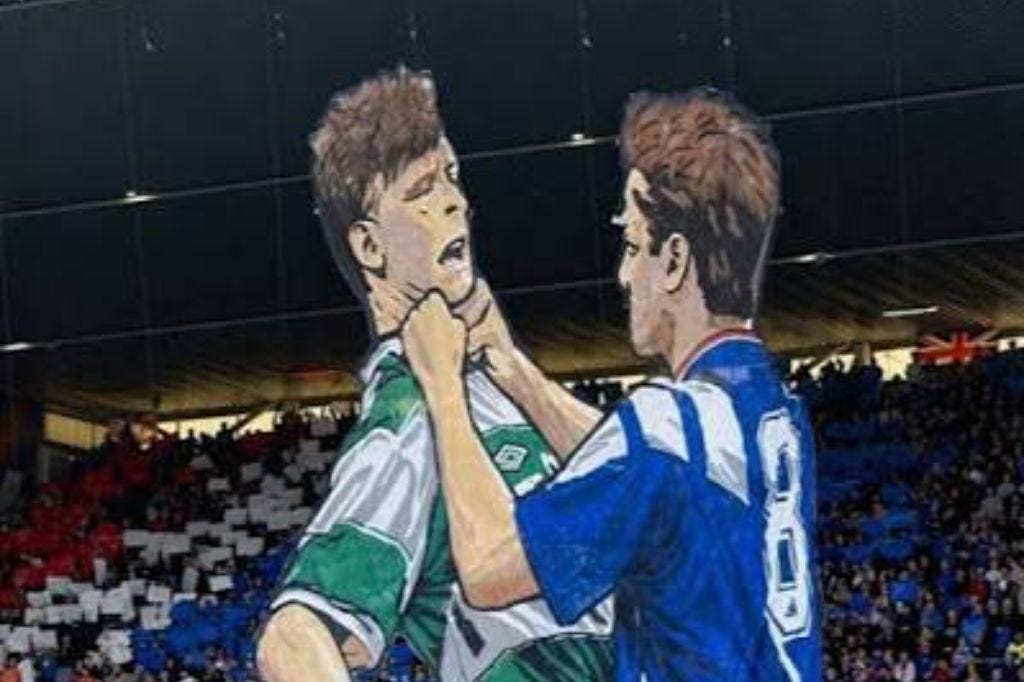
The 3-0 League Cup win for Rangers over Celtic at Ibrox on Sunday will be remembered by most as a dominant derby display by Derek McInnes’ side. But for anyone listening closely, the most enduring image of the afternoon was not Dan Neil’s brace or Kevin Kelsy’s goal, it was the unbroken stream of sectarian abuse aimed at Martin O’Neill and Celtic from the home stands, sung with impunity in a stadium with no away fans.
There is nothing unusual about a ferocious, partisan, and hostile atmosphere in a Glasgow derby. Rivalry is part of the fixture’s DNA. But what unfolded at Ibrox went well beyond “hostile”. From the first minute to the last, large sections of the Rangers support directed sustained sectarian chants and songs at O’Neill and, by extension, Celtic.
Among the most notorious were renditions of the Famine Song - a chant ruled racist by the High Court in Edinburgh in 2009 - and the banned “Billy Boys”, with its Ku Klux Klan-linked origins and the infamous “up to our knees in Fenian blood” add-ons. These are not “banter” or “old terrace songs”; they are explicitly anti-Irish, sectarian, and legally recognised as discriminatory.
Adding to the ugliness was a large tifo depicting former Rangers player Ian Ferguson grabbing Mike Galloway - the same Galloway who died just four months ago. Whether intended to the specific on-pitch incident or not from the 1990s, the effect was grotesque as the Rangers support turned a recent death into a punchline in front of 50,000 people. To suggest this was accidental strains credulity. It was a deliberate provocation, designed to wound. Yet not one media outlet condemned the aggressiveness or the grotesque use of the image just months after Galloway’s death. They all highlighted it, they seemed to laud the tifo, not one condemned it. Why is that? A tifo that Rangers FC clearly signed off on also.
Police Scotland confirmed four arrests in connection with the match were made - one for sectarian abuse, one for assaulting a police officer, one for threatening and abusive behaviour, and one for breach of the peace. Chief Superintendent Stevie Dolan said behaviour like this “is never acceptable and will not be tolerated”.
But the optics are stark, one man arrested for sectarian abuse in a stadium where tens of thousands were heard singing sectarian abuse at Martin O’Neill, along with the Famine Song and the Billy Boys. The message it sends is that while individual outliers may be caught, the collective culture that enables and amplifies this abuse is not being seriously confronted and dealt with.
Even Scotland’s so-called leading charity in challenging sectarianism was silent. Why? Just like the mainstream media, they won’t call out Rangers if they can’t call out Celtic also. Only last month, they posted on their social channels that they welcomed the ‘wholly proportionate punishment’ for Celtic and Rangers from the SFA over the scenes back in March after the Scottish Cup quarter final tie. They added: “Actions must have consequences and the violence, bigotry & antagonism witnessed that day cannot be allowed to happen again in the future.”
And this is a charity that goes into Scotland’s schools teaching our children about the scourge of sectarianism. Even they can’t call it out unless they can rope Celtic into the equation.
In the aftermath, most mainstream coverage fell back on the lazy “Old Firm” framing - as if sectarianism in this fixture is some symmetrical disease, with both sides equally to blame. Yet there were no Celtic fans at Ibrox. There was no away support to rope into the narrative. Still, the default instinct for all media outlets was to dilute the story, to avoid “singling out one club all the time”.
The only Scottish sports journalist to consistently and unequivocally call out what he heard was Graham Spiers, who posted after the match: “In victory – and thoroughly deserved victory – the Rangers fans shower Martin O’Neill with sectarian abuse.” Spiers, a self-confessed Rangers supporter himself, has long been a lone voice in insisting that this behaviour be named for what it is, even when it brings him grief, abuse, and threats from sections of the Rangers support.
This is not just about a few bad apples. It is about a culture that has been allowed to fester for years. The Famine Song and Billy Boys have been sung at Ibrox for well over a decade, despite repeated rulings and public condemnation.
Club statements and “we condemn all forms of discrimination” lines are now ritual, not remedy. They do nothing to disrupt the chants, the tifos, or the social media glorification of abuse after the fact.
If the SPFL, Scottish FA, Police Scotland, and Rangers FC truly believe this behaviour is “never acceptable”, then the response must match the scale of the problem - meaningful sanctions for the club when large sections of its support engage in sustained, identifiable sectarian abuse - not just individual arrests after the fact; clear, public disavowal by Rangers of specific chants and tifos, with active stewarding and in-stadium announcements that name and ban them, not vague “be respectful” messages; and a media culture that refuses to hide behind “both sides” rhetoric when one side is literally not in the building.
After the final whistle, an incident on Duke Street told its own story as the street cordoned off as police dealt with an incident in which four Rangers fans were believed to have attacked another Rangers fan in the Bristol Bar. In victory, the soundtrack was still the Famine, still the Billy Boys, still the chorus of Fenian blood.
Contrast that with how Celtic victories are typically framed by their own fans and players - love of the club, pride in the team, the joy of winning. That is not to say Celtic fans are perfect — they are not as some showed us last season in the Trongate — but the dominant narrative around their success is not built on sectarian hatred.
At Ibrox on Sunday, Rangers deservedly won the match. But the real story was what their support chose to celebrate with, and what the authorities, the media, and the club itself continue to refuse to deal with. If the answer remains shrugs, euphemisms, and four arrests among 50,000, then the message is clear - the abuse is not a stain on the game. It is the game.
The tifo of Ferguson trying to throttle Mike Galloway was celebrated by the clown Tam Cowan on the post match Off the Ball, BBC Scotland programme.