

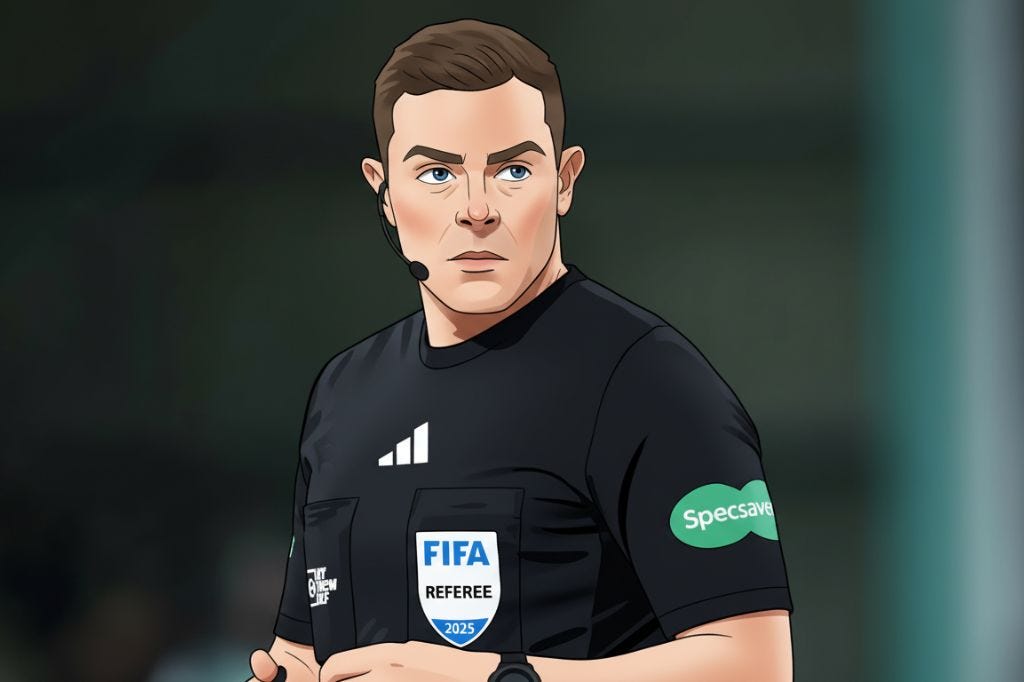
For decades, both sides of the Glasgow divide have claimed that the man in the middle has favoured their rivals. Some Celtic fans even went as a far as shooting a documentary called ‘Anyone But Celtic’ - based off the book written by Paul Larkin - to highlight what they have perceived as refereeing bias and even claims of corruption.
Referees have been condemned for decades over what the fans perceived as controversial penalty decisions against them, ruling perfectly good goals offside, and even denying clear cut penalties - and fuel is poured onto the fire when you have former Celtic players like Alan Stubbs coming out claiming that former referee Jim McCluskey told him that as long as he was referee, Celtic would never be awarded a penalty at Ibrox on his watch. Another whistler, Bobby Tait, was accused by a former colleague, Jim McGilvray, of specially requesting to be the referee at Ibrox for his last season as referee in May 1998 - that was duly delivered, but sadly for the self-confessed Rangers fan, Rangers lost the game 1-0 to Kilmarnock, which ultimately damaged Rangers’ hopes of winning ten in a row.
Then there was the greatest ever refereeing performance for Rangers by Mike McCurry against Dundee United back in 2008 - which United manager Craig Levein fired broadside after broadside at in his post-match comments. And don’t forget Hugh Dallas, his nepo baby Andrew Dallas, and Dougie McDonald who was outed by a fellow official for lying over why he overturned a decision against Celtic. This list is endless - but is it anti-Celtic, pro-Rangers bias or are our referees just incompetent and shit at their jobs?
Even with the introduction of VAR, inconsistencies and dodgy decisions remain, while former referees make their money doing after-dinner speaking tours around the lodges and Rangers supporters clubs - I have yet to see one former referee attend a Celtic fan event, but they are regulars at Rangers, why is that?
John Beaton in the firing line
Now John Beaton is the latest Scottish referee in the firing line, being accused simultaneously of being pro-Rangers and pro-Celtic. A paradox that says as much about the football culture in Glasgow as it does about his refereeing abilities. Over more than a decade at the top level, Beaton’s calls in top tier fixtures have created a narrative on both sides of the Glasgow divide that he cannot be trusted, even when old interviews with him as a schoolboy surfaced where he declared his support for Rangers - further proving to Celtic fans that he is anti-Celtic.
On top of his own declaration of allegiances, something that referees in Scotland are not forced to do unlike their English counterparts, the perception of bias from the Celtic support has further been fuelled by a series of high-profile incidents in which it’s believed that Beaton either ducked major decisions or applied the laws of the game unevenly. From allowing robust off-the-ball challenges to go unpunished in derbies, to the recent game against Motherwell where Celtic required VAR to intervene to award a penalty that seemed obvious to most observers, with Beaton perfectly positioned to see the incident in its entirety. Celtic fans see a pattern of behaviour that makes him reluctant or clearly deny making the big calls in their favour. Commentators and ex-referees have highlighted further episodes where Beaton initially waved play on before being corrected by VAR, reinforcing an image of a referee who only awards Celtic crucial decisions when technology forces his hand. For many Celtic supporters, the overall picture is not of simple incompetence, but of an official whose instinct is to go against them in moments that matter most.
On the other side of the city, Rangers fans highlight their own catalogue of grievances and insist that Beaton is pro-Celtic - despite him being a Rangers fan and drinks in a Rangers pub The Crown Bar in Bellshill. Recent derbies and cup ties have produced decisions and non-decisions that Ibrox supporters view as clear evidence of a referee who is too quick to penalise them, too lenient on Celtic, or too easily influenced by the occasion. Incidents in which potential penalties for Rangers have not been given, or where Beaton’s management of key moments has been heavily criticised by pundits, have been seized upon to argue that he is anything but sympathetic to their cause. When former officials publicly question his handling of Rangers’ appeals in high-profile matches, it only hardens the feeling among Rangers fans that Beaton is another referee they must beat as well as the opposition.
The toxicity surrounding Beaton’s performances has, at times, spilled well beyond the pitch and into the realm of personal safety. After one derby match, he reported threatening messages to Police Scotland, prompting a public statement and an investigation into the abuse he received. During the game, Rangers striker Alfredo Morelos avoided a booking after stamping on Celtic defender Anthony Ralston, he then slapped Ryan Christie in the face, before kicking Celtic skipper Scott Brown in the 1-0 win for the Ibrox side.
Celtic were angered by Beaton’s handling of that game they demanded a direct meeting with the SFA hierarchy, questioning not only specific decisions but the broader disciplinary framework that protected his on-field calls from retrospective action.
So let’s strip away all the emotion, and let his statistical record do the talking.
John Beaton’s refereeing stats
In Celtic matches officiated by Beaton, he has taken charge of 46 games in total pre-VAR, during which Celtic have won 36, drawn 7 and lost 3. Across those fixtures he has awarded Celtic 10 penalties, shown them 68 yellow cards and 2 red cards, while their opponents in the same games have received 3 penalties, 92 yellow cards and 1 red cards. In Rangers matches pre-VAR, Beaton has overseen 36 games, with Rangers winning 25, drawing 5 and losing 6 under his control. Over that sample he has awarded Rangers 9 penalties, issued them 56 yellow cards and 1 red card, and given their opponents 1 penalty, 101 yellow cards and 6 red cards.
In Celtic matches officiated by Beaton, he has taken charge of 19 games in total after VAR was introduced, during which Celtic have won 13, drawn 5 and lost 1. Across those fixtures he has awarded Celtic 5 penalties, shown them 36 yellow cards and 1 red cards, while their opponents in the same games have received 2 penalties, 42 yellow cards and 1 red card. In Rangers matches post-VAR, Beaton has overseen 17 games, with Rangers winning 11, drawing 3 and losing 3 under his control. Over that sample he has awarded Rangers 3 penalties, issued them 40 yellow cards and 0 red card, and given their opponents 3 penalties, 47 yellow cards and 0 red cards.
These stats don’t include penalties awarded but were either saved or scored from the rebound. Stats are across all competitions.
When those numbers are broken down further into Glasgow derbies alone, Beaton has refereed 9 meetings between Celtic and Rangers, in which Celtic have recorded 3 wins, 4 draws and 2 defeats, and Rangers have registered 2 wins, 4 draws and 3 defeats. Within those derbies specifically, he has awarded Celtic 3 penalties and Rangers 2 penalties, while producing a total of 23 yellow cards and 0 red cards for Celtic players and 25 yellow cards and 0 red cards for Rangers players.
Make of that what you will.
VAR pouring fuel onto the fire
The arrival of VAR was supposed to reduce noise around dodgy decisions and getting the decisions correct, but when it comes to those manning the system it has only amplified controversies of all clubs not just the big two.
When he initially refused to award Celtic a penalty only for the decision to be overturned after a video review, critics argued that technology had exposed Beaton’s instinctive reluctance to award Celtic big calls. Conversely, where VAR has not intervened on contentious challenges involving Rangers players, or when Beaton’s original decision has stood after review, Rangers supporters have claimed that the system merely entrenches on-field bias instead of correcting it. The net effect is that Beaton’s name now evokes not just arguments about individual incidents but broader questions about how Scottish referees are selected, trained and assessed for the most emotionally charged fixtures in the Scottish domestic calendar.
If anything unites both halves of Glasgow, it is a deep mistrust of referees abilities to call their games fairly, even if they disagree entirely on which side they supposedly favour. Every borderline foul, every penalty appeal, every yellow card and every VAR check in a match becomes another data point for supporters determined to prove their case, regardless of the wider context or the reality that refereeing is an imperfect craft.
Whether the numbers truly demonstrate a consistent lean towards Rangers, towards Celtic, or simply towards human inconsistency, they will continue to be read through green-and-white and blue-tinted lenses.
In that sense, the story is not just about refereeing decisions, but about how Glasgow’s tribalism can turn any whistle into a symbol of bias the moment it is blown.
It's not all about yellows, reds or penalty alone, IMO it's the timing of those actions and disruptions pulled up.
Refs can, say, dish out 3 cards to Celtic players early which handicaps the team for the rest of the match, as the game nears it's end the ref can then even up the yellows for opponents to attempt to prove neutrality in the stats. They can also pull up fouls, let others go as and when he likes, we've seen that plenty of games from many hun meaning officials.
If they want to officiate then their affiliations should be made public, they can then be disproved if and when suspicions arrive.
Does anyone really think the huns would NOT have got an immediate penalty if their player were hauled down like Maeda.
There are far too many "honest mistakes", if it isn't bias then it's incompetence which should see them demoted down a division or two until they can show their competency or otherwise.
John Beaton has always been Anti Celtic in my opinion. You only have to look at his dubious track record, which you have expertly highlighted Andy, that he only awards penalties and decisions towards Celtic, when he is forced to by technology and VAR.
Case in point, on Saturday, he is standing about 12 feet away from the Maeda penalty incident, and he had a clear and unrestricted view of the Motherwell player hauling Maeda to the ground, yet did not award a penalty, he had to be forced to go and look at the monitor by VAR, and he took an agonising twenty seconds to make up his mind on the penalty, when everybody in the ground could see it was a stonewall penalty. He did the same at Ibrox a few weeks ago with the Sterling penalty incident.