

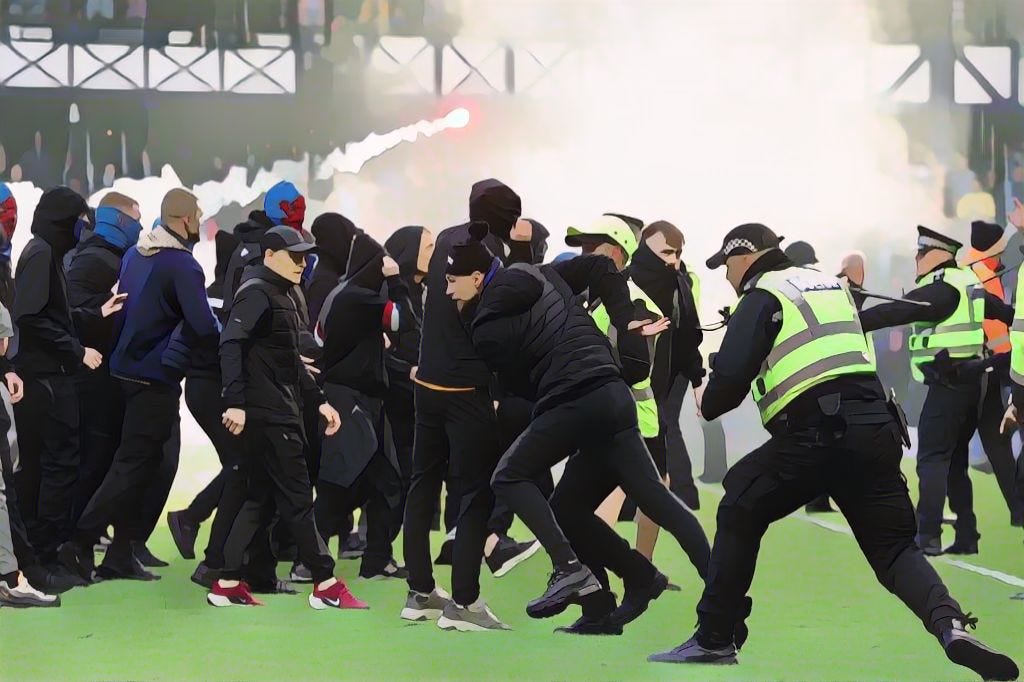
Celtic’s penalty shootout win at Ibrox should have been remembered for the tension, the drama, and the ruthless composure from the spot; instead, it will go down as another dark chapter in Rangers’ long and shameful record of hooliganism. What began as a spontaneous outpouring of joy from the 7,500-strong away support at the Broomloan End was met, not with begrudging acceptance of defeat, but with a surge of rage from the home side as hundreds of Rangers fans, fronted by the Union Bears, poured onto the pitch and charged toward Celtic fans. Missiles, bottles, coins, and pyrotechnics were launched in the direction of celebrating supporters and players, a Celtic staff member was assaulted, several Celtic players were nearly set upon, stewards and police officers and even a 10-year-old child were struck amid the chaos. Yet within hours, the usual cast of politicians and compliant pundits were hard at work muddying the waters, insisting on a predictable, both-sides narrative that equated jubilant Celtic fans with violent Rangers supporters who once again turned a football match into a public order incident.
What happened at Ibrox?
Police Scotland have already described the scenes as “disgraceful,” with nine arrests confirmed after fans from both clubs ended up on the pitch, but the context matters. Celtic’s pitch incursion came in the immediate aftermath of a high-stakes shootout win, a familiar modern flashpoint where emotion spills over the advertising boards for a few chaotic, usually harmless minutes. The Rangers response, however, was not celebratory but confrontational as home fans streamed on from behind the goals and other areas of the ground to confront the away support, trying to attack them, forcing police and stewards into a frantic line across the pitch as flares and other projectiles flew towards the Celtic end. In the melee, a member of Celtic’s coaching staff was attacked, Mexico international Julian Araujo was targeted by supporters who tried to kick and shove him, and officers and stewards sustained injuries, alongside a child hit by a coin. This was not passion overspilling; it was aggression unleashed.
The images out of Ibrox are depressingly familiar, a Rangers crowd unable to process defeat without trying to intimidate or injure the people who inflicted it. Tomas Cvancara, the match-winner in the shootout, gave his post-match interview with visible blood on his shirt, a stark symbol of how quickly Celtic’s moment of triumph was poisoned by those who cannot accept being second best. Once again, what should have been a showcase for Scottish football, watched around the world, became a montage of flares, fights, and fans charging at opposition players. And once again, the institutional response has been mealy-mouthed, focused on generic condemnations and “questions” over away allocations rather than a serious reckoning with the pattern of behaviour emanating from the blue end of this rivalry.
Pitch invasions are not all the same
It is essential to separate what happened at Ibrox from the broader culture of pitch invasions that has grown in England and Scotland over the past decade. Pitch incursions have become an almost predictable staple of modern football when a club survives relegation, wins promotion, or pulls off a season-defining result. Thousands of Everton fans famously swarmed the Goodison Park turf after securing survival against Crystal Palace in 2022, creating emotional scenes that drew more criticism for the odd confrontational incident than for any large-scale violence. The club was hammered with hefty fines - around £300,000 in total - for those celebratory invasions, and the governing bodies repeatedly used them as exhibits in their stern warnings about protecting the sanctity of the pitch.
Elsewhere in England, we have seen Manchester City supporters flood the Etihad pitch after title wins, Nottingham Forest fans pour onto the grass after play-off triumphs, and countless lower-league invasions when promotion or survival is sealed. These scenes are not risk-free; players have been confronted, goaded, and, in some cases, assaulted, and there is a legitimate conversation to be had about keeping footballers safe. But there is a clear distinction between a crowd surging onto the pitch primarily to embrace their own players and celebrate, and a mob charging three quarters of the way across the turf with the intent of confronting and attacking opposition fans and staff. What happened at Ibrox was not a spontaneous party gone too far; it was a hostile reaction to defeat and their team bottling it once again, escalating into missile-throwing and targeted attacks.
In Scotland, too, the history of pitch invasions is chequered. The 1980 Scottish Cup final between Celtic and Rangers at Hampden, where rival fans brawled on the pitch after extra-time, directly led to alcohol being banned from grounds for decades. More recently, Hibernian’s Scottish Cup win over Rangers in 2016 produced violence between both sets of supporters. But it is telling that when politicians and pundits reach for examples, they lean on these isolated flashpoints to argue that all pitch incursions are equally pathological, rather than asking why one club seems to feature so heavily in the roll of dishonour when it comes to serious disorder.
Rangers’ long record of riots
The events at Ibrox fit into a much longer and darker pattern. The most infamous example remains the 2008 UEFA Cup final riots in Manchester, when an estimated 125,000 Rangers fans descended on the city and a failure of a big screen transmission tipped an already volatile situation into open mayhem. Thousands of supporters were involved in disorder, barriers were torn down, sales units were overrun, and people were seen jumping on roofs and urinating in public spaces, while police described the scenes as the worst destruction Manchester had seen “since the Blitz.” Thirty-nine officers were injured amid sustained violence against the police, and the city was left counting the cost of a night that turned a European final into a battlefield.
That night was no aberration. Rangers’ support has been linked with repeated episodes of large-scale disorder and violence, both domestically and in Europe, often wrapped up with the club’s well-documented issues around sectarian singing and bigotry. These are not the odd idiot letting down the many; they are recurrent flashpoints that follow Rangers around the continent, from UEFA sanctions over songs to crowd trouble that requires heavy policing wherever they go. When you add in domestic flashpoints - from seats and facilities ripped up and damaged at venues across Scotland to running battles with police and opposition fans - it becomes impossible to maintain the fiction that all clubs are equally culpable. The Ibrox pitch invasion in 2026 is simply the latest entry in a long, ugly ledger.
Targeting Celtic players and staff
Within that pattern, one particularly sickening thread is the repeated targeting of Celtic players and staff at Ibrox. This is not about mutual animosity or “Old Firm passion”; it is about one set of supporters who too often see opposition personnel as legitimate targets for coins, bottles, and physical attacks. In April 2022, the second half of an Old Firm game at Ibrox was delayed because a glass bottle was hurled into Joe Hart’s goalmouth, shattering across his penalty area and forcing stewards to pick shards of glass off the turf. On the way to the dressing rooms that day, a Celtic backroom staff member was struck by another bottle from the Ibrox crowd, sustaining a head wound that required stitches and prompting an official Celtic statement and a police investigation.
That incident sits alongside a growing catalogue of missiles aimed at Celtic personnel at Ibrox, coins hitting players, bottles aimed at the away end, objects thrown toward the dugout. Former Celtic assistant John Kennedy was struck by items launched at the technical area, forcing the club to raise “serious concerns” with Rangers over their inability or unwillingness to protect opposition staff. Compilations now exist documenting bottles and missiles thrown at Celtic players, fans, and staff inside Ibrox over multiple fixtures, to the point where each fixture feels like a test of whether the host club can get through 90 minutes without someone in green and white ending up bruised or bloodied.
Seen through that lens, what happened after the penalty shootout in 2026 is not an isolated flare-up but a continuation of the same story. A Celtic coach attacked amid the chaos, players confronted and kicked at by onrushing Rangers supporters, and objects raining down from the stands as police struggle to restore order: this is the environment Celtic are asked to operate in, supposedly under the protection of the Scottish football authorities. It is not good enough to describe this as “unsavoury scenes”, and move on.
Media deflection and what must change
Perhaps the most galling part of the Ibrox fallout is the speed with which the Scottish mainstream media and certain politicians rushed to dilute Rangers’ responsibility by framing the whole episode as just another example of “Old Firm chaos.” Reports leaned heavily on the fact that some Celtic fans initially breached the pitch to celebrate, as though exuberant supporters spilling onto the grass is remotely comparable to charging rival fans, throwing bottles, and assaulting staff. Politicians and pundits who are usually quick to moralise about fan behaviour suddenly discovered nuance and symmetry, eager to avoid saying plainly what anyone watching could see - that the real danger came from one side and one side only.
This both-sides-ism is not just cowardly; it is dangerous. It reinforces a narrative in which Celtic and Rangers are equally to blame for any and all disorder attached to their meetings, no matter the facts of each incident. It creates political cover for doing nothing meaningful about the recurring pattern at Ibrox and among Rangers’ support, because any attempt to act can be framed as “anti-Rangers bias” rather than a necessary response to a chronic problem. And it tells Celtic supporters, who have now seen their players, staff, and fellow fans repeatedly targeted at this ground, that their safety is less important than the comfort of those who would rather not upset a volatile constituency.
If Scottish football is serious about tackling disorder, it needs to stop pretending that all pitch invasions are created equal and start dealing with the specific, recurring issues staring it in the face. That means bans and meaningful sanctions for Rangers supporters identified in the Ibrox chaos, serious questioning of why pyros, missiles and bottles continue to find their way onto the pitch from the same sections, and a willingness from broadcasters and politicians to stop hiding behind lazy equivalence. Celtic’s win should have been remembered for nerve and resilience; instead it has become another reminder that until the culture around Rangers is confronted head-on, Scottish football will keep returning to the same grim, blood-stained script.
A club that puts out orange away or keeper kits is only going to lean one way. Scum.
Hi Andy
Congratulations on another highly prescient article.
M own take...I see a highly volatile and unstable set of elements which have brought this to the inevitable billing point ;
....a completely unmerited sense of supremacist entitlement:
-many years of being starved of the success they "naturally" deserve:
-a collective and very angry humour by-pass which simply cannot deal with opposing fan ridicule and banter:
-A disturbing culture of easily-led and impressionable teens cos-playinh at being a sub-paramilitary unit:
..and lashings of cheap cocaine and MDA (allegedly)
What could possibly go wrong?
By the way, a few of these last few elements could equally be applied to our own fan base - we mustn't be blind to that and they shouldn't get a pass - that disgusting graffiti in particular crossed a red line and should have been self-policed.