

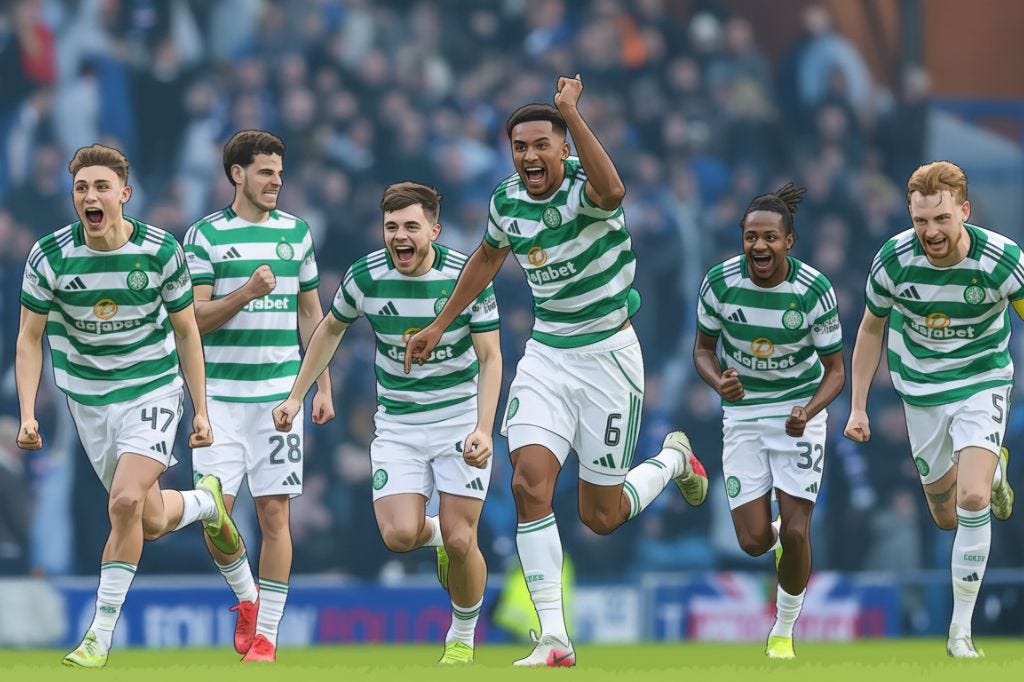
Rangers came into this tie with the usual Ibrox bluster pre-match, but it was Celtic who walked out with a Scottish Cup semi‑final place after a 4–2 penalty shoot‑out win following a goalless 120 minutes. This was the first time since 2018 that Celtic had the full Broomloan Stand, around 7,500 away tickets, and you could feel and hear that pocket of green and white noise all afternoon in a stadium full of rival fans desperate to see them fail.
On the pitch, it wasn’t pretty from a Celtic perspective, but it was deeply satisfying. Rangers had more of the ball, more efforts, and more territory, yet did precious little with it when it really mattered. They racked up more than twenty attempts, but between wayward finishing, heroic blocks, and a Celtic side that refused to buckle, the hosts never turned pressure into composed finishes.
Rangers had an early penalty shout when a shot struck Austin Trusty’s arm in the box, but VAR ruled that no offence was committed as the defender’s arm was tucked close to the body and did not constitute a penalty - despite the howls of derision from the terracing and the Rangers players.
Celtic thought they’d grabbed a precious opener when Daizen Maeda buried a diving header past Rangers keeper Jack Butland, only for VAR to chalk it off for offside in the build‑up - despite replays showing that Nasser Djiga’s shoulder looked to have kept Liam Scales onside in the run-up to the goal.
Rangers did have the ball in the net from a corner during Extra Time, but a blatant handball from Emmanuel Fernandez meant that effort was rightly ruled out.
Celtic fans had to accept that the game was going to be a grind rather than a flowing performance. Rangers tried to bully them, hit long diagonals, and play the territory game, but Viljami Sinisalo and his thin green line of defence stood firm, dealing with crosses and second balls with an assured performance that contrasted sharply with the panic in the Ibrox stands that followed.
In pure footballing terms, a 0–0 felt about right - one team huffing and puffing without the quality to blow the door down, the other managing the game defensively hoping for their moment to strike.
That moment came from 12 yards as Celtic’s mental game trumped the home side from the spot. Celtic have learned that the hard way in past years, but at Ibrox this time they showed the kind of steel you need in a hostile environment.
The shoot‑out immediately tilted Celtic’s way with Rangers captain James Tavernier smashing his kick off the crossbar, a miss that visibly rattled the home support and seemed to drain belief from his own players, with Rangers substitute Djeidi Gassama compounded the collapse by missing the target entirely, a wild effort that summed up their lack of composure under pressure.
Celtic, by contrast, were ruthless. They converted four of their penalties with a steely authority that silenced the bigoted and sectarian taunts from three sides of the ground. Celtic striker Tomas Cvancara, stepped up to bury the decisive kick, sparking bedlam in the Free Broomloan Stand as thousands of Celtic supporters celebrated watching their side knock Rangers out of the Scottish Cup on their home patch.
A Rangers side that claimed home advantage, bigger transfer spend this season, and supposedly superior squad - if you believed all the hype from the usual suspects - had just been sent packing by a Celtic team that hadn’t managed a single shot on target in 120 minutes, missing five first team players through injury, and yet held their nerve when it mattered most. That psychological blow alone will linger long after the replays of the match and sees Danny Rohl’s side with just three wins out of the last nine games in all competitions.
But while Celtic’s players and fans deserved to savour that moment, what followed turned a night of football triumph into yet another indictment of Rangers and their support.
As Celtic fans from the Free Broomloan Stand spilled onto the pitch to celebrate with the players – taking photos, videos and basking in their triumph at Ibrox – Rangers fans chose a different script.
Dozens, then hundreds, of Rangers supporters surged from the stands and onto the pitch, many from the Union Bears section, turning a moment of sporting celebration into a flashpoint. Missiles and pyros were thrown in the direction of the Celtic support and players, with Police Scotland and stewards belatedly moving in to form a human barrier between the two sets of fans.
At least one Rangers fan was arrested after attacking a member of Celtic’s back‑room staff amid the chaos, underlining that this wasn’t just posturing or gesturing – it was physical aggression against club employees doing their jobs. While Celtic players tried to usher their own supporters back towards the stand and made their own way down the tunnel to safety, the Rangers end produced the predictable cocktail of fury, flares and flying objects, unable to handle the sight of the away end enjoying their victory.
Stewards and police were slow to react, and only when the situation visibly escalated did a serious line of protection appear between Rangers fans and the celebrating Celtic contingent. By that point, the image was already seared into memory - a wall of police and stewards separating Celtic fans and players from Rangers supporters who had chosen violence over dignity in defeat.
For all the noise about “standards”, “class” and “respect” that comes out of Ibrox whenever it suits them, once again we saw what happens there when the result goes against them on a big occasion.
If this was a one‑off, you could chalk it up to emotions running high. It isn’t. What we saw at Ibrox in this Scottish Cup tie was part of a long and ugly pattern of behaviour whenever Rangers lose a big game.
The scenes were immediately reminiscent of the 2016 Scottish Cup Final, when Rangers lost to Hibernian at Hampden and Rangers fans responded to Hibs’ celebrations by spilling onto the pitch and clashing with opposition supporters. That afternoon was widely condemned across Scottish football, and yet here we are again a decade later, watching another Rangers support decide that if they can’t win the match, they’ll resort to hooliganism.
Go back further to the infamous 1980 Scottish Cup Final, when Celtic’s victory over Rangers at Hampden descended into a full‑scale riot after Rangers fans stormed the pitch and clashed with celebrating Celtic supporters. That afternoon led to an alcohol ban in Scottish football grounds and has hung over the fixture’s reputation ever since.
The constant in all of this is glaring. When Rangers suffer a high‑stakes defeat whether it’s Hibs lifting a trophy at their expense, Celtic celebrating a cup win, or now a penalty shoot‑out humiliation at Ibrox – too many of their fans cannot simply accept the result and leave. They must turn losing into violence, rage, and confrontation. The “hard men” culture that surrounds sections of that support doesn’t melt away, it manifests exactly as we saw this afternoon in pyros, missiles, and attempted attacks on Celtic staff and fans.
For a club that constantly tries to position itself as unfairly maligned, the recurring pattern of behaviour from its own support in moments of defeat is impossible to ignore.
That brings us to another uncomfortable truth for the Ibrox hierarchy, they cannot keep pretending they are powerless passengers in all this. Their chairman, Andrew Cavanagh, sat in the directors’ box and watched his club’s ultras fan group lead a charge towards Celtic fans and staff in the immediate aftermath of a defeat that was, in football terms, entirely fair. He has been happy enough to bask in the atmosphere the Union Bears create when they are roaring the team on; now he must confront the darker side of that same group.
Cavanagh and his board have a choice. They can continue to ignore, indulge, or half‑condemn the Union Bears while doing nothing substantive, or they can finally take serious action – banning, relocating or dissolving that section before their behaviour leads to someone being seriously injured or killed. When you have fans attacking opposition staff and hurling flares and missiles at a mixed group of players and supporters, you are not far from tragedy.
From a Celtic perspective, the priority is that our players, staff and supporters can go to away grounds – including Ibrox – without being treated as fair game when we have the audacity to celebrate a victory. The images from this tie showed Celtic fans and players sharing a rare, brilliant moment in front of a packed away end, only for that to be overshadowed by Rangers fans trying to turn the pitch into a battleground.
The Scottish media have already tried to paint this as fans on both sides resorting to violence - but it is clear to see for anyone watching the scenes unfold that Celtic fans were celebrating not resorting to violence, unlike the Rangers support. There were no clashes, just Rangers fans throwing missiles, pyros, and fireworks at jubilant Celtic supporters and anyone labelling it or reporting it as ‘fans of both sides’ should be called out for their lies. We have games up and down the country that see fans invade the pitch to celebrate - that doesn’t descend into violence from the defeated side’s supporters - and those scenes are celebrated by the media.
This is not about point‑scoring; it is about basic safety and standards. Rangers have now presided over yet another episode where their support’s response to defeat is aggression, and it is long past time for the Scottish FA and their own directors to say that this is unacceptable, not just in statements, but in punishments and reforms that actually bite.
Celtic did their talking where it matters most, on the park and from the spot. Rangers and their followers answered that with fury, pitch invasions and attacks. That contrast tells you more about the two clubs than any slogan or PR campaign ever will. The Scottish game now has a choice: either confront the problem at Ibrox head‑on, or wait for the next “unthinkable” incident that, if history is any guide, is sadly all too predictable.
this is all the fault of Celtic FC due to the fact of winning a penalty shoot out!!
Rangers fans have always been bad news when they lose. As has been already stated, there is many episodes in the past of Ranger's fans invading pitches and wrecking whatever gets in their way, when the result goes against them. They did it with Hibs in the Cup Final, against Celtic several times, and they have continually shamed Scotland in European matches abroad. Time to call it what it is. It's a Ranger's problem.