

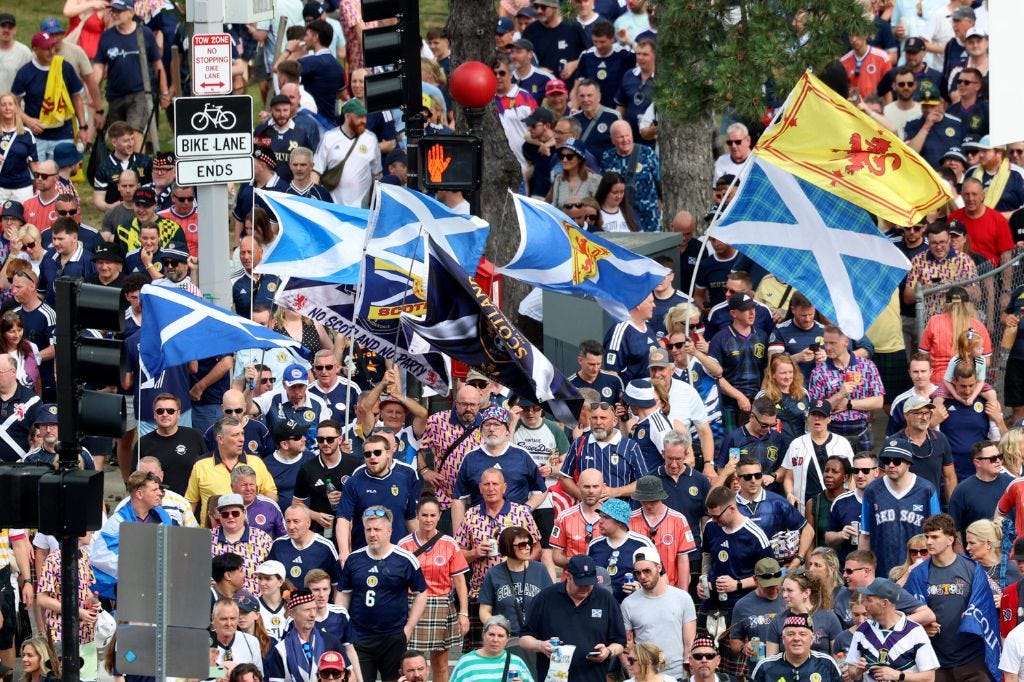
There is something quite remarkable about the way Scotland turns up to a tournament. Not in a footballing sense, we know the limitations, we’ve lived them, we’ve laughed at them often enough ourselves - but in the way a nation carries itself when it crosses borders with little more than hope, humour, and a battered sense of optimism.
The 2026 World Cup in the United States was always going to be an unusual stage with the vast distances, unfamiliar cities, and a commercial sheen that often strip tournaments of their soul. And yet, somehow, the Tartan Army have managed to drag that soul across the Atlantic with them. They always do. Wherever they go.
From the streets and bars of Boston, there is already a familiar story taking hold. Kilts in the heat. Bagpipes where there probably shouldn’t be bagpipes. Songs that veer from heartfelt to utterly ridiculous within the same verse. And, most importantly, a sense that Scotland supporters are not just attending the tournament, they are adding to the spectacle of it. They are bringing the World Cup to Boston proper.
This has been the defining feature of the Tartan Army for decades. They are not tourists, and they are not simply consumers of football. They are participants in a travelling carnival, one that has consistently earned admiration from locals, rival fans, and even the authorities tasked with keeping order. It is no accident that Scotland supporters have repeatedly been recognised for their conduct at major tournaments. That reputation was not manufactured by PR teams; it was built pint by pint, song by song, interaction by interaction. And, in the sprawling theatre of the United States, that reputation is not only intact but thriving, growing bigger than ever before.
You can see it in the small details. American bar staff posting videos of Scottish fans teaching them chants. Local businesses leaning into the influx rather than boarding up in anticipation. Police officers posing for photos and doing keepy-uppies rather than bracing for confrontation and violence. There is a lightness to it, a sense that football for all its tribalism, can still be a force for connection rather than division.
Of course, none of this guarantees success on the pitch. Scotland may yet flatter to deceive, they may yet fall short of the knockout stages, may yet provide the usual cocktail of frustration and gallows humour. But that has never been the point.
The Tartan Army’s greatest strength is that it decouples identity from results. Supporting Scotland is not contingent on winning; it is an expression of belonging. It is about showing up, regardless of the outcome, and doing so in a way that reflects something deeper than the scoreboard.
Which makes the contrast with England’s travelling support all the more stark and, frankly, all the more predictable.
Because while Scotland fans have been busy turning Boston into a temporary outpost of good-natured chaos, early reports from Dallas tell a depressingly familiar story when it comes to England fans. It begins, as it so often does, with isolated incidents dismissed as anomalies. A scuffle here. A pub cleared there. Property damaged, tempers frayed, police forced to intervene.
But patterns have a way of revealing themselves quickly.
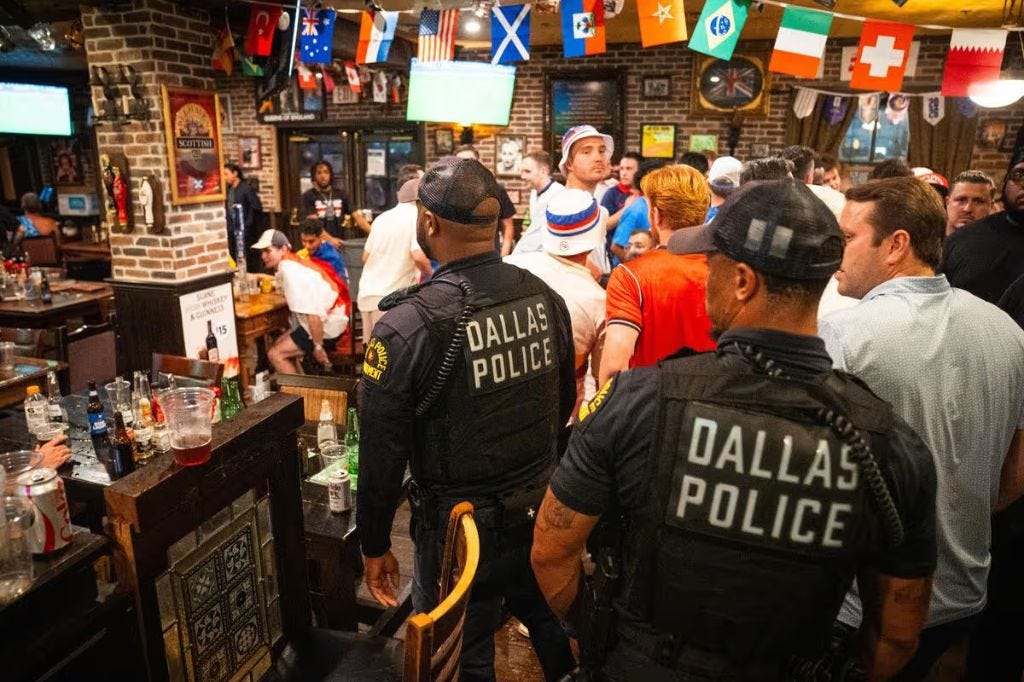
In Dallas, reports of England supporters being ejected from bars following damage to property and surrounding areas have already started to filter through. Landscaping ripped up, furniture broken, tensions escalating to the point where intervention became unavoidable. It is not yet wall-to-wall coverage, but the drip feed has begun. And anyone who has watched England at major tournaments over the past three decades knows exactly how this script tends to unfold.
First comes the minimisation. A few bad apples. Overzealous policing. Media exaggeration. Then, inevitably, comes the footage.
The chants, too, are starting to surface. Not the clever, self-aware humour that characterises Scotland’s travelling support, but something more sickening. More hostile. The kind of bile that feels less like support for a team and more like an assertion of dominance over others. It is football stripped back to its ugliest impulses - exclusionary, aggressive, and, at times, deeply uncomfortable.
It would be easy to paint this as a simple morality tale. Scotland good, England bad. One set of fans embodying everything that is right about the game, the other representing its worst excesses. But reality is, as ever, more complicated.
England, too, has countless supporters who travel in good faith. Families, lifelong fans, people who simply want to experience a World Cup and back their team. To reduce them all to the actions of the worst among them would be both unfair and inaccurate.
And yet, the uncomfortable truth is that these incidents are not new. They are not isolated in any meaningful sense. They are part of a recurring pattern that continues to re-emerge, tournament after tournament, despite repeated attempts to distance the modern England fan from the hooligan element.
That is the real issue here - not that trouble occurs, but that it keeps occurring in ways that feel eerily familiar.
By contrast, Scotland’s consistency lies not in results but in behaviour. There is a cultural expectation baked into the Tartan Army - you represent the country, and you do so with a degree of self-awareness. You sing, you drink, you celebrate, but you do not cross the line into destruction or intimidation. And when you do, as inevitably happens in any large gathering, it is treated as a breach of identity, not an inevitable by-product of it.
That distinction matters.
It speaks to something broader than football, something that touches on how each nation sees itself and wishes to be seen. Scotland, particularly in recent years, has leaned into a softer projection of identity - open, self-deprecating, outward-looking. The Tartan Army is, in many ways, an extension of that.
England, by contrast, continues to wrestle with competing narratives. A modern, diverse nation on one hand; a lingering attachment to older, more aggressive forms of expression on the other. Most of the time, those tensions coexist without issue. But tournaments have a way of amplifying them, of bringing underlying currents to the surface. And that is what we are beginning to see again in the United States.
It is early, of course. The tournament has barely settled into its rhythm. There is still time for narratives to shift, for perceptions to change, for both sets of supporters to redefine how they are viewed. But first impressions matter.
Right now, Scotland fans are once again writing a story that transcends results. They are reminding the world, that football can still be joyful, communal, and disarmingly human. That you can travel in huge numbers, drink in unfamiliar cities [even to excess], and leave behind not a trail of damage but a collection of memories that others are glad you created.
England, meanwhile, stand at a familiar crossroads. They can point rightly to the many supporters who behave impeccably. They can highlight positive interactions, and the sheer scale of their travelling fanbase as a mitigating factor. All of that is true. But it will not drown out the images if they continue to emerge.
Because the harsh reality of modern tournaments is that perception travels faster than context. A single video of disorder will circulate more widely than a thousand quiet pints shared without incident. And once that narrative takes hold, it becomes incredibly difficult to shift.
This is where the comparison with Scotland becomes particularly uncomfortable. Because while Scotland fans are not perfect, no group of this size ever is, their dominant narrative is overwhelmingly positive. It is reinforced year after year, tournament after tournament, to the point where it has become part of football’s folklore. When Scotland qualify, the expectation is not success on the pitch, but success in the stands. And they deliver.
If England are to change their own narrative, it will require more than statements and condemnations. It will require a cultural shift that is sustained over time, one that redefines what it means to follow the national team abroad. That is not an easy task, and it is certainly not one that can be completed within a single tournament. For now, the contrast remains.
Scotland, whether they progress or not, will leave the United States having added another chapter to their unique legacy. They will go home with stories, friendships, and the satisfaction of having represented themselves and their country in a way that resonates far beyond football.
England, unless something changes, risk leaving with questions that feel all too familiar. And as the tournament unfolds, those questions will only grow louder if the early signs prove to be more than just a blip. Because the mask, once it starts to slip, rarely stops halfway.
A bit of historical context would help here Andy. Scottish hooliganism was a very real thing in the sixties and seventies. It seems that while English carried on causing havoc around Europe, the Scots realised that the same nationalistic culture was better served up as humour rather than aggression. There are less of you and it’s easier to create that narrative. English nationalism never had the same trajectory. In recent tournaments, even if there wasn’t violence, you just wouldn’t want to be around English fans and I fear that Reform UK and the vile Restore whatever their name is, are manifestations of a nationalism that has always bubbled under the surface but which has now been unleashed again thanks to Brexit.
I take it you dont read any of my articles Alan, because I dont skirt around any Glasgow derby and the scenes that unfolded after games etc. I highlight them, I call them out in fact. Have been doing it for 20 years.