

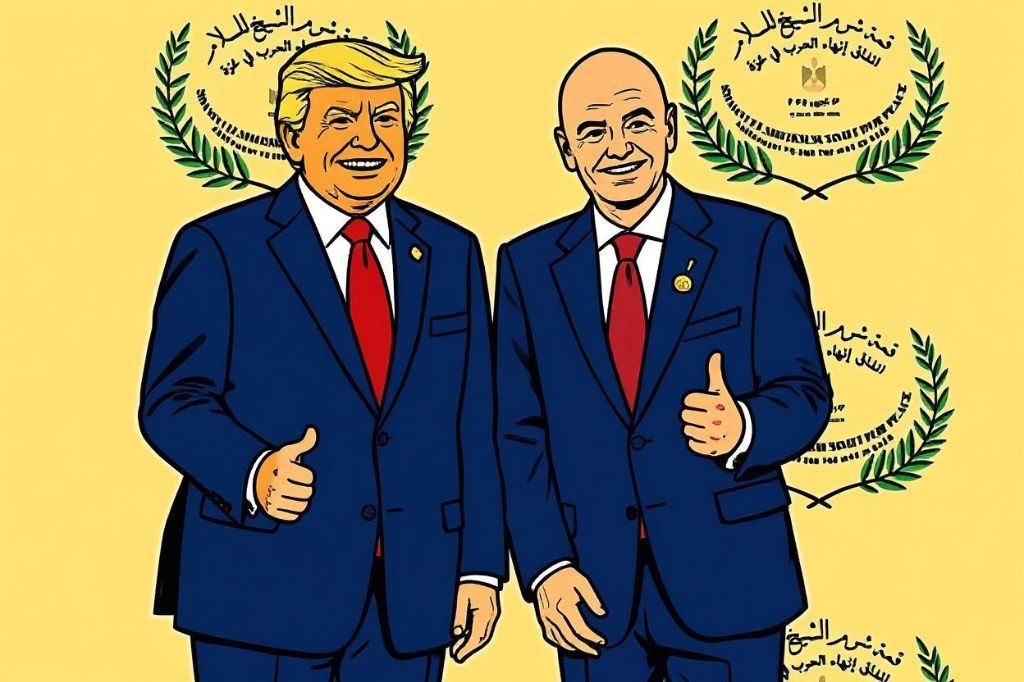
The 2026 FIFA World Cup, set to be hosted jointly by the United States, Canada, and Mexico, arrives at a moment of profound political unrest in North America. The tournament will unfold under a US administration that has openly declared its intention to use the event as a vehicle for political messaging, immigration enforcement, and international deal-making. This convergence of sport and authoritarian-adjacent governance echoes two of the most troubled episodes in modern sporting history: the 1936 Berlin Olympics, which the Nazi regime transformed into a global propaganda spectacle, and the 1978 World Cup in Argentina, where a military junta allegedly rigged the tournament to legitimise its brutal rule.
The parallels are not superficial. In each case, a sporting body desperate for legitimacy and revenue found itself accommodating a government that viewed the event not as a celebration of international fair play, but as a stage for projecting power, suppressing dissent, and extracting commercial advantage. The documented patterns of corruption, intimidation, and rule-bending around World Cup 2026 suggest that FIFA may be repeating the mistakes of its predecessors, placing the tournament’s integrity at risk.
The 1978 Template: How a Junta Captured a World Cup
Argentina’s 1978 World Cup remains the benchmark for state interference in football’s premier event. The military junta that seized power in 1976 faced international condemnation for mass disappearances, torture, and murder. The World Cup offered a chance to rebrand. General Jorge Rafael Videla dubbed it the “World Cup of Peace,” while his regime systematically used the tournament to project normalcy.
The most glaring abuse came in the semi-final against Peru. Argentina needed to win by four goals to reach the final over Brazil. They won 6-0 in a match that defied sporting logic. Peru had performed credibly throughout the tournament [including beating Scotland 2-0 in the group stages], yet collapsed utterly. Multiple investigations have pointed to a coordinated campaign: Argentine officials allegedly offered Peru $50 million and 35,000 tons of grain, delivered via decree after the tournament. Rear Admiral Carlos Alberto Lacoste, head of the World Cup organising committee, reportedly made direct contact with Peruvian officials. Former US Secretary of State Henry Kissinger, architect of Operation Condor, accompanied Videla to the Peruvian locker room before kick-off. The chilling detail is that the junta’s violence did not pause for sport - torturers at the ESMA detention centre watched the final with their prisoners, some of whom were driven through the streets to demonstrate that “nobody cared about them”.
FIFA’s role was one of acquiescence. The organisation scheduled Argentina’s match after Brazil’s, giving the hosts the precise target needed. It ignored pleas for simultaneous kick-offs, citing television revenue. This was not direct match-fixing by FIFA, but a structural decision that handed the junta a decisive advantage. The lesson is that when a host government is determined to manipulate outcomes, FIFA’s institutional weakness can become complicity.
The 1936 Precedent: When the Olympics Legitimised Nazism
The 1936 Berlin Olympics provide an even starker warning. The International Olympic Committee (IOC) awarded the Games to Germany in 1931, before the Nazi takeover. By 1933, Adolf Hitler was Chancellor. The regime immediately recognised the propaganda value. Joseph Goebbels, the propaganda minister, convinced Hitler that the Olympics would introduce the world to the “New Germany”. The regime removed anti-Jewish signs, toned down rhetoric, and presented a sanitised version of the “master race” to foreign journalists.
The IOC collaborated actively. Avery Brundage, president of the American Olympic Committee, fought ferociously against a US boycott, arguing that politics had no place in sport. He visited Germany, accepted Nazi assurances that Jewish athletes would be treated fairly, and dismissed evidence of persecution as “Jew-Nazi altercation”. The IOC was not naïve. Its German members included Carl Diem, a Nazi collaborator who organised the torch relay as a propaganda exercise, and Karl Ritter von Halt, an acknowledged Nazi supporter who remained on the IOC executive until 1963. The committee chose to believe Hitler’s promises rather than confront the regime.
The result was a spectacle that legitimised tyranny. The Games showcased German efficiency and Aryan athleticism, diverting attention from the Nuremberg Laws and the concentration camps. After the Olympics, the regime accelerated its persecution of Jews and launched its expansionist wars. The IOC had not just failed to uphold Olympic ideals - it had lent them to a genocidal regime.
Trump’s Second Term: Institutionalised Corruption and Transactional Governance
The Trump administration’s second term has escalated corruption to unprecedented levels. Citizens for Responsibility and Ethics in Washington (CREW), which catalogued nearly 4,000 conflicts of interest in Trump’s first term, reports that the current administration is “orders of magnitude” worse. Trump has refused to divest from his business empire, which now includes a publicly traded social media company, cryptocurrency ventures, and new international real estate projects. Foreign governments, corporations, and lobbyists can buy influence by spending at Trump properties, investing in his companies, or using his financial products.
This is not incidental corruption - it is systemic. Republican committees, foreign delegations, and corporate groups route events and spending to Trump properties at higher rates than ever before. The administration has dismantled ethics oversight mechanisms, allowing the presidency to function as a direct revenue engine. The Guardian frames it as “the looting of America,” where policy access is explicitly for sale.
This matters profoundly for the World Cup. A president who monetises his office and treats foreign policy as a series of transactions will inevitably view the tournament through the same lens. The 2026 World Cup is not just a sporting event - it is a $5 billion economic opportunity, a global media platform, and a lever for international deal-making. In Trump’s framework, every aspect of it is negotiable.
ICE as Political Police: The Threat to Fans and Players
The most immediate risk to the tournament’s integrity comes from immigration enforcement. The expanded FIFA Club World Cup 2025, hosted entirely in the US, has served as a dress rehearsal for intimidation. Before matches in Miami, ICE posted warnings that agents would be “suited and booted” at games and that attendees should carry proof of legal status. The agency later confirmed that ICE and Customs and Border Protection (CBP) would be present at venues to “support security,” while simultaneously telling non-citizens to carry documentation.
The intimidation is not hypothetical. Human Rights Watch documented a case where an asylum seeker attending the Club World Cup final with his children was questioned by local police, asked about immigration status, handed to ICE on site, and rapidly deported - despite initial assurances he would be cited and released. Many host cities have agreements that deputise local police as immigration agents, meaning any interaction with stadium security could trigger detention.
The threat extends beyond undocumented fans. The administration has made clear that legal immigration status is no guarantee of safety. Trump has threatened to move matches from “unsafe” cities - code for Democratic-run jurisdictions that resist his immigration policies. This creates a chilling effect on all foreign visitors, particularly from Latin America, the Middle East, and Africa, who may fear profiling or paperwork issues. For players, the risk is acute. A foreign national who speaks out against US policies could find their visa status suddenly scrutinised or even revoked. An opponent of the US national team who celebrates too provocatively could attract law enforcement attention. The architecture is in place for ICE to function as a political police force, suppressing dissent and opposition to the US National team on the field under the guise of immigration enforcement.
FIFA’s Eager Compliance: The Infantino-Trump Alliance
FIFA President Gianni Infantino has actively courted Trump, transforming the organisation into a de facto booster for the administration. Infantino has called Trump a “close friend” and praised his “valuable support” for the World Cup. He has visited the White House more than ten times since late 2024, appearing at events unrelated to football, including peace summits and foreign policy celebrations. FIFA has leased office space in Trump Tower in New York, a move critics see as symbolic deference.
The most blatant example of this alliance was the creation of a new FIFA “peace prize” that was awarded at the World Cup draw in Washington, D.C.. The prize was announced shortly after Trump failed to secure a Nobel Peace Prize he had openly courted. Infantino had publicly advocated that Trump deserved such recognition. When asked whether the inaugural award would go to “someone we saw earlier today” at a Miami business forum where Trump spoke, Infantino replied, “On December 5, you will find out,” heavily implying Trump was the intended recipient as we all suspect. The award was pushed through so quickly that many FIFA officials were caught by surprise, suggesting it was driven personally from the top by Infantino himself rather than through normal governance channels. And as we saw, Infantino duly delivered the award to Trump in the manner of a lickspittle sucking up to a megalomanic would.
This is not neutrality - it is active political alignment. Former FIFA governance chief Miguel Maduro has stated that this pattern “crosses a line” and violates FIFA’s supposedly strict neutrality rules. The organisation is not just hosting a tournament in the US; it is lending its brand and honours to a specific, polarising head of state in pursuit of organisational advantage.
The Ronaldo Ban: A Case Study in Selective Justice
The Cristiano Ronaldo case demonstrates how FIFA’s rules become flexible when political and commercial interests align. In Portugal’s World Cup qualifier against Ireland, Ronaldo elbowed Dara O’Shea which saw the referee show a yellow card to the Portuguese talisman. VAR upgraded his yellow card to a red for violent conduct, which carries a minimum three-match suspension. FIFA’s disciplinary committee initially imposed the standard three-match ban: one game (Portugal’s final qualifier against Armenia) plus the first two matches of the World Cup.
Then came the surprising reduction. FIFA used Article 27 of its Disciplinary Code, which allows sanctions to be “fully or partially suspended,” to reshape the punishment. Two matches of the three-match ban were suspended under a one-year probation, with only one match actually served. Ronaldo starts the World Cup with a clean slate; the remaining two matches of the ban would only take effect if he commits a similar offense during the probation period.
This is highly unusual. While reductions are not unheard of, splitting a violent-conduct ban in this way - one served, two “on hold” - is unprecedented at the World Cup level and significantly more lenient than cases involving less globally marketable players. The timing is striking. Days before the reduction, Ronaldo attended a lavish White House state dinner hosted by Trump for Saudi Crown Prince Mohammed bin Salman. FIFA President Infantino was also present and appears in Ronaldo’s post-event selfie alongside Trump.
There is no hard public evidence that Trump, MBS, or Infantino directly intervened in the disciplinary process. But the sequence is troubling: red card, three-match ban, high-profile White House dinner with the US president and FIFA president, then an unprecedented lenient reduction that ensures Ronaldo’s presence at his final World Cup. Critics argue this is at minimum an egregious conflict-of-interest situation, showing that disciplinary justice is contingent on commercial and political value.
The Global Game: Countries Seeking Favour
The Trump administration’s transactional foreign policy creates powerful incentives for other nations to seek his favour through the World Cup. The second term has been marked by aggressive use of sanctions, tariffs, and visa restrictions to force compliance with US priorities. Trump has threatened 25% tariffs on Colombian imports and travel bans on Colombian officials to pressure Bogotá into accepting mass deportations. He has mused about military action against Mexican cartels while relying on Mexico as a World Cup co-host.
In this environment, the World Cup becomes a bargaining chip. Nations that cooperate with Trump’s agenda - on migration, trade, or security - might reasonably expect favourable treatment in tournament logistics, security arrangements, or even scheduling. Those that resist could face “safety” concerns that lead to matches being moved or other penalties. The US has already demonstrated its willingness to use sporting events as leverage when Trump threatened to relocate matches from “unsafe” Democratic-run cities like Boston, Los Angeles, and Seattle.
Smaller nations with players or fans in the US face particular pressure. A national federation that criticises US immigration policies could find its supporters and even its players targeted for “random” document checks. A team that performs a politically charged celebration could see its travel plans to their next game disrupted and their supporters targeted off the back of it. The architecture of intimidation does not require explicit threats to function. The mere presence of ICE at matches, combined with Trump’s demonstrated willingness to punish political opponents, creates a powerful incentive for self-censorship.
The Propaganda Spectacle: 1936, 1978, and 2026
The through-line from Berlin 1936 to Buenos Aires 1978 to the United States 2026 is the use of sport to launder reputations and project power. In each case, the sporting body - IOC or FIFA - accommodated an authoritarian or authoritarian-adjacent regime in pursuit of commercial success and global reach. In each case, the regime exploited the event to suppress dissent, intimidate opponents, and present a false image of normalcy to the world.
The specific mechanisms vary, but the pattern is consistent. The key difference is that 2026 involves a democratically elected leader in a country with robust institutions - at least on paper. But the erosion of those institutions, the monetisation of the presidency, and the weaponisation of immigration enforcement create a functional equivalent to the authoritarian capture seen in 1936 and 1978. The US is not a military junta or a one-party state, but the Trump administration’s actions demonstrate a willingness to use state power for personal and political gain that mirrors the behaviour of those regimes.
The Specific Dangers for 2026
For Fans and Players
The most immediate risk is the ICE and CBP presence at matches. The Club World Cup 2025 demonstrated that immigration agents will be physically present in stadiums, that they will question attendees about status, and that they will cooperate with local police to detain and deport individuals. For the World Cup, which will draw millions of international fans, this creates a minefield. A fan who overstays a visa by a day, who has incomplete paperwork, or who simply appears “suspicious” could face detention and deportation. A fan who protests US policies - wearing a political t-shirt, chanting anti-Trump slogans, or displaying a banner critical of ICE - could attract law enforcement attention and find their immigration status suddenly scrutinised.
For players, the risk is more subtle but equally real. A player who criticises or has criticised US policies could face visa complications for themselves or their family members. A team who celebrates a goal against the USA a little bit too much for Trump and MAGAs liking could find themselves targeted for “security” concerns. The Trump administration has shown it will punish private companies, foreign governments, and even foreign nationals for speech it dislikes; there is no reason to believe footballers would be exempt.
For the Competition’s Integrity
The Ronaldo ban reversal sets a dangerous precedent. If FIFA’s disciplinary rules can be bent for a star who attended a Trump state dinner, they can be bent for other politically connected players or teams. A host nation that wants a particular team to advance could apply pressure through visa delays, “security” concerns, or other bureaucratic obstacles. FIFA’s eagerness to accommodate Trump suggests it would be ill-equipped to resist such pressure.
The threat of moving matches from “unsafe” cities also undermines competitive integrity. Trump has explicitly threatened to relocate games from Democratic-run jurisdictions. This could allow the administration to reward allies (by giving them matches) and punish opponents (by taking them away). It could also be used to influence outcomes - moving a match to a venue that favours one team or fan base, or to a location where ICE presence is heavier, intimidating the opposing team’s supporters.
For Global Football Governance
FIFA’s courtship of Trump represents a fundamental abandonment of its constitutional neutrality. The organisation is not just accommodating a host government; it is actively aligning itself with a specific political faction. The creation of a peace prize that is all but custom-designed for Trump, the leasing of office space in Trump Tower, the repeated White House visits - all signal that FIFA sees its interests as aligned with Trump’s personal brand.
This has long-term consequences. If FIFA is willing to bend its rules for Trump, it will be willing to bend them for other authoritarian leaders who offer commercial advantages. The organisation’s credibility as a neutral arbiter of the world’s game is already damaged; active political alignment could destroy it entirely.
What Is at Stake?
The 2026 World Cup was conceived as a celebration of football in North America, the first time the tournament would be hosted by the three nations together. It could still be that. But the documented patterns of corruption, intimidation, and compliance suggest a darker path. The Trump administration sees the event not as a neutral sporting competition but as a platform for political messaging, a tool for immigration enforcement, and a leverage point for international deals. FIFA, eager to secure its commercial interests, has shown it will accommodate these impulses, even to the point of creating new awards and bending disciplinary rules.
The parallels to 1936 and 1978 are not exact - the United States in 2026 is not Nazi Germany or Argentina’s junta yet. But the functional similarities are alarming.
The 2026 World Cup could still be decided on the pitch. But the documented evidence suggests that the field is tilting, the referees are watching the wrong game, and the spectators are being asked to trade their freedom for a seat in the stands. If FIFA and the international community do not push back now, they risk repeating the mistakes of 1936 and 1978 - mistakes that cost far more than sporting integrity.
A chilling analysis. The Hunger Games.
Concerned about how the FIFA Peace Prize recipient is selected?
Please add your voice to our petition to FIFA:
https://www.change.org/fifa-peace-prize