

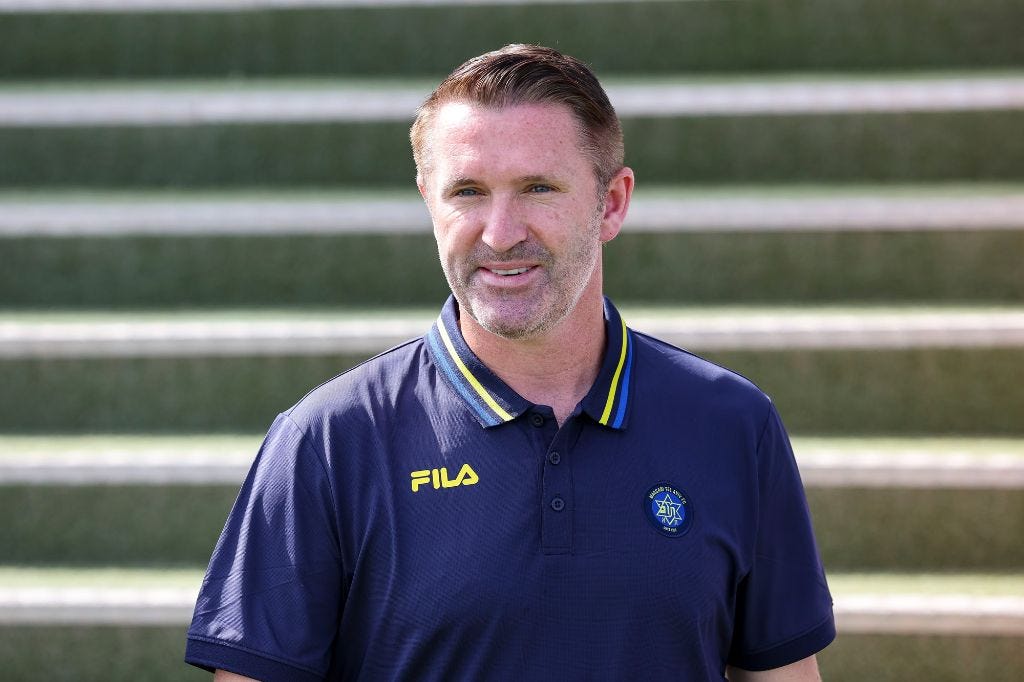
There was a familiar simplicity to the way the latest Celtic fan protest was packaged by their critics. Angry fans, ugly optics, and a crowd apparently motivated by little more than tribal grievance. It is a neat story, the kind that drops easily into newspaper columns and panel-show talking points. It is also a deeply incomplete one.
Because if you strip away the lazy shorthand and actually look at why so many Celtic supporters reacted so strongly to Robbie Keane’s association with Israeli football, you get to the heart of the matter far more quickly than the critics ever do. This was not just about a manager, or a contract, or a footballing appointment, or simply because he coached in Israel. It was about Gaza. It was about the political and moral reality surrounding Israel’s war on Palestinians. And it was about a fanbase that has, for years, seen solidarity with Palestine not as an imported stunt but as part of its own identity.
That context matters. A lot.
The problem with the mainstream response is that it often treats political protest from football supporters as if it has to be irrational, performative, or sectarian by default. If Celtic fans object, it must be because they are Celtic fans. If they boo, it must be because they are looking for trouble. If they raise Palestinian flags, it must be some kind of coded provocation and support for terrorists. That mindset allows journalists and commentators to bypass the actual substance of what is being protested. Conveniently. But there was substance here. Serious substance.
Israel is not simply engaged in a normal military conflict. The scale of destruction in Gaza, the civilian death toll, the collapse of basic humanitarian conditions, and the public celebrations of violence by supporters and officials of the very club that Robbie Keane managed had already created a moral outrage that extended far beyond politics and into the realm of human conscience. Many people, including football supporters, looked at the situation and concluded that neutrality was no longer morally adequate. They saw a population under siege. They saw children being murdered. They saw hospitals, homes, schools, and entire neighbourhoods destroyed. They saw a state and a military apparatus - supported by the United States and many of the Western nations - acting with a level of impunity that ordinary people found intolerable and grotesque.
That is the background against which fans judged Keane’s presence there.
It is one thing to say that a football manager or coach is not personally responsible for every political act around him. Of course that is true. It is another thing entirely to pretend that the setting in which he works has no meaning at all. Football does not exist in a vacuum. It never has. Clubs are not abstract employment agencies floating above history. They are institutions embedded in society, affected by politics, identity, and the moral choices of those around them.
So when Celtic fans objected, they were not objecting to football in the narrowest possible sense. They were objecting to a larger political and ethical reality. They were saying that there is something profoundly wrong with treating business as usual as though business as usual were still defensible. That is the part many critics refuse to engage with, because once you do engage with it, the protest becomes harder to caricature.
Instead, the familiar response arrives almost immediately - bigotry, sectarianism, hysteria, mob rule. Sometimes the accusation is said outright. Sometimes it is merely implied. And if the issue is Israel, Palestine, or Gaza, the anti-semitism charge circles like a vulture, ready to be deployed whenever criticism becomes inconvenient to Israel and their sycophants worldwide.
That is precisely where careful language matters.
Antisemitism is real. It is ugly. It is dangerous. It must be condemned absolutely, without hesitation or excuse. But the word cannot be allowed to become a shield against all criticism of the Israeli state. It cannot be used to whitewash over Palestinian suffering or to silence people who are responding to mass civilian death with outrage.
Those are not the same thing.
A principled opposition to war crimes is not antisemitism. A refusal to sanitise the bombing of Gaza is not antisemitism. A demand that public figures, clubs, and institutions reckon honestly with the political implications of their associations is not antisemitism. The moment commentators collapse all of that into one lazy accusation, they stop arguing in good faith and start policing the boundaries of acceptable dissent.
That is why the silence on Gaza in so much of the reporting is so revealing.
Many supporters of the Zionist state are all too eager to frame protests through the lens of political influence, club politics, or supposedly irrational fan behaviour, while skipping over the foundational issue that made the protest resonate in the first place. You cannot honestly explain the reaction without naming the war. You cannot understand the anger without acknowledging the images and reports coming out of Gaza. You cannot discuss the protest and then act surprised that supporters saw Keane’s continued involvement in Israeli football as morally unacceptable.
That omission is not neutral. It is editorial. And it shapes public perception in exactly the way the establishment prefers.
For Celtic fans, solidarity with Palestine is not a recent trend. It has been visible in the terraces, in banners, in displays, and in the broader culture surrounding the club for decades. It has become bound up with the club’s self-image as more than just a football institution. Whether one agrees with every expression of that identity or not, it is undeniable that many Celtic supporters see their club as connected to causes of anti-colonial struggle, international solidarity, and resistance to oppression.
That makes the Gaza issue especially potent.
When those fans see civilians being killed in huge numbers, when they see public enthusiasm for military force, and when they see football figures continuing in that environment as if none of it matters, they do not interpret that as a minor discomfort. They interpret it as a moral test. And in their eyes, Keane failed it.
That is the part the detractors never seem to want to admit. They would rather reduce the protest to noise than concede that it had an ethical foundation. But if football fans are capable of mobilising over ticket prices, ownership disputes, kit colours, VAR decisions and club governance, why is it suddenly unthinkable that they might also mobilise over a genocide abroad?
The answer is that it is not unthinkable at all. It is simply inconvenient to those who prefer football to stay comfortably apolitical unless the politics happen to suit them.
There is also a striking asymmetry in how fan culture gets judged in Scotland. When one group of supporters expresses a position that aligns with international solidarity or anti-war protest, it is scrutinised for hidden motives, exaggerated, and often moralised against. When another group is associated with sectarian symbolism, political provocations, or overtly adversarial displays, the reaction is often far more forgiving. The standard is not applied evenly. Everyone can see that.
That does not mean every criticism of Celtic support is wrong, or that every protest is above reproach. It means context matters, and context is too often discarded when the subject is Palestine or Israel. The media can be remarkably expansive when explaining one club’s grievances, and remarkably cramped when explaining another club’s solidarity.
The result is predictable. Celtic supporters are treated as though they have wandered into politics by accident, when in fact many of them have chosen to stand in solidarity with Palestinians deliberately and consistently. They have attached meaning to that solidarity. They have made it part of the club’s fan culture. And because they have done so openly, they are then judged more harshly than those who avoid political questions altogether while still benefiting from them.
The other issue is this, it is not enough to say that people should be “above politics” when politics is already shaping the lives being destroyed on the ground. Neutrality is a luxury claim. It sounds balanced in a studio. It feels evasive in a war zone. When children are being buried in their thousands, when families are being displaced, when the scale of civilian death is staggering, the demand that football supporters keep quiet can sound less like moderation and more like complicity.
That is why the Celtic fan response resonated so strongly.
It was not because every supporter shares the same analysis of the Middle East. It was not because every chant or banner is perfectly phrased. It was because many fans saw the situation for what it was - a moral emergency. And once that judgment is made, you cannot expect people to clap politely at appointments, partnerships, or associations that seem to ignore the very crisis they are protesting.
The most frustrating part of the whole debate is how easily critics substitute character judgments for actual argument. Instead of grappling with Gaza, they label fans as “bigots.” Instead of discussing the genocide, they talk about fan behaviour. Instead of asking whether the protest speaks to a legitimate ethical concern, they talk about anti-semitism.
That tells you everything.
If the media wants to be taken seriously, it needs to report the full story. That means naming Gaza. It means acknowledging the deaths of civilians. It means understanding why fans around the world - not just Celtic fans - have chosen Palestinian solidarity as a moral line in the sand. It means resisting the temptation to reduce every expression of outrage to prejudice.
And yes, it also means being fair about the difference between criticism of a state and hatred of a people. That distinction is essential. Without it, the debate collapses into slogans, and slogans are the favourite language of those who would rather not confront the facts. Celtic fans don’t hate Jews, they hate the Zionist state of Israel.
Celtic supporters are entitled to their politics. They are entitled to protest. They are entitled to judge public figures through the lens of conscience, not just footballing competence. And they are entitled to ask why the coverage so often omits the very context that makes their protest intelligible.
The answer, bluntly, is that Gaza is too uncomfortable for many of the people writing the headlines. It forces moral clarity. It forces specificity. It forces them to say what they really think about genocide, rather than hiding behind vague phrases about “controversy” and “backlash.”
But football supporters, especially those who have long embraced solidarity politics, are not obliged to cooperate with that evasion. They saw what they saw. They heard the statements. They understood the symbolism. And they responded accordingly. That does not make them bigots. It makes them politically conscious.
The real question is whether the commentators who criticise them are prepared to be equally conscious, or whether they will continue to ignore the mounting dead toll in Gaza while lecturing living people about tone. That is the standard now. That is the choice.
And if the media refuses to meet it, the public will increasingly understand why so many fans no longer trust it to tell the full story.
Brilliant piece Andy, it's not just about politics per se it's about being decent human beings and having empathy for your fellow human beings who are being killed in a mass genocide that's the tall and the short of it. You can't claim moral outrage about Russia invading Ukraine whilst not having the same outrage about what's going on in Palestine, no war or mass genocide has more importance than any other you can't simply be selective in your outrage, war is war and genocide is genocide and to be classed as antisemitic for standing up for a cause you believe in is just an insult to people's intelligence and those stenographers insisting that that's what Celtic supporters are doing is minimising and trivialising an issue that is morally and ethically wrong.
FIFA etc have no right to say that politics and football should be kept separate when they fawn over Trump and present him with fake trophies to stroke his ego. It really is sickening.