

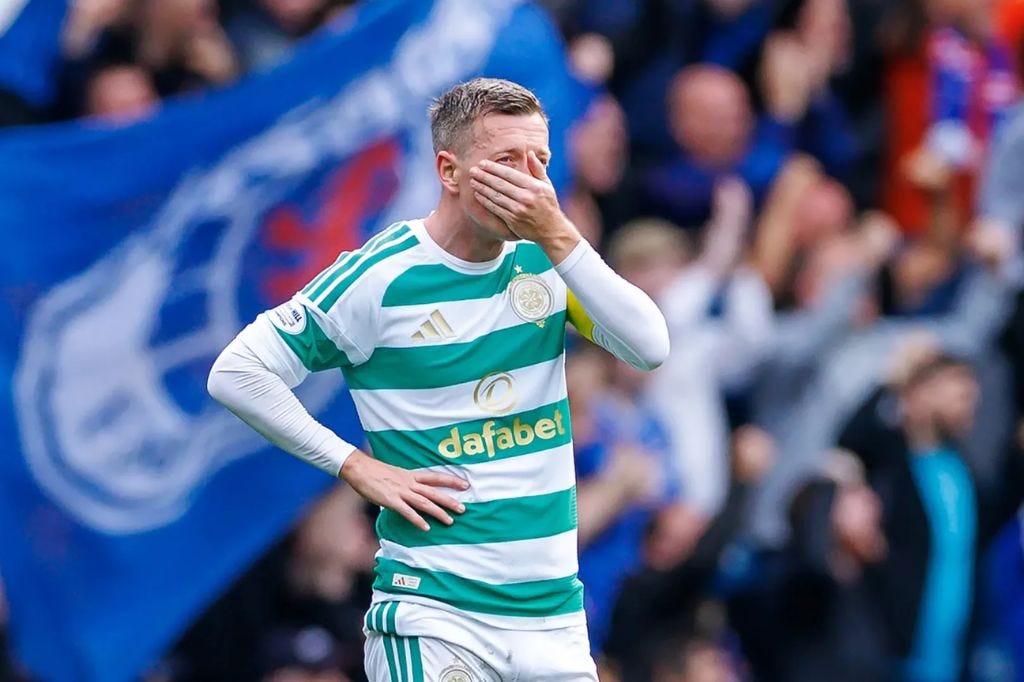
To sit in the stands at Celtic Park on a high-stakes European night, or amidst the visceral heat of a derby, is to witness a club defined by its historical totems. For over a decade, Callum McGregor has been the calm amidst that storm, the well groomed player around whom the modern era of Celtic dominance was constructed. A product of a youth system that often struggles to bridge the divide between promise and the first-team dressing room, McGregor stood as proof of concept. Alongside James Forrest and Kieran Tierney, he formed a holy trinity of academy graduates who proved that homegrown talent could not only survive in Paradise, but transform it.
McGregor’s service to the Scottish champions is beyond question. He inherited the captaincy from the irrepressible figure of Scott Brown and proceeded to define the armband in his own understated image. Where Brown was all snarling defiance and tactical intimidation, McGregor brought spatial awareness, tactical intelligence, and a relentlessness that saw him play more minutes than almost any elite professional in world football over a five-year stretch. His legacy as a devoted servant is secured in silverware and sweat. Youngsters currently navigating the harsh terrain of the Celtic academy ought to look to his professionalism, his application, and his discipline as the gold standard.
Yet elite football is an unforgiving arena, one that demands cold rationalism over misty-eyed nostalgia. And the uncomfortable, increasingly glaring truth that Celtic must now confront is that McGregor’s time as the lynch pin of this team has run its course.
There comes a juncture in every great player’s career where the attributes that once made them indispensable begin to fade, replaced by a vulnerability that opposition managers smell from miles away. For Celtic, that moment with McGregor is no longer approaching on the horizon; it has arrived, parked itself on the edge of the eighteen-yard box, and begun dictating play in the wrong direction.
He is no longer at the physical or dynamic level required of a starting midfielder for a club the size of Celtic. In matches where the pace is controlled and the opposition retreats into a passive mid-block, McGregor can still resemble the composed distributor of old, neatly shifting the ball from left to right, keeping the wheel turning. But football at the highest level - and increasingly within the quickening demands of the Scottish Premiership - is rarely played in a vacuum of passive space. When the pressure intensifies, when teams aggressively press or flood the centre of the park with power and athleticism, McGregor dissolves into anonymity.
Watch Celtic in domestic matches where the opposition refuses to be awed by their reputation. More and more frequently, McGregor watches the game pass him by. Rather than anchoring the side, grabbing a match by the throat, and imposing his authority, he drifts on the periphery of the action. He has become a reactor rather than an instigator, forced into chasing shadows as younger, faster, and more physical midfields bypass Celtic’s engine room with alarming ease.
The primary issue is one of command. A Celtic captain in the heart of the pitch cannot simply be a neat passer of the ball; he must be a point of resistance, an aggressive barrier, and an energetic catalyst. McGregor is not a commanding physical presence. Against sides that crowd the centre of the pitch, deploying robust, athletic profiles designed to disrupt and dominate, McGregor’s tactical flaws are laid bare. He lacks the recovery speed to cover horizontal space when transitions break down, and he lacks the physical steel to win dirty second balls when a match descends into a battle of attrition.
Time and again, particularly at the top level where tactical flaws are amplified to an unforgiving degree, McGregor has been found out. Opposition no longer view Celtic’s midfield as an obstacle to be carefully negotiated, but as a gateway to be exploited. When high-calibre teams flood the central channels, Celtic’s skipper is routinely swamped, overwhelmed by superior mobility and power. Instead of adjusting or asserting himself, McGregor’s default setting in these moments has become one of passive survival. He retreats into standard sideways or backward passes, shielding himself behind the tempo of the game rather than actively changing it.
This decline creates a compounding problem for the team. When your main midfielder and captain cannot win his duels or dictate the physical tempo, the burden shifts onto those around him. Creative midfielders are forced deeper to help build play from the back, stripping Celtic of their threat in the final third. Full-backs become hesitant to invert or overlap, acutely aware that the central axis offers no structural security if the ball is turned over. The entire tactical system becomes skewed, anchored to a player who can no longer hold the line.
The emotional connection between Celtic’s support and McGregor makes this a painful diagnosis to deliver. Football fans naturally cling to continuity. In an era where player loyalty is a vanishing commodity, a local boy who climbed through every tier of the club’s development pipeline to lift trophies as captain is a rare and precious thing. But football clubs cannot operate as museums for past heroics. The standard required to remain a first-team regular at Celtic must be absolute, unyielding, and independent of past achievements.
Holding onto McGregor out of sentimentality is a disservice to the club’s future. It breeds complacency, signals to the squad that reputation supersedes form, and stifles the necessary evolution of the team. Worse still, it leaves Celtic perpetually vulnerable in the exact moments where authority is needed most - in tight, frantic derby matches and punishing continental ties.
The imperative for Celtic’s recruitment department is now stark and immediate. The club must search high and low, leaving no stone unturned across global markets, to source a genuine successor to McGregor. Celtic do not simply need another neat passer to rotate into the squad; they need a transformation in the profile of their midfield. They require an imposing, dynamic, athletic presence who can physically dominate matches, break up play with authority, and carry the ball through congested midfields under pressure.
Finding a player who possesses both the requisite physical suite and the requisite technical quality is neither cheap nor easy, but it is the baseline requirement for a modern European football club. Celtic have demonstrated at times an ability to scout effectively in distant markets in recent years, unearthing rough diamonds and polishing them into high-value assets - despite recent failures. That same analytical sharpness must now be deployed to fix the central spine of the team.
This transition need not be bitter, nor does it require McGregor to be cast out completely. His institutional knowledge, his understanding of what it means to represent Celtic, and his leadership around the training ground remain invaluable assets. Young players coming through the ranks, as well as new foreign signings adjusting to the intense pressure cooker of Glasgow, still have immense amounts to learn from his example. A reduced role, transitioning from an automatic starter to an experienced squad player capable of seeing out games or starting specific domestic fixtures, would prolong his career while allowing the team to move forward.
However, the illusion that Callum McGregor can remain Celtic’s undisputed starting midfielder and captain on the pitch must be shattered. The modern game has moved on, moving faster and becoming more physical, leaving a great servant behind in its wake. Celtic have spent years building a dominant domestic legacy, but staying at the top requires cold, unsentimental choices. To evolve, to compete, and to thrive, Celtic must acknowledge the obvious, that the McGregor era in the heart of midfield has reached its natural conclusion, and the search for his successor can no longer be delayed.
As with Scott Brown, Celtic have done Callum McGregor a great disservice by not managing the concluding stage of his career. I often recall how Barcelona retired the peerless Xavi when the player himself believed he had at least one more campaign in him. The club stated that they would not allow such a legend to “die in the shirt”.
I think the vast majority of Celtic fans realise Callum McGregor is at the end of his glittering Celtic career. We shed the same tears and sadness, when the legendary Scott Brown had to finally hang up his boots for Celtic.
We need pragmatism now, not sentimentality, if we are to progress as a club, and I believe
we need not just one, but two dynamic holding midfielders, to cover for rotation and suspensions.
Great post again Andy, you call it as you see it, with honesty, clarity and perception.