

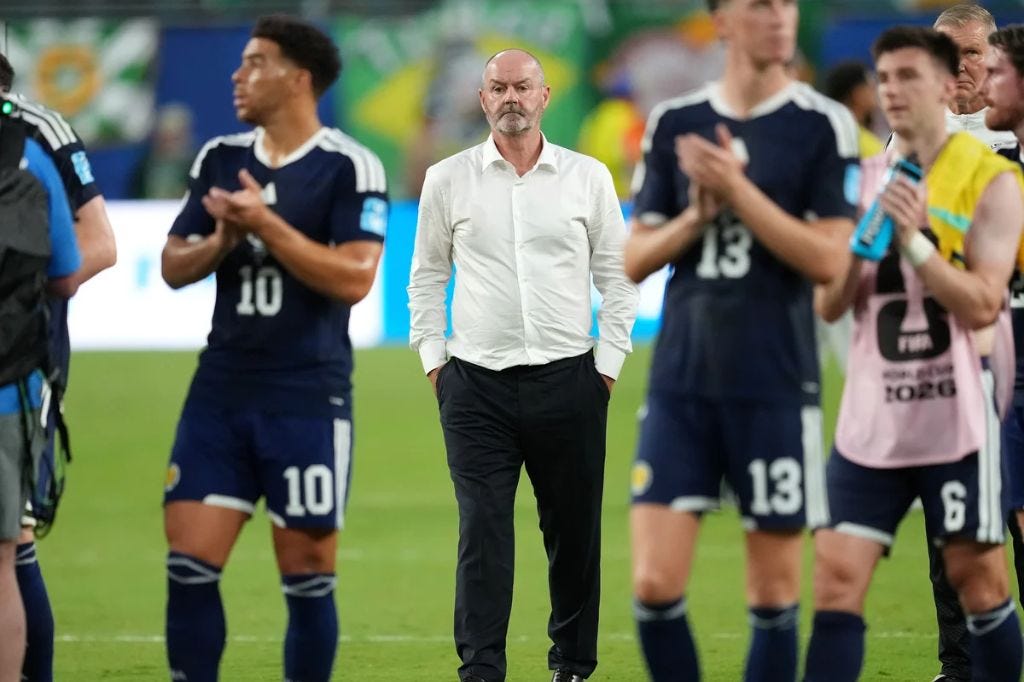
There are bad tournaments, there are disappointing tournaments, and then there is whatever Scotland have just served up at the 2026 World Cup, a limp, lifeless, utterly predictable collapse dressed up as progress because we happened to show up.
And at the centre of it all, once again, stands Steve Clarke - defiant, evasive, increasingly irritable, and looking every inch a man who has taken this team as far as he possibly can which, unfortunately for Scotland, is absolutely nowhere when it actually matters.
After the narrow, nervy, far-from-convincing 1-0 win over Haiti, we were told this was a Scotland side growing into the tournament. Professional. Controlled. Mature. Clarke was front and centre, happy to take the plaudits, happy to talk about structure, discipline, and “doing what we needed to do.”
What we didn’t hear then and what has become painfully obvious since is that Scotland weren’t growing into anything. They were shrinking. Retreating. Playing within themselves to such an extent that when the real tests came, there was nothing to give.
Because Morocco exposed them. Brazil dismantled them. And now Scotland sit in the all-too-familiar position of calculators out, permutations flying, hoping and praying that someone else does them a favour to mask the reality that they simply have not been good enough. Not unlucky. Not victims of fine margins. Just not good enough.
And that is where the conversation has to turn, inevitably and uncomfortably, toward the manager. Steve Clarke cannot hide from this one. Not this time. Not after a third consecutive major tournament where Scotland have arrived with hope and left with excuses.
What makes this collapse even harder to stomach is not just the results, it is the manner of them, and more importantly, the reaction to them.
After the defeat to Morocco, Clarke bristled. After the humbling against Brazil, he all but spat the dummy. Gone was the composed, measured operator we saw after Haiti. In his place was a man irritated by scrutiny, defensive in tone, and most damningly unwilling to look in the mirror.
Instead, the blame began to shift. Players were questioned without being named. Mistakes were highlighted. Individuals subtly hung out to dry. And yes, there were mistakes. Plenty of them.
Scott McKenna’s error was schoolboy stuff. Jack Hendry dallied in possession like a man playing a testimonial, fortunate that Brazil’s second was chalked off. Angus Gunn, all 6 foot 4 of him, flapped at a cross like a goalkeeper unsure whether to come or stay rooted. Across the pitch, Scotland looked hesitant, reactive, and overwhelmed. But here is the uncomfortable truth, those mistakes are symptoms, not causes.
They are what happens when a team is set up to survive rather than compete. When players are drilled to avoid risk rather than impose themselves. When the overarching message is caution, containment, and damage limitation. That is not on McKenna. That is not on Hendry. That is not on Gunn. That is on Steve Clarke. Because this is his team. His system. His mentality. And the mentality is the real issue here.
Scotland do not just look technically inferior at this level, that can happen. Smaller nations bridge that gap all the time. What Scotland lack is belief. Courage. The basic conviction that they belong on this stage. Look at Curacao. Look at Cape Verde. They may not progress. They may fall short. But they competed. They played without fear. They took the game to sides with bigger reputations and deeper squads. They can walk off with their heads held high, regardless of the result.
Scotland, by contrast, look like a team waiting for something to go wrong and then, when it inevitably does, they collapse under the weight of it. That is not a talent issue. That is psychological. And that, again, comes back to the manager.
Clarke has built a side that is organised, difficult to break down on its day, and capable of grinding out results in qualifying campaigns. That much is true. It is also where the praise should end. Because international football at major tournaments is not about qualifying. It is about adaptability, bravery, and the ability to rise above your perceived level when it matters most.
Clarke’s Scotland do the opposite. They retreat. They narrow. They hope. And hope, as we are seeing yet again, is not a strategy.
What makes this entire situation even more frustrating is the narrative that has been carefully constructed around Clarke’s tenure. Three tournaments. That is the headline achievement. The supposed evidence that he is Scotland’s greatest modern manager. But qualification is not the finish line, it is the starting point.
If getting there is all that matters, then yes, Clarke has been a success. But if the ambition is to actually compete, to progress, to leave a mark beyond participation, then this era has been an unmitigated failure.
Scotland have played nine matches across three major tournaments under Clarke. Just 1 win out of 9. They have, time and again, frozen on the big stage. That is not progress. That is repetition.
And yet, somehow, the Scottish FA looked at this trajectory and decided the solution was continuity. Stability. Rewarding mediocrity with a four-year contract extension that now feels less like backing a project and more like locking the door and throwing away the key.
Because what exactly is the long-term vision here? Is it simply to qualify, collect the financial windfall, and accept elimination as an occupational hazard?
Is it about maintaining a status quo that keeps Hampden’s corridors comfortable, the suits well-fed at UEFA and FIFA dinners, and expectations conveniently low?
Or is there any genuine ambition to push this national team beyond its self-imposed limitations?
Right now, it is impossible to tell.
What is clear is that there is a disconnect between the potential of the squad and the way it is utilised, between what Scotland could be and what they currently are. Because let’s not pretend this is a hopeless group of players. There is quality here. There are players operating at a high level across Europe. There is experience, athleticism, and genuine technical ability. But too many of them look like they believe their own hype until the moment arrives to justify it. And when that moment comes, they shrink. That is not entirely their fault.
They are products of an environment that does not demand more, that does not challenge them to step beyond their comfort zone, that does not instil the belief required to compete with the best.
Instead, they are asked to execute a game plan rooted in caution and limitation. And when it fails, as it inevitably does at this level, they are left exposed. So yes, Clarke cannot take all the blame. But he must take the majority of it. Because he sets the tone. He defines the approach. He determines how this team sees itself. And right now, Scotland look like a side that does not believe it belongs.
That is the most damning indictment of all.
Meanwhile, in the stands and on the streets, a very different story unfolds. The Tartan Army have, once again, been exceptional. They have brought colour, noise, and humanity to this tournament. They have turned cities into celebrations. They have connected with supporters from Morocco, Brazil, and beyond in a way that embodies everything good about football.
Boston embraced them. Opponents respected them. They have been, as they always are, the best of Scotland. Which is why it feels so wrong that the team representing them falls so far short. Because being Scottish is not the problem. Despite what Trainspotting might have you believe, there is nothing remotely shite about being Scottish.
What is shite is watching a national team repeatedly underperform, repeatedly underwhelm, and repeatedly retreat into the same tired narratives of “glorious failure” that serve only to soften the blow of what is, in reality, plain old failure. There is nothing glorious about this. There is nothing admirable about scraping a win against Haiti, collapsing against Morocco, and being brushed aside by a Brazil side that barely needed to get out of second gear. There is nothing noble about hoping and praying for other results to bail you out.
And there is certainly nothing acceptable about a manager who appears increasingly unwilling to answer for it.
If Scotland somehow stumble into the knockout stages, it will not change that. It will not validate the approach. It will not rewrite the performances. It will not suddenly transform this campaign into a success. It will simply delay the inevitable reckoning. Because deep down, everyone can see it. This is as good as it gets under Steve Clarke. And that should concern anyone who cares about the future of the national team.
The idea that Scotland must restrict itself to Scottish managers feels increasingly outdated, almost self-sabotaging. The fear born from the Berti Vogts era has calcified into an unofficial policy of insularity, one that limits ambition rather than protects identity.
There is a wider world of coaching talent out there. Ideas. Philosophies. Approaches that could challenge the stagnation that has set in. Instead, Scotland have settled. And settling, in international football, is just another way of standing still while everyone else moves forward.
Which brings us back to the central question - how did it come to this?
How did a manager with fewer than 200 games in club management, with modest success and limited top-level experience, become the long-term steward of a national team desperate for evolution?
The answer lies not just with Clarke, but with the system that appointed him, extended him, and continues to shield him from meaningful scrutiny. Because accountability, at this level, should not be optional. No job is beyond questioning. No manager is beyond criticism. And yet Clarke often carries himself as though he is.
That cannot continue.
Not if Scotland have any intention of becoming more than just participants. Not if the Tartan Army are to be given a team worthy of their passion. Not if the cycle of qualification followed by inevitable disappointment is ever to be broken.
For now, though, the reality is stark. Scotland are staring down another early exit. Another post-mortem. Another round of excuses. Another reset that changes nothing. And at the heart of it all, the same figure will remain steadfast, stubborn, and increasingly out of his depth.
There is no glorious failure here. Just failure. Repeated, predictable, and entirely preventable.
It's been embarrassing watch for a home nation. So-called minows: Haiti, Congo, Cape Verde, Curacao, as you astutley observed, played ambitious, interlocking and technically competent football. Scotland by contrast, looked clunky, outdated and at times frankly seemed terrified that they are at a World Cup.
This is all at the brogue clad dinosaur’s feet clinging on to their little staunch ramparts in Hampden.
Refusal to change or adapt. I started watching fitba with my auld man almost sixty years ago and still today when I go watch a professional game, still fucking today I hear coaches and managers shouting “man oan, man oan”
Nothing, zero, absolutely nothing has changed!
Embarrassing