

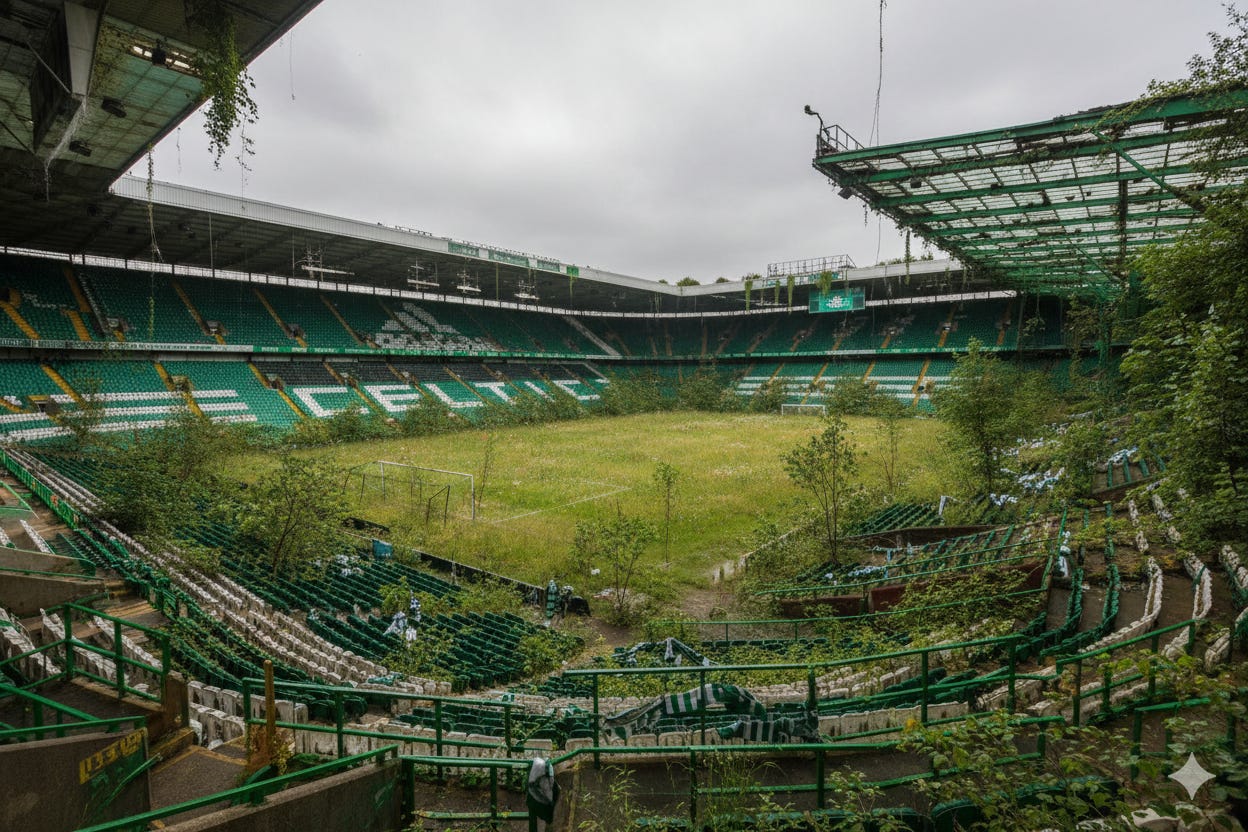
The first half of the 2025-26 season at Celtic has been an embarrassment of administrative chaos, managerial shifts, a summer transfer window horror show, a squad that looks like a bunch of strangers who have never played football before, and a manager with the worst win ratio in the history of Celtic Football Club.
After Brendan Rodgers resigned in late October following a 3-1 loss to Hearts that left Celtic trailing by eight points, the club turned to legend Martin O’Neill to steady the ship.
O’Neill did more than stabilise, he revitalised the side, winning seven of his eight games in charge and dragged Celtic back into the title race. That has now all been undone by the hiring of Nancy and a record of just two wins out of 7 games. It beggars belief that he is still in a job with Rangers travelling to Celtic Park on the 3rd January - a game that everyone is now fearing will resemble a cricket score despite Rangers not being at their best either.
As we enter 2026, Celtic are now knee deep in their most severe institutional crisis since the 1990s. We have went from domestic dominance to existential turmoil across every dimension of the club - from the board room and transfer strategy to tactical coherence and squad morale. This is not a temporary slump masking underlying stability; it is a structural failure rooted in boardroom dysfunction that has cascaded across every operating system of the football club.
So where did it all go wrong for Celtic?
The Transfer Window That Changed Everything
The summer of 2025 marked Celtic’s critical juncture. The club faced a straightforward strategic choice: reinforce defensive fragility while maintaining the attacking potency that had delivered 112 league goals the previous season, or prioritise financial prudence over sporting ambition.
They chose the latter, and it proved catastrophic.
The sale of Kyogo Furuhashi to Rennes for £10 million in January 2025 - though technically a winter sale - was the catalyst for a broader pattern of asset stripping that left Celtic’s attacking department hollowed out. By summer, Nicolas Kuhn had departed to Como, and Adam Idah moved to Swansea. Simultaneously, Jota suffered a devastating ACL injury in May and Reo Hatate sustained a serious injury that ruled him out of the Scottish Cup final defeat to Aberdeen. Within months, Celtic’s front line was systematically dismantled without establishing a coherent long-term replacement strategy in place to counter transfers or long term injuries.
Then-Celtic manager Brendan Rodgers screamed for new signings, quality first team ready players, both at board level and in front of the press. Yet what he was faced with was a club signing project players and following an outdated transfer model and pricing structure that was popular twenty years ago.

An injury plagued Kieran Tierney returned to the club after a pre-contract agreement saw him leave Arsenal. Another former Celt returned home, as keeper Ross Doohan arrived on a free from Aberdeen to replace the vacant slot left behind by Scott Bain. While Shin Yamada and Hayato Inamura arrived from the land of the rising sun for a combined £1.75m - two players that Rodgers clearly knew nothing about given his comments following their signings. Benjamin Nygren and Callum Osmand also arrived from Nordsjaelland and Fulham respectively. Before youngster Jahmai Simpson-Pusey, joined on loan from Manchester City,
Only two of the summer signings played in the penalty shootout defeat to Kairat Almaty, failing to qualify for the Champions League and costing the club between £30-50 million in revenue. Tierney and Nygren.
Following Celtic’s failure to qualify for Europe’s elite club cup competition, the Celtic board quickly sanctioned the signings of Marcelo Saracchi, Michel-Ange Balikwisha, and Sebastian Tounekti for around £11 million. Before the sale of Adam Idah was sanctioned and Celtic ended the summer transfer window with no main first team striker in the squad at all. Days later striker Kelechi Iheanacho, who had been released by Sevilla, arrived in Glasgow to sign for Celtic.
Despite a very healthy bank balance and the ability to strengthen significantly without risking the financial stability of the club, the board’s logic was driven by spreadsheet efficiency rather than tactical necessity - they had saved money by selling the club’s main assets in Nicolas Kuhn, Kyogo, and Adam Idah - but damaging the club’s ability on the football pitch. Where it matters most.
They very nearly lost Yang and Maeda in the same window, Yang’s deal to sign for Birmingham City fell through at the last minute and Maeda remained, much to his dismay - quite visibly in subsequent games.
The Champions League Collapse
On August 27th Celtic faced FC Kairat Almaty in Kazakhstan in a Champions League qualifying play-off. Over 210 minutes of play without a single goal, Celtic’s squad produced one of the most sterile European performances in recent memory. It was a result that typified Rodgers’ tenure this season. The result extended Celtic’s Champions League qualifying nightmare to five consecutive failures.
The financial cost proved significant. Celtic forfeited approximately £25 million in lost Champions League revenues. Performance bonuses, broadcasting revenue splits, and gate receipts will push the total opportunity cost closer to £50 million when accounting for potential deeper runs.
It still beggars belief that a board full of accountants, bankers, and lawyers cannot see the justification around spending £30 million to strengthen a side that had reached the knockout stages of the Champions League last season - when you were guaranteed £25 million just for qualifying alone. Before the sale of Kuhn to Como.

Celtic’s wage bill was not constructed around sustained Champions League football and the tournament’s prize money. So why has the club’s board perpetuated a downsizing of the playing squad over the past 18 months - when subsequent financial results paint a picture of a club that didn’t need to downsize and who had paid the taxman nearly £30 million over the past few years - when it would have been more prudent to invest further in the playing squad and use tax incentives.
This failure to qualify will almost certain affect the club’s ability to conduct a meaningful January transfer window, despite the rhetoric from the usual suspects in the media and boardroom stooges in fan media who claim to be in the know.
The Rodgers Resignation and Boardroom Implosion
By early October 2025, the relationship between Brendan Rodgers and the board -particularly Dermot Desmond - had become irreparably fractured. Rodgers publicly complained about transfer backing, citing his lack of recruitment support following the Kairat disaster. The board, through Desmond, had reportedly made promises of investment that were never fulfilled. Internally, Rodgers faced leaks from the boardroom, growing isolation, and a sense that the executive hierarchy was actively undermining his authority.
On October 27th, following a 3-1 loss to Hearts that left Celtic eight points adrift of the Edinburgh side, Rodgers resigned. His departure itself was unremarkable and unsurprising - football managers exit clubs regularly and Rodgers was no stranger to walking out on Celtic. What transformed the moment into institutional crisis was Dermot Desmond’s subsequent statement, in which the majority shareholder savagely attacked the departing manager.

Desmond accused Rodgers of being “divisive, misleading, and self-serving.” Rich indeed coming from the absentee landlord. He denied ever restricting transfer backing, insisting Rodgers had full autonomy. He blamed the manager for creating a “toxic atmosphere” around the club and for fueling “hostility towards members of the executive team and the Board.” The statement was not a measured corporate response; it was a public evisceration that poisoned the well for any incoming manager and signalled to the fanbase that the board operated via personal vendetta rather than strategic governance.
Critically, John Kennedy - Celtic’s long-time assistant and a figure with 20 years of continuity at Celtic - also departed immediately. This was not an accidental casualty of the managerial change; it represented a complete severing of ties with past regimes, when stability was needed most. Despite many fans, including yours truly, that Kennedy had outstayed his welcome by several managers.
Fan Unrest and the Supporter ‘Not Another Penny’ Boycott
What began as murmurs of discontent during the summer evolved into an unprecedented supporter uprising within weeks not seen since the last days of the Kellys & Whites. The Celtic fanbase, historically patient and long-suffering, reached a breaking point driven not by a single failure but by a cumulative sense of institutional contempt emanating from the boardroom.

In mid-October, the Celtic Fans Collective announced the “Not Another Penny” boycott campaign, which has fundamentally disrupted the club’s revenue streams. The campaign called on supporters to withhold all non-essential spending: no merchandise purchases, no food and drink at Celtic Park, no stadium tours, no club-run events—nothing beyond match tickets. The campaign was set to run until at least February 2026, unless tangible changes occurred at board level. This will clearly now continue - despite Peter Lawwell’s departure from the board officially on New Year’s Eve.
The financial implications of a boycott could hit Celtic’s merchandise revenue alone represents approximately £20-30 million annually. The club’s catering operations, stadium tours, premium hospitality, and club-run events generate additional millions. The boycott threatened to compound the £30 - 50 million already lost through Champions League qualification failure.
Critically, the Collective framed their protest with surgical precision: “Our support for the team remains unequivocal. But our protest against the Celtic board and in particular Michael Nicholson, Chris McKay and Peter Lawwell continues.” This distinction - between the team and the board - was essential in preventing dressing room contamination, yet the board failed to recognize or respect this demarcation.
The Abandoned AGM and Institutional Breakdown
On November 21, 2025, Celtic’s Annual General Meeting descended into chaos that more akin to the last days of a dying regime than a corporate body facing disgruntled shareholders looking for answers. Within minutes, the board called a 30-minute recess after shareholders displayed red cards and chanted “sack the board.” Upon resumption, board members watched as shareholders departed en masse when they tried to play the obligatory video puff piece.

Nepo baby Ross Desmond delivered a statement from Daddy Desmond that fundamentally revealed the board’s operating psychology. Rather than listen to shareholder concerns, Desmond attacked the fanbase, labelling critics “bullies” and defending the CEO and CFO as “devoted individuals” unfairly maligned. Shareholders were not accusing the board of insufficient devotion; they were accusing them of strategic incompetence and institutional dishonesty.
Chair Peter Lawwell’s response - ”This disruptive behavior is intolerable” - was equally revealing. The board continued to frame legitimate shareholder accountability as disruption, rather than as evidence of governance failure that demanded board accountability. Ultimately, calling a halt to proceedings early and before voting or questions from the floor could take place in a calculated and premeditated move from the Celtic hierarchy - following Desmond’s inflammatory and poisonous statement.
The Green Brigade Crisis and Divide-and-Conquer Politics
In early November, Celtic moved to ban the Green Brigade - the club’s ultra supporters group - following an alleged incident at the Falkirk match. By December 1, the club extended the ban indefinitely, adding accusations that two members had directly threatened the head of stadium safety and security.
Critics argued that the club’s response was not aimed at resolving safety issues at all but at eliminating the most vocal opposition voice among their detractors.
Video evidence of the alleged Falkirk incident provided no clear picture. The Green Brigade’s own account suggested the ban was retaliatory for their display of Palestine flags, criticism of the board, and heavy handed responses from Police and security in the vicinity of the Safe Standing section - not a genuine safety response. The club’s failure to provide transparent evidence or engage in dialogue suggested bad faith engagement. Not for the first time either.
I have never been a huge supporter of the Green Brigade, as many of their leadership can attest to, but even I can see the targeting of their members as an attempt by the board to splinter the fan unrest against them and that in turn has damaged what little credibility the board still had but it has also damaged the atmosphere at Celtic Park - now resembling a morgue than a football stadium on match days.
The Green Brigade have always been known for their opposition to the Celtic hierarchy, it’s within the DNA of the group, but the fan unrest is not merely a small militant wing or a fringe opposition. Hundreds of Celtic Supporters Groups mobilised voting unanimously to pass a motion of no confidence in the board.
The Board’s Response: Gaslighting and Contempt
Throughout the protest movement, the board’s communication strategy oscillated between defensive statements and public silence. CEO Michael Nicholson was repeatedly described as refusing to engage with the Collective, creating an impasse that the club then blamed on supporters.
Dermot Desmond, the absentee landlord, issued no direct communication to the fanbase throughout this entire 18-month period. His philosophy, articulated in past interviews, was to distance himself from what he viewed as “emotional volatility.” Rather than see supporter engagement as a symptom of institutional failure, Desmond appeared to view it as interference that principled leadership must ignore. What other business in the world ignores their customer base? Only ones destined to collapse sooner rather than later unless change is made.
Throughout this 18-month period, the constant was Dermot Desmond’s boardroom dominance and the club’s institutional refusal to acknowledge systemic failure. Rather than engage in honest reflection about transfer strategy, recruitment timing, or managerial support, the board responded to mounting criticism with hostility.
Martin O’Neill called it “one of the saddest mornings” of his football career. The board’s refusal to engage with legitimate governance questions had transformed the club’s institutional culture from one of aspiration to one of defensive recrimination.
CEO Michael Nicholson subsequently promised the new manager coming in support in January and summer recruitment windows, yet offered no public roadmap for addressing the squad’s structural gaps or the questions around the corporate governance of the club. The board continued to operate in the shadows, issuing statements through proxies rather than directly addressing the fanbase.
The next step left open to the fans in their boycott is match day attendances. Fans turned their back on Celtic during the Ronny Deila years due to the football on show - after recent results coupled with contempt for the board - it won’t be long before fans vote with their feet once again.
Martin O’Neill’s Respite and the False Dawn
When Martin O’Neill, the legendary Celtic manager from 2000-2005, stepped in as interim manager on October 27, the club was in a mess Celtic trailed Hearts by eight points, the fanbase was in open revolt, and the Europa League presented a modest consolation prize rather than a path forward.
What happened next temporarily obscured the deeper institutional rot: O’Neill won 7 of his 8 matches across all competitions. Under his leadership, Celtic closed the gap to Hearts to just two points with a game in hand. They defeated Feyenoord 3-1 away in the Europa League - their first away European victory since 2020. They reached the League Cup final after beating Rangers 3-1 AET. O’Neill won Manager of the Month for November.
The interim manager’s success was real, but it was also an illusion. O’Neill’s short-term tactical adjustments - demanding physicality, simplifying the system, restoring psychological belief - masked rather than remedied the squad’s underlying deficiencies. Players responded to a short-term reset that would have gotten them to the January transfer window if O’Neill had remained in the role. When O’Neill departed after just six weeks, the gains evaporated within days, as Wilfried Nancy took charge.
Wilfried Nancy: Celtic’s Worst Ever manager
On December 2nd, Celtic appointed Wilfried Nancy, who arrived from MLS side Columbus Crew with a 50.7% career win ratio - and after finishing 7th in the Eastern Conference. Nancy’s appointment represented a significant gamble: bringing in a manager with no European experience, no experience managing in a proper competitive league with historical rival derbies, no familiarity with Scottish football’s intensity and tactical demands., and a club whose fan base demanded they win every game - not through entitlement but a collective belief.
Nancy lost his opening four matches - the first Celtic manager ever to do so - including a flaccid performance against St.Mirren in the League Cup Final - losing the first piece of silverware this season. Against Dundee United on December 18, Celtic suffered their first defeat to that opponent in over a decade. The run was characterised not just by losses but by defensive collapse: 10 goals conceded in the opening four games.

After last night’s humiliating 2-0 defeat to Motherwell - which the Fir Park side deservedly won I may add - with a record of just 2 wins and 5 losses in his first month in charge he is now the worst manager in the history of Celtic Football Club with a win ratio of just 28.57% - Lou Macari sits on 35.29% from 1993-1994.
Yet Nancy remains publicly defiant about his tactical system - a back-three formation that he continues to whip like a dead donkey that hasn’t worked in any of the seven games he has managed. Players being shunted into positions they don’t normally play in, the morale that had been built back up under O’Neill has now disintegrated with players storming off the pitch visibly angry and Nancy disappearing up the tunnel and away from sight as quickly as possible.
But that’s what happens when you let a failed Stevenage manager, masquerading as a football doctor with a temu analytics system, appoint his mate’s mate.
It is clear that Nancy is a charlatan and a fraud. A man clearly out of his depth that his appointment and hopefully sacking sooner rather than later. should also signal the sacking of those who hired him - Paul Tisdale, Ross Desmond [whatever role he plays at the club] and Michael Nicholson - for sheer incompetence.
I said it weeks before his appointment, hiring Nancy would risk the Celtic board repeating past managerial mistakes, undermining hopes for a swift return to dominance domestically and further dimming the once bright Celtic flame on the European stage. That it was a moment for decisive leadership and ambition. That settling for Nancy would be an abandonment of Celtic’s rich heritage and future promise. That it would be a missed opportunity to appoint a genuinely experienced, battle-hardened manager ready to command the pressures and deliver the success fans demand.

And what I warned against has predictably transpired - mediocrity. A manager out of his depth, peddling buzzwords and bewildering statements after another defeat in the league. His performance over results mentality is nothing more than hipster gentle-parenting where kids are told that winning or losing doesn’t count, that taking part is what matters. Where everyone gets a participation certificate. That may work in the MLS, but in the cutthroat world of Scottish Football - let alone Celtic Football Club, you are deemed a fucking loser.
If Nancy was Celtic’s number one target for manager, I’d hate to see who number two and three were.
Peter Lawwell’s Resignation – The Board’s First Casualty
On December 16, 2025, Peter Lawwell announced his resignation as Celtic chairman, effective December 31, 2025. The timing was acutely symbolic: the announcement arrived hours before Celtic’s critical clash against Dundee United, a match that would prove to be another defeat in Nancy’s catastrophic opening month.
Lawwell’s resignation represented the first institutional consequence of the fan uprising. After 21 years at Celtic - 18 as chief executive from 2003 to 2021 and three years as non-executive chairman since returning in 2023 - the 66-year-old cited “intolerable” abuse and threats directed at himself and his family as the reason for his departure. Yet none had been reported to the Police at that time according to enquiries made to Police Scotland by yours truly. Funny that. In his statement, Lawwell conveyed a sense of exhaustion: “At this stage in my life, I don’t need this. I cannot accept this and so I leave the Club I have loved all my life.”
The resignation statement was notably defensive. Rather than acknowledge the legitimate governance concerns that had animated supporter protests throughout 2025, Lawwell framed dissent as abuse. He refused to engage with the substance of criticism - transfer strategy, recruitment timing, board communication - instead positioning himself as a victim of irrational hostility. This posture revealed the unbridgeable gap between the board’s self-perception and the institutional reality that had driven the fanbase to unprecedented protest.
CEO Michael Nicholson characterised Lawwell’s departure as “a sad day for Celtic,” and added context that further exposed the dysfunction: three Celtic Park employees had been assaulted after the League Cup final defeat to St Mirren on December 15. Nicholson conflated legitimate supporter anger with violent misconduct, using the alleged assault of staff members to suggest that all board criticism was illegitimate.
Yet this framing obscured a critical distinction: the “Not Another Penny” boycott had been organised with explicit rejection of violence and disruption to the playing squad. The Fans Collective had publicly condemned any supporters engaging in threats or violence, emphasising that their protest was economic and reputational, not physical. Nicholson’s decision to link lawful protest with alleged threats and assaults from a minority was a rhetorical tactic designed to delegitimise the entire supporter movement.
Non-executive director Brian Wilson speaking following the news of Lawwell’s departure, as the incoming interim chairman on December 31, immediately signalled a different posture. He characterised the board’s role as “part of a process of transformation” and acknowledged that the club needed to “address the issues that have become apparent in recent times.” This language - admitting to “issues” that had become “apparent” - was the first indication from any board member that systematic failure had occurred.
Yet Wilson’s appointment is in itself interim, and the club has offered no timeline for a permanent replacement. The board remains paralysed, unable to demonstrate strategic clarity about how it would address the specific failures around transfer failures, managerial support structures, and governance transparency.
The Deeper Significance of Lawwell’s Exit
Lawwell’s resignation was simultaneously a defeat for the board and a vindication of supporter organising. The “Not Another Penny” boycott, the abandoned AGM, the unified fan groups’ no-confidence vote, and the explicit shareholder demand for board change had produced tangible institutional consequences. For the first time in the 18-month crisis, the board had suffered a direct casualty.
Yet Lawwell’s departure, without corresponding change at CEO level or substantive reform of board operations, remained an incomplete victory for supporters. Chief Executive Michael Nicholson - who has has consistently defended board decisions throughout the crisis- remains in post. The board’s inner circle, which had been broadly characterised as the source of dysfunction, has not fundamentally altered by Lawwell’s exit in any way either.
Dermot Desmond, who had orchestrated the public destruction of Rodgers and has continually refused direct engagement with supporters other than to get his son to read out a diatribe of lies about fans, remains absent and untouchable as per usual. The board’s core power structure - Desmond, Nicholson, McKay and the non-executive directors - remain intact. Lawwell’s resignation was a pressure-relief valve rather than a fundamental reset.
The Optics Problem
Lawwell’s invocation of “abuse and threats” against his family proved immediately controversial. While legitimate security concerns may exist - it can be argued that conflating alleged violent extremism with lawful supporter protest was intellectually dishonest.
The Celtic Fans Collective have clearly distinguished their campaign from any violent action. They emphasised again that their “Not Another Penny” boycott was explicitly designed to pressure the board through economic means, not physical or violent. Yet Nicholson and Lawwell successfully merged all forms of dissent - lawful boycotts, shareholder votes, chanting, banner displays, and violence - into a singular “abuse” narrative that is trying to delegitimise the entire movement. thanks to their lickspittles in the Scottish mainstream media.
This rhetorical move has been strategically effective in muting much of the criticism of the board outside the fanbase. Mainstream media, commentators, and some within the supporter base who were uncomfortable with confrontational protest tactics in the first place felt obliged to condemn “abuse.” The board has successfully weaponised security concerns to discredit legitimate protest efforts.
And yet the fans discontent and unrest remains. Substantive reform at board room level must address the recruitment failures, governance dysfunction, and communication breakdown that created this 18-month collapse, further departures -of board members and the fraud of a manager - must take place and quickly.
A Club in Need of Fundamental Reset
Celtic’s 18-month decline represents not just a managerial failure but an institutional one. The club moved from league & cup double winners in season 2024-25 to a team fighting to retain second place - let alone the Scottish Premiership title by December 2025. They’ve lost approximately £50 million in potential Champions League revenues and had one of the worst summer transfer windows in decades all created by the board’s strategic mismanagement.
Celtic have had three managers this season operating within a structural environment in which the board abrogated responsibility, made poor recruitment decisions, and responded to legitimate criticism with hostility rather than reflection. Rodgers and Nancy clearly have their own failures to hold their hands up to and just like the board deflect criticism and blame by using buzzwords and fancy terms before passing the buck.
Until the board demonstrates willingness to acknowledge these failures and implement systematic change - in recruitment governance, managerial support structures, and stakeholder communication - Celtic will continue their downward spiral. The 2025-26 season will likely conclude with Hearts or Rangers potentially winning the title, with Celtic struggling to keep third place in a two-horse race and if Nancy remains until the end of the season - the lack of European football at all could be a distinct possibility. The squad possesses talent sufficient to compete in this league as Martin O’Neill showed, but talent alone will not overcome institutional dysfunction, piss poor morale, and a manager who would rather fiddle with fridge magnets.
Celtic needs a complete reset - at board level, at managerial level, and a complete overhaul of the playing squad.
With Rangers travelling to Celtic Park on the 3rd January - with the Ibrox side just three points behind in third place - Saturday’s tie has come at the worst time for Celtic fans. Despite their own dysfunction, Rangers have won four out of their last five league games and the upcoming derby could see Celtic on the end of a cricket score.
The biggest win over Celtic in Rangers’ history at Celtic Park was 4-0 in March 2000. When the full time whistle blows on Saturday, it wouldn’t be a surprise if the score was more than that this time round.
And yet despite being in such a huge mess on and off the pitch, four points behind Hearts in the league, there is still time for Celtic to turn things around on the pitch. Nancy must be sacked, a new manager installed, first team ready players signed in the January transfer window, and a style of play and tactics that suit the players at our disposal - can all play a part in getting us over the line as champions come May.
Until that happens however, all Celtic fans can do is watch the club in freefall. What a state the Celtic nation is in. God help us all!
A brilliant summary delivered like a precision guided A-bomb.
Thanks Andy for all your excellent insights during thus past 12 months....let's pray that 2026 is a happier new year.
An article that is extremely depressing but 100% accurate and well written