

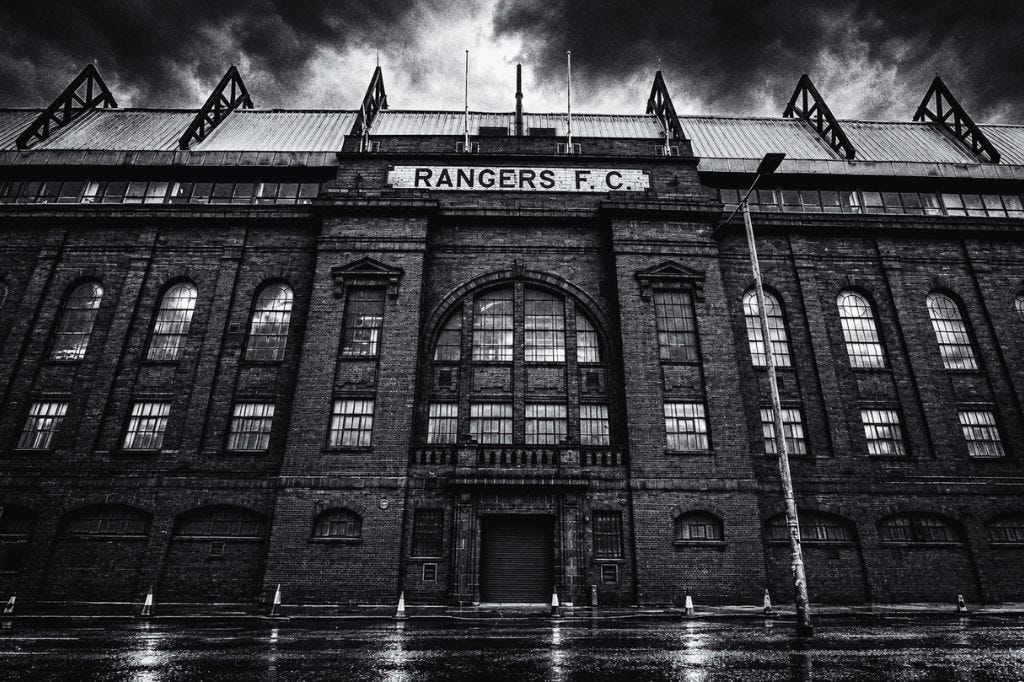
There are football clubs, and then there are institutions. Rangers were an institution. For generations, the club stood for more than ninety minutes on a Saturday afternoon. It was a name inherited before it was understood. It belonged to fathers and sons, mothers and daughters, families and friendships, streets and towns across Scotland and far beyond it. It lived in the noise of Ibrox, in the climb of the marble staircase, in the sight of a blue shirt under floodlights and in the expectation that Rangers should win.
Rangers were not supposed to be fragile.They were not supposed to need saving.They were one half of the Old Firm, one of the dominant commercial forces in Scottish sport and a club whose history had been built around continuity. Managers could fail. Players could leave. Seasons could disappoint. Boards could be criticised. But Rangers would remain.
That was the belief. Then, on Valentines Day 2012, that belief shattered as Rangers Football Club entered administration.
A ten-point deduction followed. The title challenge that season was over. HM Revenue & Customs was pursuing unpaid PAYE and VAT. Administrators entered Ibrox. Employees, players, creditors and supporters waited to discover whether one of Scotland’s largest football clubs would survive.
The immediate explanation seemed simple.Craig Whyte had bought Rangers from Sir David Murray for £1 less than a year earlier. He had promised to clear debt, fund the club and restore financial freedom. Instead, he had used money linked to future season-ticket sales to help complete the takeover, and Rangers had failed to meet tax obligations that any functioning business should have paid.
Whyte became the face of the collapse. It was easy to understand why. He was the new owner. He had made the promises. He had taken control. The club entered administration during his ownership. He was the obvious villain in a story that demanded one. But the story did not begin with Whyte.
It began years earlier, when Rangers were winning titles, signing expensive players and presenting themselves as one of Britain’s great football institutions. It began in boardrooms, banks, tax offices and legal documents. It began with borrowing, wage commitments, Employee Benefit Trusts, side letters and the belief that a club of Rangers’ size could always find another solution. That belief was not confined to supporters.
It existed among directors, bankers, football authorities, journalists and those who moved through the tightly connected world of Scottish business and sport. Rangers were too important to fail. Ibrox was too valuable to close. The supporters were too numerous to abandon. The Old Firm was too central to Scottish football’s commercial life to allow one half of it to collapse.
For years, the club behaved accordingly. Rangers spent to win. For every fiver Celtic spent, Rangers would spend a tenner - that was the mantra. They borrowed to compete. It used financial structures intended to reduce the cost of paying elite players. It entered into side-letter arrangements that football authorities later concluded should have been disclosed. It carried debts and risks that grew harder to manage once the age of easy credit ended. And when the bank finally demanded repayment, Rangers were sold to a man who appeared to offer an escape. A new beginning. The price was £1. The cost was everything.