

There is a particular kind of dread that settles over a Celtic supporter in moments like this. Not the dread of losing, though that is painful enough, but the dread of watching your club stumble at a moment when clarity and decisiveness are desperately needed. We are at such a moment now. The managerial appointment that Dermot Desmond is about to make - and we all know it is down to him and him alone - will either launch Celtic into a new era of genuine ambition or condemn them to another cycle of stagnation dressed up as progress. The stakes could not be higher, and the warning signs could not be clearer.
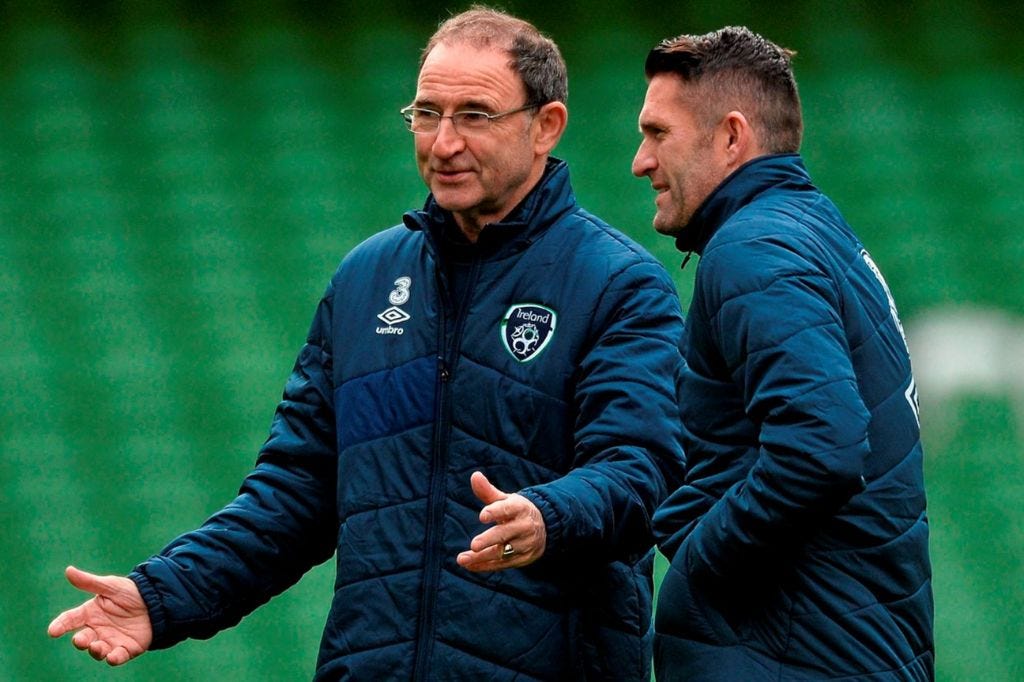
By the end of this week, if reports are accurate, Desmond will have held talks in London with both Martin O’Neill and Robbie Keane, the two men now at the front of the queue to take charge at Parkhead next season. No other candidates are in the frame. In the space of a few days, the future direction of Scotland’s biggest and most successful club will be decided and if Desmond and the Celtic board get it wrong again, the consequences will reverberate far beyond a single season - although the pessimist in me, thinks that Desmond has already made his mind up before the talks.
Let us begin with some honesty about what Celtic actually faces. This is not a routine appointment. The club has just won a remarkable league and cup double under O’Neill, a man who was brought back with the club in crisis and performed a near-miracle by steadying the ship - not once but twice. That achievement deserves genuine respect and gratitude. But the summer ahead is not about sentiment. It is about construction. Celtic need a substantial rebuild of their squad before the Champions League play-off in mid-August. The new manager must be given as much time as possible to reshape the group, but leeway is tight and the margin for error is almost non-existent. Whoever takes this job must be someone capable of hitting the ground running. Is that man Keane? Or is it the present incumbent Martin O’Neill?
The Ghost of Wilfried Nancy
Before Celtic’s hierarchy commits to anyone, they owe themselves and the club’s supporters one long, uncomfortable look in the mirror, because the Wilfried Nancy episode should haunt this process like a spectre.
Nancy arrived at Celtic Park with what fans were told were ‘impressive’ credentials from his time in the MLS with CF Montréal and Columbus Crew. Some of us were less than impressed before a ball was kicked under his management. Yet the theory was sound enough - a young, dynamic coach who had overperformed in league ranked higher than the SPFL, an attractive prospect on the face of it. The reality was a complete and utter catastrophe. Nancy was a deeply poor fit for the demands of Scottish football let alone the pressures of managing Celtic, where expectation is not just high, it is relentless, total, and unforgiving. He made mass changes more or less immediately. The players clearly lost confidence in his methods or didn’t have a clue how to implement them. The results were dire. The atmosphere at Parkhead curdled. In the end, his dismissal after 33 days was inevitable, his tenure damaged Celtic’s title winning chances, with the majority of fans and pundits alike seeing any title win as nigh on impossible.
The lesson was not simply that Nancy was the wrong man. The lesson was that Celtic cannot afford to appoint the wrong man. Not even once. Not even for a short while. Not even when the choice looks intriguing on paper. The club’s season is simply too compressed, the pressure too immediate, the cost of a false start too severe. And yet here we are, on the verge of another appointment, with the clock ticking and the Champions League barely two months away.
A repeat of the Nancy situation, even a milder version, could cost Celtic Champions League qualification once again. That cannot happen. The hierarchy needs to be right, first time, and then back whoever they choose with the full financial and structural support the job demands.
Martin O’Neill: The Safe Harbour
There is a compelling case, built on emotion and pragmatic logic in almost equal measure, for simply handing Martin O’Neill the job on a permanent basis and letting him see out one more chapter with the club he loves.
O’Neill is a Celtic legend. There is no denying that. His first tenure between 2000 and 2005 transformed the club, producing that astonishing run to the UEFA Cup final in Seville in 2003, along with some big results domestically and in Europe. His connection to the supporters is deep and visceral. When he walked back into Parkhead last season, the support from the stands was immediate and real. And then he delivered. Against the odds, against the pressure, against the chaos of a season that had already been derailed, O’Neill guided Celtic to a league and cup double. That is no small feat given the state that the club was in on and off the park.
He has also, crucially, already said he would not rule out starting the new season in the dugout. The infrastructure he has built around him with Shaun Maloney, Stephen McManus, and Mark Fotheringham provides a ready-made coaching unit that knows the club, knows the players, and knows exactly what Scottish football demands.
But O’Neill himself has been the most honest voice in this conversation. He is 74 years old. He has stated plainly that he does not see himself as the right candidate if Desmond is looking for someone to lead a long-term project. And that, ultimately, is precisely what Celtic needs. Not a custodian. Not a caretaker elevated to permanence. The club requires a coach who will be here in three years’ time, who will recruit with a plan that extends beyond one window, who will embed a playing identity that develops over multiple seasons. O’Neill is a brilliant football man. But there is something almost noble in his own recognition that this job, in its full scope, might belong to someone younger.
That said, if the alternative being offered is Robbie Keane - with everything that brings - then O’Neill’s case strengthens considerably, and a shorter-term arrangement might still be the wiser choice for a club that has no long-term strategy when it comes to the football side of the business.
The Robbie Keane Problem
Let us talk about Robbie Keane. And let us do so without pretending the full picture does not exist.
On paper, certain elements of Keane’s candidacy make sense. He is a self-confessed Celtic supporter. He played for the club on loan in 2010. He has managed Ferencvaros in Hungary, where he won the league and cup double in an 18-month stint; and before that, Maccabi Tel Aviv in Israel, where he also claimed the title. He is 45 years old, young enough to commit to a multi-year project, which he is reportedly willing to do for three years. He has reportedly already identified former Celtic players Scott Brown and Johnny Hayes as potential backroom figures. There is a vision, a timeline, and an enthusiasm from the man himself.
These are not nothing. Keane is clearly serious about this opportunity, and his managerial record, while not extensive, is not without merit.
But there is a dimension to this candidacy that a substantial portion of Celtic’s support finds deeply uncomfortable, and it would be an act of cowardice to ignore it.
Robbie Keane managed Maccabi Tel Aviv. Maccabi Tel Aviv is not merely a football club that happens to be Israeli. It is an institution with explicit ideological commitments, a club whose ultras and ownership have shown unwavering support for Israel’s military operations in Gaza - operations that have been described by United Nations officials, international legal bodies, human rights organisations, and any right-minded individual as ethnic cleansing and genocide. The images of Maccabi supporters celebrating military strikes, of club officials making statements that aligned the club with state violence, are not fabrications. They are well-documented.
Celtic’s fanbase has one of the most visible and passionate records of Palestinian solidarity in world football. The Green Brigade’s display of Palestinian flags during a Champions League match in 2016, which resulted in a UEFA fine that supporters crowd-funded and doubled as a donation to Palestinian charities, became a symbol recognised worldwide and celebrated. For a significant, vocal and principled cohort of Celtic supporters, the idea of appointing a man who managed Maccabi Tel Aviv while that institution supported the genocide in Gaza is not merely uncomfortable. It is a line they will not cross in silence.
This is not a fringe view. It is not the position of a tiny minority of militant Celtic fans who can be safely dismissed. It is the considered moral position of thousands of Celtic supporters for whom the club’s identity - rooted in the Irish diaspora, in solidarity, in the historical understanding of what it means to be dispossessed and persecuted - cannot be separated from what is happening in Gaza. For those supporters, the appointment of Keane would represent a betrayal of something they believe is fundamental to what Celtic means.
Dermot Desmond, as we all know, cares not one iota about what the Celtic fans think. One of the few businessmen in the world that controls a business with such a sizeable following and treats them like shit. But if he thought last season was a bump in the road, he needs to think again, he would be making a serious error if he dismissed concerns around Keane simply as noise. The atmosphere at Parkhead, the energy in the stands, the relationship between the club and its most passionate supporters, these are not peripheral to Celtic’s success. They are central to it. A manager who takes the job under a cloud of protest, who is met with banners demanding his removal before he has taken a single training session, begins at a significant disadvantage. That is a problem of Desmond’s making once again if he ignores the signals - which he undoubtedly will.
Back Them. Properly. Generously. Without Hesitation.
There is one more thing that must be said, clearly and without qualification - whoever is appointed as Celtic manager must be backed fully.
Not with promises. Not with vague assurances about “investment.” With actual money, actual first-team ready players, actual structural support - delivered quickly, delivered decisively, and delivered in proportion to the scale of the task at hand.
This squad needs significant rebuilding. That is not an opinion; it is a fact. The last-gasp nature of Celtic’s title win, secured through the extraordinary efforts of a manager brought back from semi-retirement, was not the product of a cohesive, well-constructed team operating at full capacity. It was the product of experienced heads, a dramatic late run, and a monumental intervention by a man who should have been allowed to enjoy his retirement in peace. The underlying structural issues in the squad have not been resolved with the title win, they have simply been papered over.
The Champions League play-off in August is not a formality. Celtic will be a side at the start of their rebuilding process, with a new manager barely weeks into his tenure, will be vulnerable unless that rebuild is completed at pace and with genuine quality.
The new manager must be given a budget that reflects the ambition this club is supposed to represent. He must be given the authority to move players on without bureaucratic delay. He must be supported in the recruitment of his own backroom staff. And he must be trusted to make decisions - even difficult ones, even expensive ones - without having to fight the boardroom for every signature. Which seems to be the norm with this Celtic hierarchy.
The Nancy disaster was not only about managerial quality. It was also about what happens when a club fails to create the conditions for success. When the support is thin, when the backing is hesitant, when the institutional structures creak under the weight of mismanagement and half-measures. Celtic must not repeat that failure.
The Moment of Truth
Dermot Desmond is, by all accounts, leaning towards Robbie Keane. He controls Celtic despite not having a majority shareholding and by the looks of it he is the only one making the decision on who our new manager is.
But he should make it with full awareness of what he is choosing. He should make it knowing that a significant portion of the club’s most committed supporters will regard a Keane appointment as a moral failure, and that the noise will not disappear once the announcement is made. He should make it knowing that O’Neill, for all his age and acknowledged reservations about the long term, has already demonstrated this season that he can still manage at the highest level of Scottish football. And he should make it knowing that getting this wrong again, in the way Celtic got it wrong with Nancy - is not an option the club can afford.
Whatever the outcome of those London meetings, one truth remains non-negotiable: Celtic cannot stumble into this appointment. They cannot hedge, or compromise, or choose a name for the optics of it rather than the substance. They cannot appoint someone and then fail to fund the rebuild. They cannot, once again, let the summer drift past in uncertainty and political manoeuvring while the squad stagnates and the Champions League looms.
The double is won. The celebrations are over. Now the real work begins.
The supporters are watching. The empty Parkhead seats of a future campaign and a continued boycotting of merchandise etc. will be the verdict, if they do not.
Of if not equal importance, is who is going to be responsible for identifying potential players. It doesn't matter if it's Keane or O'Neill, he can't make a silk purse out of a sow's ear. If the January window is anything to go by, the future fills me with dread.
Personally, with the current state of the club, I don’t think it would be a bad idea to engage MON for another year to work with the team. Plan to engage the younger manager for the longer term project at the end of next season when we (hopefully) have rebuilt the squad to a certain extent. In the meantime, the club could recruit personnel and put in place all the structures we need for effective, modern player recruitment, ready to work with the new manager when he arrives. As regards Desmond and his apparent preference for Keane, I can’t help asking myself what might be his motivation for that appointment. He obviously knows the level of resistance to it but still seems hell bent on getting his way like a truculent teenager - which is entirely consistent with the speech delivered by his son at the last AGM. It looks for all the world like hubris and arrogance related to his position as “owner” of the club when he is not actually the owner. I wonder whether the club can move forward with Desmond in his current role and a board filled with lapdogs who allow him to do whatever he wants? I suspect not no matter who is in the dugout.