

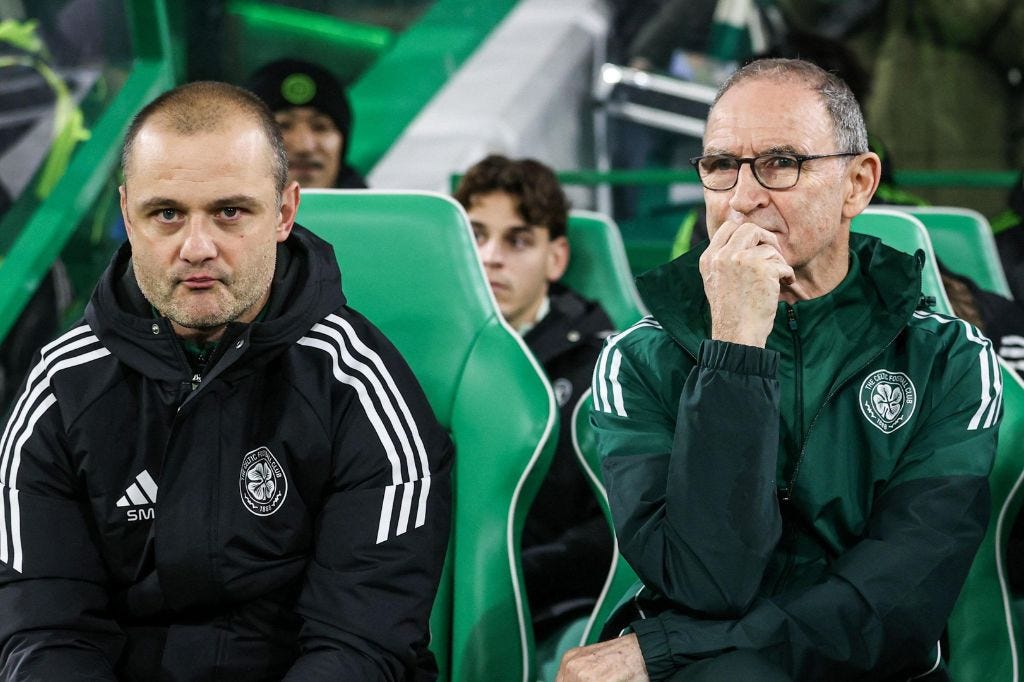
Scottish football has always had a weakness for the returning hero. The old manager or club legend coming back, the club rediscovers its bearings and a familiar face restores a little order to a place that has lost its way. Martin O’Neill’s return to Celtic last season offered precisely that kind of comfort - a revered figure reappearing at a moment of uncertainty, carrying with him the authority of past triumphs and the promise that some problems can still be solved by experience, personality and a forceful presence in the room.
O’Neill did not merely return. He steadied the club, presided over a domestic double and was rewarded with a permanent deal. At 74, he was welcomed back as both manager and symbol - a reminder of a more forceful Celtic, one with a clearer emotional register and a greater confidence in its own identity. It was easy to understand the appeal. Football clubs often turn to familiar figures, to club legends not because they offer novelty, but because they offer reassurance and hope of a return to more successful days.
Yet the longer this Celtic season has developed, the harder it has become to ignore an awkward reality. The football being played has little obvious connection to the football O’Neill spent his managerial career constructing. The structures, rotations and patterns of possession have another author. O’Neill may be the public face of the project, the figure receiving the ovations, the plaudits when they come, and facing the microphones, but the tactical architecture belongs to Shaun Maloney.
That distinction matters. It matters because Celtic’s recent performances have not merely raised questions about results. They have raised a more fundamental question about authority - who is actually deciding how this team plays?
A partnership of contrasts
The initial description of O’Neill and Maloney’s roles was revealing, even if it did not initially seem so. Callum McGregor spoke warmly of O’Neill’s capacity to bring calm, character and continuity to a dressing room that had endured an unsettled period. He spoke equally warmly of Maloney’s work on the training ground - the intensity of the sessions, the quality of the coaching, the standards he demanded every day.
It sounded, at the time, like the normal division of labour within a coaching staff. One man supplied stature and perspective; the other supplied detail and energy. Celtic were winning, which tends to settle such matters before anyone has to examine them too closely.
But winning can conceal the nature of an arrangement rather than explain it. It can turn an imbalance into a virtue. It can make delegation appear seamless even where one person is visibly shaping the football more than another.
The clearest glimpse of that came during Celtic’s extra-time victory over Rangers in the Premier Sports Cup semi-final. With the game stretched and the pressure mounting, it was Maloney who appeared to be driving the tactical urgency from the technical area. He urged players higher, demanded that the press remained aggressive and addressed the players before extra time with the kind of short, focused instruction usually associated with the coach who has spent the match calculating its next tactical turn.
O’Neill, by contrast, was described as overseeing the larger context. There is nothing inherently wrong with that. A manager does not need to bark every instruction or map every passing lane. But the phrase carries an implication - the fine-grain work, the football itself, belongs elsewhere.
At Celtic, it increasingly belongs to Maloney.
The shape of Maloney’s team
There is little mystery about the kind of football Maloney wants to coach. His previous managerial work has been uneven in results but remarkably consistent in intention. At Hibernian, he spoke of possession, bravery on the ball and the need to play at a higher tempo. He wanted defenders and goalkeepers to begin attacks from deep, full-backs to advance with purpose and his team to create overloads rather than simply wait for space to appear.
At Wigan Athletic, he moved away from a conventional 4-2-3-1 towards a more fluid back-three system, built around rotation, a double pivot and control through the ball. The intellectual roots were clear enough. Maloney played under Roberto Martínez and absorbed many of the positional ideas that shaped Martínez’s teams - build from the back, manipulate opposition structure, create superiorities in central areas, trust the ball as both an attacking weapon and a form of defensive control.
The details now visible at Celtic are difficult to separate from that background. Celtic’s attacking shape has frequently resembled a 2-3-5 or 3-2-5. Full-backs drift inside to support the midfield platform or push high to stretch the opposition. Wide players and advanced midfielders occupy half-spaces. The ball is circulated patiently, often with the aim of creating a third-man run or an underlap behind the first line of pressure.
This is not simply modern football in a generic sense. It is recognisably Maloney’s football. The principles are familiar from his work at Hibernian and Wigan, wide centre-backs, diagonal progressions, midfield rotations and a belief that structure can create the moment before individual quality finishes it.
It is also a world away from O’Neill’s established managerial identity.
The first O’Neill Celtic team was built on force, speed, crossing and a kind of purposeful emotional aggression. It had technical players, certainly, but its strengths were rarely hidden beneath layers of positional choreography. His best sides overwhelmed opponents physically and psychologically. They attacked with conviction, made territory matter and treated aerial dominance as an essential part of their authority.
There is no reason why a 74-year-old manager cannot evolve. Football would be a poorer place if every coach were trapped by the ideas with which he first made his name. But there is a difference between evolution and substitution. What Celtic are doing now does not look like a refined version of O’Neill’s football. It looks like a different footballing language spoken by a different coach.
O’Neill’s influence remains real
To say this is Maloney’s tactical team is not to argue that O’Neill has become irrelevant. That would be simplistic, and it would underestimate what he has restored.
Celtic required more than a formation when he returned. They needed a sense of consequence. They needed someone capable of making the club feel less brittle, of restoring a degree of authority around the dressing room and the stadium. O’Neill has always understood the emotional demands of Celtic Park - the need to play on the front foot, the appetite for width and delivery, the requirement that opponents feel pressure even when they have possession.
His influence can be felt in Celtic’s willingness to go forward early, to attack from wide areas and to make the penalty area a place of confrontation rather than merely the final point in a passing sequence. There is a preference for crosses, for second balls, for forcing defenders into decisions they do not want to make.
Those are meaningful instincts. They may even be necessary instincts at a club where possession for its own sake has never been enough.
But instinct is not the same as system. O’Neill’s contribution appears to be one of tone, tempo and mentality. Maloney’s is one of positioning, structure and repeated tactical pattern. The manager supplies the emotional weather; the assistant seems to be drawing the map.
Maloney’s own description of the changes after O’Neill’s arrival was telling. He described tactical alterations as slight, with the greater adjustment involving a mentality to run beyond the opposition and use the wide players more aggressively. It was a revealing formulation. If the tactical shifts were genuinely minimal, then the underlying framework was already in place. O’Neill had not rebuilt Celtic’s football. He merely added urgency to it.
That may be an entirely sensible arrangement when it works. But it becomes more problematic when the structure itself begins to fail.
Linz and Ibrox exposed the faultlines
Celtic’s second leg collapse against LASK was not simply a bad result. It was a demonstration of the risks built into their current football. Holding a 4-0 lead after the first leg, Celtic travelled to Linz with every opportunity to manage the tie sensibly. They did not need to abandon ambition, but they did need to understand the circumstances. The occasion demanded control in the broader sense - compact distances, protection for the central defenders, fewer players committed ahead of the ball and an acceptance that the most attractive solution is not always the most appropriate one.
Instead, Celtic continued to expose themselves in the spaces behind their attacking structure, while the defence was repeatedly stretched. The pivot was drawn towards the ball. The back line was left flat and vulnerable. LASK found access to the far-side channel with alarming ease, exploiting the space Celtic’s shape had voluntarily surrendered.
The problem was not a lack of courage. Celtic had too much of one particular kind of courage - the determination to continue playing their preferred way even when the match demanded a more conservative answer.
That is where the distinction between O’Neill and Maloney becomes significant. O’Neill’s teams, for all their limitations and occasional crudity, generally understood the value of survival. They knew how to play ugly football. They knew how to turn the final half-hour into a series of duels, crosses, clearances and territorial battles. They could close a door.
Celtic in Linz seemed unable to find the door.
Then came Ibrox on Sunday. Rangers’ 3-0 victory was not merely emphatic; it was destructive. Celtic were beaten in the physical and tactical contest. Rangers pressed man for man, disrupted the first phase of build-up and left McGregor exposed in midfield. Celtic’s structure, intended to give them numerical superiority and passing options, instead produced confusion. Players appeared disconnected, unable to create stable angles under pressure and unable to protect the central spaces when possession turned over.
The criticism that followed was unusually pointed. The concern was not simply that the team had played poorly. It was that the coaching operation appeared unclear. There were questions over whether the team was moving between competing ideas, whether different approaches were being imposed from one phase of a match to another, and whether Celtic had reached a point where a committee was effectively trying to manage the team.
That is the danger of hybrid management. When it succeeds, it looks like collaboration. When it fails, it looks like indecision and cluelessness.
The question Celtic cannot avoid
There is an obvious defence of the current setup. Assistants coach. Managers delegate. No senior coach works alone, and football is increasingly built around specialist staff with responsibility for set pieces, analysis, player development, opposition preparation and training design. It would be absurd to suggest that every movement in a successful side must originate in the manager’s own notebook.
But there is a difference between an assistant helping to deliver a manager’s vision and an assistant creating the vision itself.
Most assistants are translators. They help articulate a footballing identity already established by the manager. Maloney’s role at Celtic appears more substantial than that. The patterns of play are not merely compatible with his own history; they are almost identical to it. The back-four principles, the positional rotations, the half-space occupation and the insistence on building through structured possession all resemble the ideas Maloney has pursued independently elsewhere.
O’Neill, meanwhile, remains an unusually important figure around the club. His return has provided authority and familiarity. He has restored a sense of weight to the dugout. He has reminded Celtic that football is not reducible to diagrams, data points or the clean geometry of a passing network.
Yet the central problem remains. A football club can have a public manager, a spiritual leader and a tactical architect, but it needs clarity about how those roles connect. Players need to know whose instruction are primary. Supporters need to understand what the team is trying to do and to become. And when a performance collapses, someone needs to have the authority to change course rather than preserve a system for the sake of consistency.
Celtic’s current side is caught between two compelling but incompatible impulses. One belongs to Maloney - patient possession, positional control, rotations and the belief that the game can be solved through superior structure. The other belongs to O’Neill - directness, confrontation, width, urgency and a conviction that football sometimes needs to be felt before it can be understood.
There is room for both. In fact, Celtic may need both.
But a team cannot be jointly authored forever. At some point, somebody must decide whether the football belongs to the manager whose name is on the door or the assistant whose ideas are on the pitch. Until then, O’Neill will continue to carry the burden of Celtic’s successes and failures, while Maloney’s tactical fingerprints remain visible all over a side that has yet to decide exactly what it is.
The real threat now for Celtic supporters is that come the end of the season, Martin O’Neill will retire as Celtic manager and Dermot Desmond will promote Shaun Maloney to manager - a plan that looked written in the stars since the sacking of Wilfried Nancy back in January. God help us if that comes to fruition.
I think many of us have worked for a boss who delegates responsibility to us for something and then comes along and changes bits of what we’ve done and the whole thing collapses. You’re convinced that it’s failed because of his tinkering and he’s sure it’s failed because it wasn’t good enough in the first place despite his attempts to fix its most obvious defects. I have no idea whether Shaun Maloney is a good enough coach for Celtic, but it’s certainly quite clear that the current arrangement isn’t working. To be frank, it wasn’t very good last season either, but they got away with it. Lady Luck has left the building.