

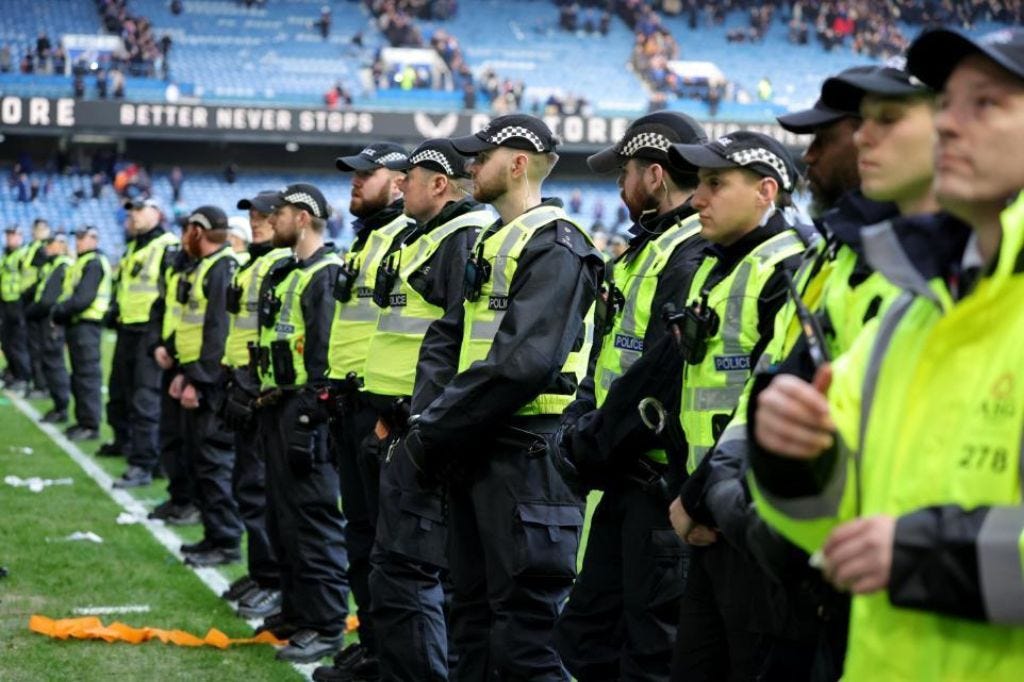
A repeat of the disorder we saw at Ibrox last season is not inevitable, but only if Scotland finally takes matchday safety out of the hands of the conflicted interests Rangers and Police Scotland.
The news that Rangers will host Celtic at Ibrox in the Premier Sports Cup quarter-final, only months after disorder marred the Scottish Cup tie between the same opponents at the same venue, should not be treated as routine football business. It should be treated as a live safety test for Scottish football’s governance, policing, and club accountability.
The independent review into the March 8th disorder at Ibrox didn’t pull its punches, it described the events as a “significant failure of planning, communication and matchday safety” and warned that several moments came within a very small margin of becoming a violent mass confrontation with the potential for fatalities. Yet, as things stand, the same system of actors - Rangers, Police Scotland, contracted security firms, and the clubs’ own internal safety structures - is being asked to plan and police the next Glasgow derby cup tie at Ibrox with no binding external authority to overrule them when risk assessments are downgraded or when operational decisions prioritise convenience over safety.
That is not acceptable. The League Cup quarter-final must be planned and overseen by an independent body with real teeth, a body that can set minimum standards for staffing, segregation, and police presence; that can compel the disclosure of information on known risk groups; and that can hold Rangers, their security contractors, and Police Scotland to account for every decision taken before, during, and after the match. Anything less repeats the failures that produced the Ibrox disorder in the first place.
What went wrong at Ibrox and why it matters now
The independent review, led by consultant Mark Blackbourne, commissioned by the Scottish FA, makes clear that the disorder was not simply the result of a few “bad apples” rushing the pitch after Celtic won the penalty shootout. It was the product of systemic weaknesses in planning and risk assessment that left the matchday operation exposed when emotions spiked.
Key findings included:
The initial risk assessment underestimated the unique challenges posed by a large away allocation at Ibrox, the first such fixture en masse since 2018.
Planners failed to appreciate how quickly emotions could escalate after a penalty shootout, despite the obvious flashpoint that such a climax represents.
There were disagreements over supporter routes, concerns about turnstile arrangements, insufficient crowd segregation, weaknesses in ticket checking, and inadequate contingency plans for forced entry.
The report highlights that a “crushing incident was a real and foreseeable risk” due to non-compliant ultra-group fans surging past police and stewards.
Most chillingly, the review notes that the four minutes and 28 seconds it took police to re-establish control on the pitch was a period in which “life-threatening violence” was possible.
In other words, the disorder was not an unforeseeable bolt from the blue. It was the foreseeable outcome of a planning process that did not treat the fixture with the seriousness it demanded.
Both Rangers and Celtic now face disciplinary charges under the Scottish FA’s Rule 37 on “good order and security” and “unacceptable conduct”. That is a necessary step, but it is not sufficient. Sanctions after the fact do not prevent the next failure in real time. The question for the League Cup tie is not only “who will be punished?” but “who will be in charge?”
The League Cup context - fewer guarantees, more risk
The ticketing context for the League Cup quarter-final adds another layer of risk. Under Scottish Cup rules, the away club could request up to 20 per cent of available tickets, a provision that helped Celtic receive more than 8,000 seats at Ibrox in March. League Cup regulations, however, contain no equivalent guarantee. That means the away allocation could be cut dramatically, concentrating more home supporters in and around the stadium while reducing the formal space for away fans.
Smaller away allocations do not eliminate risk; they can amplify it. They increase the likelihood of angry disgruntled fans gathering outside the stadium, complicate exit routes, and intensify the pressure points where rival groups might meet. If the away support is squeezed into a smaller footprint while the overall emotional charge of a Glasgow derby cup tie remains the same, the margin for error shrinks further.
This is precisely the moment when an independent safety authority is most needed, when commercial and competitive incentives might push clubs and police towards minimal compliance rather than best practice. Without a body that can set and enforce best practice standards for away allocations, segregation, and staffing levels, the League Cup tie risks becoming another cost-cutting exercise dressed up as operational prudence.
Policing, double standards, and the Trongate shadow
Police Scotland’s Operation Moonglint has made 37 arrests to date in connection with the Ibrox disorder, with injuries reported among police and stewards. At the same time, detectives have issued multiple CCTV appeals and identified 83 people they wish to speak to over the Trongate disorder following Celtic’s title win, with two police officers sustaining injuries and three civilians requiring medical attention. Media coverage has highlighted aggressive police tactics during the Trongate investigation, including TV crew “ride-alongs” and forceful entry methods that look more like drugs raids on Pablo Escobar than public-order investigations.
The contrast is stark. On one side, there is a high-visibility, high-intensity policing posture towards Celtic fans associated with Trongate, amplified by media access and dramatic enforcement imagery. On the other, there is widespread frustration that the same level of investigative zeal has not been directed at those who attacked officers, stewards, Celtic players and officials, and a Rangers club official inside Ibrox, including members of the Union Bears ultra group identified in reporting as initial perpetrators of the pitch invasion.
The independent review does not exonerate any group; it criticises ultra groups on both sides and describes their behaviour in terms more often associated with organised crime than spontaneous fandom. But the perception - and, for many fans, the lived experience - is that enforcement is selective. That perception corrodes trust. It makes cooperation with police less likely. It encourages a narrative in which one set of fans is treated as inherently criminal and another as indulged until things spiral beyond control.
For the League Cup tie, that dynamic is dangerous. If Celtic fans believe they will be treated as the primary threat regardless of behaviour, and if Rangers fans believe that only the most egregious conduct will be pursued, both groups have less incentive to align with safety instructions. An independent body cannot solve cultural bias overnight, but it can impose transparency by publishing risk assessments, staffing plans, and post-match reviews so that decisions can be scrutinised and, where necessary, challenged.
Why stewards are not enough and why police presence must be meaningful
The independent review is clear that stewards, however numerous, are not a substitute for properly resourced police operations in high-risk fixtures. Stewards are not trained for crowd management, they are not trained to deal with coordinated surges, missile-throwing, pyrotechnics, or violent confrontations involving weapons. The report’s description of ultra groups behaving like “organised crime groups” underlines the mismatch between the threat and the tools available to private security staff.
At Ibrox in March, police officers and stewards struggled to restore order as Rangers fans ran the length of the pitch to attack celebrating Celtic fans, fireworks were thrown, and missiles flew. The review’s warning that life-threatening violence was possible in the minutes before control was re-established is not hyperbole; it is an operational assessment.
For the League Cup quarter-final, that means:
Police Scotland must not plan to the bare minimum. The “minimum necessary” posture criticised in the wake of Ibrox cannot be repeated when the stakes are this high.
There must be a visible, mobile, and rapidly deployable police presence capable of intervening before small incidents escalate into mass confrontations.
Protection for players and club officials must be treated as non-negotiable. The March disorder saw Celtic staff and players attacked after the penalty shootout; that cannot be allowed to happen again - even though it has happened many times at Ibrox over the years without the authorities and Rangers themselves dealing with it.
Contingency plans must include clear protocols for pitch invasions, including immediate suspension of play if safety is compromised and pre-agreed routes for evacuating vulnerable individuals from the field.
To suggest that hundreds of stewards can substitute for this level of policing is to ignore the lessons of March. Stewards are part of the solution; they are not the solution.
The case for an independent matchday safety authority
The core argument is simple, the agencies with the most to lose - reputationally, commercially, and competitively - should not be the only ones setting the rules for high-risk fixtures. Rangers, as home club, have a direct interest in maximising capacity and minimising disruption. Police Scotland faces resource pressures and political scrutiny. The Scottish FA and SPFL want the competition to run smoothly and avoid reputational damage. All of these incentives can, in certain circumstances, align against the most conservative, safety-first approach.
An independent matchday safety authority or a significantly strengthened and formalised Safety Advisory Group with statutory powers, could:
Set binding best practice standards for high-risk fixtures, including minimum police numbers, segregation distances, and staffing ratios for stewards and security firms.
Require clubs to share information on known risk groups, including membership lists where legally permissible, and ensure that this intelligence is acted upon rather than filed away.
Approve or reject operational plans, with the power to demand changes before a match is given the green light.
Conduct real-time oversight on matchday, with the authority to halt or delay kick-off if conditions are not met.
Publish post-match reviews that name failures and assign responsibility, making it harder for clubs and agencies to hide behind vague statements about “a small minority”.
The independent review already points in this direction. It criticises the current sanctions regime as “too modest, too deferred and too inconsistently applied to alter the behaviour of the clubs, groups and individuals they are designed to deter”. It also notes the vacuum left when recommendations from Glasgow City Council’s Safety Advisory Group were overturned at a senior level within Police Scotland, and it welcomes the idea that the status of Safety Advisory Groups should be formalised and strengthened.
That is the blueprint. What is missing is the political will to implement it before the next Glasgow derby tie, not after the next inquiry.
What Celtic fans can and should do - without absolving anyone else
For Celtic fans attending the League Cup quarter-final, the advice must be pragmatic and unsentimental. Support the team. Celebrate the win if or should I say when it comes. Wind up the opposition all you want. But do not rely on systems that have already shown they can fail.
Practically, that means:
Be aware that stewarding, despite the numbers, are not fit for purpose in a fast-moving disorder scenario.
Understand that police tactics may be heavily skewed towards controlling away fans, regardless of who initiates trouble.
Avoid unnecessary flashpoints: large, coordinated displays that could be misread as provocations; congregating in known tension zones; or lingering in restricted areas after the final whistle.
Keep moving with the flow of the crowd when exiting, and follow the safest exitroutes even if they are longer.
Record incidents where possible, but prioritise personal safety over documentation.
And god forbid, refrain from blessing yourselves too aggressively, for an enraged David Tanner will spit blood your way.
None of this is intended to let Rangers, their security firm, or Police Scotland off the hook. It is an acknowledgment that, until an independent body with real authority is in place, fans must act as if the system is fragile, because the independent review says it is.
Accountability cannot wait for the next disaster
The Scottish FA’s independent review into the Ibrox disorder is one of the most damning documents ever produced on matchday safety in Scottish football. It lays bare failures of leadership, planning, and coordination that left police officers “petrified” and brought the sport to the brink of a mass-casualty incident. It also exposes a disciplinary architecture that clubs and fans alike have learned to game - complain about the other side’s supporters, resist responsibility for your own, and accept that sanctions will be modest and delayed.
The League Cup quarter-final at Ibrox is not just another Glasgow derby. It is the first major test of whether Scottish football has absorbed those lessons. If the same actors are allowed to plan and police the match with no independent oversight, the answer will be no. If, instead, an independent body is empowered to set and enforce safety standards, to demand transparency from clubs and police, and to hold all parties accountable in real time, then there is a chance that the next chapter in this story will be about prevention rather than inquiry.
The choice is not between “tough on fans” and “soft on disorder”. It is between a system that learns from near-misses and one that waits for a catastrophe to force change. Given what the independent review has already revealed about Ibrox in March, Scottish football does not have the moral right to wait any longer.