

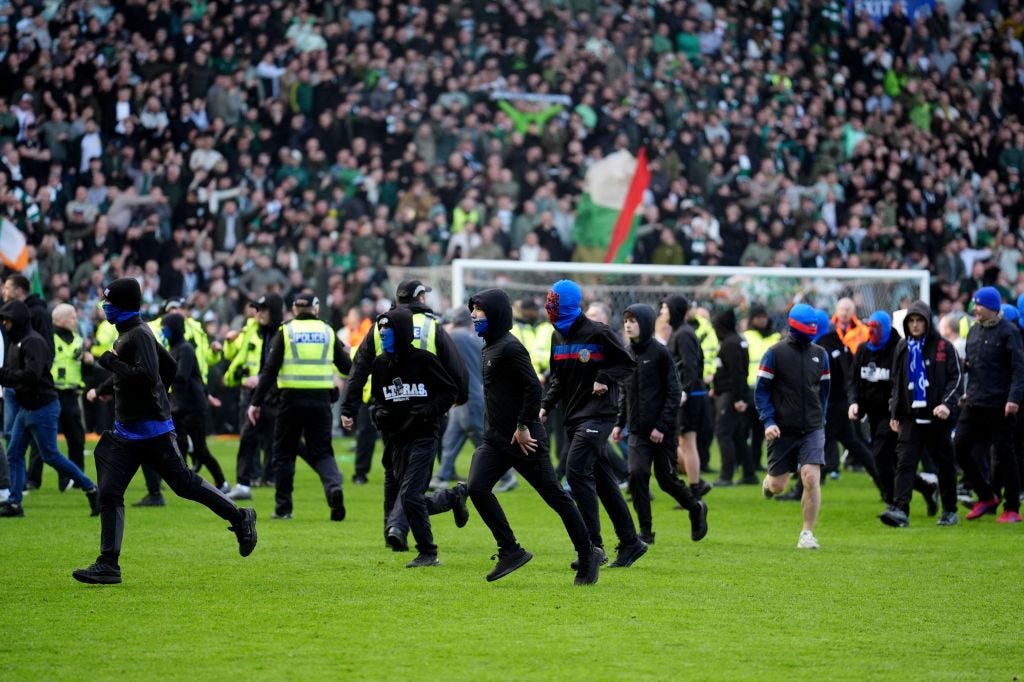
The Independent Review into the events at Ibrox on 8 March 2026 has delivered a devastating verdict on Scottish football’s disciplinary architecture. It read, “Sanctions are too modest, too deferred and too inconsistently applied to alter the behaviour of the clubs, groups and individuals they are designed to deter.”
This is not a failure of individual cases or isolated incidents. It is a systemic collapse. The disciplinary framework exists to reverse the upward trajectory of unacceptable conduct. The evidence of this review is that, in its current form, it is not doing so.
But here is the uncomfortable truth that the review dances around, this is not an accident. The current disciplinary framework’s inadequacy is the direct result of a deliberate choice by Scottish clubs, a choice they have consistently reaffirmed over more than a decade. It is the product of collective self-interest masquerading as principle, of hypocrisy dressed as practicality, of clubs who want opposition fans punished while refusing to accept responsibility for their own.
A Framework Designed to Fail
The review identifies nine damning observations about the Scottish FA and Scottish Professional Football League frameworks. The Scottish FA has not imposed a single immediate crowd restriction as a first-response measure in the 2025/26 season. Every venue closure sanction was suspended. The Scottish FA’s maximum immediate financial penalty applied in 2025/26 would not deter a club operating at any professional level. The SPFL’s cash equivalent for suspended ticket reductions is of similarly low consequence.
The Scottish FA applied the full three-limbed charge - prevention, identification, and sanction - in only one of its three 2025/26 cases. The other two were limited to the prevention duty alone. By contrast, the SPFL applied the three-limbed charge consistently across its proceedings. The Scottish FA must match that consistency, but the review stops short of explaining why it hasn’t.
Most revealing is the review’s observation that a charge of unacceptable conduct brought by the Scottish FA in a cup competition and a charge brought by the SPFL in a league fixture are treated as separate proceedings with no mechanism for one to compound the other. This is structurally inadequate. A club carrying a suspended sanction in one competition that commits an equivalent offence in another should not have its later charge treated as a first breach. The frequency of misconduct is the relevant fact, not the competition.
The review notes that “the continued independence of the Scottish FA and Scottish Professional Football League sanctioning regimes produces an outcome that is neither coherent nor credible.” This is diplomatic language. The reality is that the disciplinary framework is a two-headed monster, each head capable of ignoring the other, each head empowered to block meaningful reform, each head serving the interests of its member clubs rather than the integrity of the game.
The 2013 Vote on Strict Liability
In June 2013, Scottish clubs voted against implementing stricter regulations to combat hooliganism, racism and sectarianism. The proposals included longer player suspensions, points deductions, and stadium bans. Members decided against the introduction of automatic sanctions. Then-SFA chief executive Stewart Regan admitted the plan had been “too onerous” and that “to move to strict liability from where we are now was quite a leap.”
The SFA president called the result “disappointing.” Anti-sectarian charity Nil By Mouth responded with a devastating assessment that still resonates today: “Football was asked to stand up and be counted, and was found wanting. It certainly sends out the wrong sort of message, not just in Scotland but around European football.”
A BBC Sport Scotland survey revealed that just three of the 42 SPFL clubs supported strict liability: Partick Thistle, Queen of the South, and Annan Athletic. Fourteen clubs were against, seventeen would not comment, and eight - including Celtic, Rangers, Hearts, and Kilmarnock - did not respond at all.
SPFL chief executive Neil Doncaster’s response to the survey was revealing in its naked self-interest: “Strict liability doesn’t work anywhere in the world. If you start to make away clubs responsible for their fans, very quickly you will see away clubs stopping selling tickets to the away fans.” This is the logic of convenience, not principle. The argument is not that strict liability is ineffective as a deterrent; it is that clubs might be inconvenienced by having to sell fewer tickets. Safety, accountability, and the integrity of the game are secondary considerations.
Article 28.10: The Get-Out Clause
Even if the Scottish FA were to implement strict liability - and there is no indication that it will - its own Articles of Association would allow the SPFL to opt out.
Article 28.10 states: “The provisions of Articles 28.1 to 28.9 (both inclusive) shall not apply in the case of any match played under the jurisdiction of the Scottish Professional Football League, unless the board of directors of the Scottish Professional Football League shall request the Board to invoke the powers granted to it under these Articles.”
This is a structural get-out clause. The SPFL can simply decline to request the introduction of the SFA’s disciplinary powers. Given that only three SPFL clubs were in favour of strict liability in 2019, the likelihood of the SPFL board voluntarily subjecting itself to stricter sanctions is remote.
The review acknowledges this problem without fully addressing its implications. It notes that “the continued independence of the Scottish FA and Scottish Professional Football League sanctioning regimes produces an outcome that is neither coherent nor credible.” But it does not explicitly tackle the fundamental obstacle that the SPFL clubs have the power to block any meaningful reform. The review’s recommendations are directed at the Scottish FA, but the SPFL can simply ignore them.
The Hypocrisy of Complaints
The disciplinary framework’s inadequacy is compounded by the hypocrisy of clubs who complain about opposition fans’ behaviour while refusing to accept responsibility for their own supporters.
The review notes that “the volume and variety of incidents documented across seasons 2024/25 and 2025/26 - pyrotechnics, objects thrown, pitch incursions, anti-social behaviour and targeted intimidation of players and officials - is not a statistical fluctuation. It is a trend.” Every club has been affected. Every club has complained. Every club has demanded action.
Yet when the opportunity to create meaningful deterrents arose - including strict liability, immediate stadium closures, and points deductions - the vast majority voted against them. The reason is clear, clubs do not want to face fines and potential stadium bans for the actions of their own fans. They want the benefits of passionate support without the consequences of disorder. They want opposition fans punished while their own supporters are indulged.
This is turkeys voting for Christmas. Clubs want opposition fans punished for misconduct, but they refuse to accept the consequences when their own supporters transgress. The current “reasonably practicable” defence allows clubs to avoid sanctions by arguing they took adequate steps, regardless of whether those steps were effective. This creates a perverse incentive structure where clubs have minimal motivation to confront or curtail their Ultra groups.
The Offensive Behaviour Act: Criminalising Emotions, Not Solving Problems
The review’s criticisms of the disciplinary framework must be understood against the backdrop of the Scottish Government’s own legislative failures. The Offensive Behaviour at Football and Threatening Communications (Scotland) Act (OBFA) of 2011 was a piece of reactionary SNP legislation designed to criminalise fans rather than address root causes.
The Act created offences concerning “offensive behaviour” in relation to regulated football matches, with a broad definition that included “behaviour that a reasonable person would be likely to consider offensive.” This vague and subjective standard allowed prosecutors to target fans for emotional reactions rather than actual harm. Thousands of charges were brought under the Act, with the total number of charges under Section 1 (Football) fluctuating between 65 and 287 annually.
The Act was eventually repealed due to significant public and political pressure, but its legacy remains, a punitive approach that criminalised fans rather than holding clubs accountable for failing to manage their supporters. The Scottish Government and football authorities have consistently preferred to blame individual fans for systemic failures, rather than confront the clubs that profit from their attendance.
The review’s recommendations - immediate sanctions, section closures, financial penalties scaled to revenue - represent a different approach. They are club-focused rather than fan-focused. They recognise that the primary responsibility for supporter conduct lies with the clubs that profit from their attendance. But they face the same obstacles that defeated strict liability in 2013. Clubs do not want to accept responsibility. They will continue to complain about opposition fans while refusing to confront their own.
Selective Enforcement: The Celtic-Rangers Divide
The review’s framing of the two clubs’ approaches to discipline is revealing, though it stops short of drawing the uncomfortable conclusions.
Celtic has taken meaningful action against the Green Brigade. The review notes that Celtic imposed a banning order on approximately 200 identified members of the Green Brigade for the period November 2025 to April 2026, preventing access to Celtic Park and away match tickets. This was a club-imposed restriction that, while imperfect in implementation, demonstrated a willingness to confront difficult issues. The review also notes that Celtic “openly discussed the group’s intended drums and seating locations” at pre-operational meetings - this is evidence of responsible planning, not complicity. Celtic were upfront about the challenges posed by their Ultra group and sought to manage them within the framework available.
Rangers’ relationship with the Union Bears is qualitatively different. The review describes how Rangers, “through season ticket allocations, have agreed to position Union Bears members centrally within the lower tier of the Copland Stand.” This placement afforded the group “the most direct and unimpeded access to the pitch, and the greatest capacity to influence crowd behaviour at moments of high tension and emotion.” The review does not explicitly criticise this arrangement, but the implication is clear, Rangers has facilitated the Union Bears’ access to the most sensitive area of the stadium.
The contrast is stark. Celtic has sought to restrict its Ultra group; Rangers has facilitated its access and influence. The review’s treatment of the two groups as equivalent - both described as operating “like organised crime groups” - omits this fundamental difference. It allows Rangers to avoid scrutiny of its role in facilitating the Union Bears’ activities, while Celtic is implicitly blamed for the Green Brigade’s conduct.
The hypocrisy extends to Rangers’ complaints about Celtic’s actions. When Celtic demanded the banning of Union Bears members from the May 10th derby match last season, Rangers complained to the football authorities. A club that has not taken meaningful action against its own Ultra group for invading the pitch on March 8th objected when the opposition club did so.
The Review’s Recommendations: Necessary but Not Sufficient
The review’s recommendations are sound in principle. REC01A calls for immediate sanctions as the default first-response, financial penalties scaled to club revenue, consistent application of the three-limbed charge, and a published escalation tariff. REC01D proposes a rolling three-year escalation tariff. REC02 recommends a Joint Safety and Security body with independent oversight.
But the review does not adequately confront the fundamental obstacle, the clubs will block meaningful reform because meaningful reform would cost them money and restrict their operations. The review notes that “the Scottish FA, as the primary regulatory body responsible for the governance of supporter conduct at Scottish Cup and all other Scottish FA-governed fixtures, and as the commissioning body for this Report, is best placed to assume a lead position in opening structured dialogue with the Scottish Professional Football League.” This is a polite way of saying that the SFA needs to persuade the SPFL to accept reforms that the SPFL clubs have repeatedly rejected.
The article 28.10 get-out clause remains. The SPFL can simply decline to request the introduction of the SFA’s powers. The clubs that voted against strict liability in 2013 will not suddenly embrace it in 2026. The structural misalignment between the SFA and the SPFL is not a technicality; it is a fortress built by clubs to protect themselves from accountability.
Words Without Action
The review’s final observation is that “action is greater than words - greater than a report.” This is correct. But the report itself is words. The action required - meaningful disciplinary reform, immediate sanctions, club accountability - has been consistently rejected by the clubs that would need to implement it.
The Scottish Football Association has the power to lead, but it has consistently chosen to consult. It has the authority to impose sanctions, but it has consistently chosen to suspend them. It has the mandate to reform, but it has consistently chosen to negotiate. The result is a disciplinary framework that is structurally aligned on paper but operationally misaligned in practice.
Until clubs are prepared to accept responsibility for their own supporters’ conduct, the disciplinary framework will remain inadequate. Until the SPFL is prepared to subject itself to the same sanctions as the Scottish FA, the structural misalignment will persist. Until clubs stop complaining about opposition fans while refusing to confront their own, the hypocrisy will continue.
The review’s recommendations are necessary. But they are not sufficient. The problem is not a lack of good ideas or sound proposals. The problem is a lack of political will among the clubs that control the game. The problem is a disciplinary framework that exists to serve the interests of its member clubs rather than the integrity of the game or the safety of its players, staff, and supporters.
Scottish football has been here before. The Bowen Report after the 2016 Scottish Cup Final disorder between Rangers and Hibernian fans made similar recommendations. The Roberts Report on football policing in 2019 identified similar problems. Baroness Casey’s review of the Euro 2020 final at Wembley offered lessons that Scotland could have learned from, but haven’t. The cycle of disorder, report, recommendation, and inaction is well established.
The question is whether this time will be different. The evidence suggests it will not. The clubs have not changed their position. The SPFL has not changed its stance. The Scottish FA has not demonstrated the courage to impose reform against the will of its members.
The review’s observations on Ultra groups are particularly instructive. It notes that these groups “exercise a power over clubs and the wider supporter base that is disproportionate to their size.” The majority of supporters are being held hostage to the behaviour and demands of a disorderly, vocal, and at times threatening minority. The majority of clubs have demonstrated a reluctance to confront this dynamic, in part because of the atmospheric value Ultra groups provide, and in part through fear of the consequences.
This is not a failure of the disciplinary framework. It is a failure of the clubs to exercise the authority they have but have been reluctant to use. The Scottish FA and SPFL cannot solve the problem of Ultra group misconduct if the clubs are unwilling to confront the groups that operate within their grounds.
The review’s recommendation that clubs must formally sanction Ultra groups as a condition of continued stadium access may be seen by some as a good one. But it will only work if the clubs are willing to enforce it. And the clubs - outwith Celtic - have consistently demonstrated that they are not. Especially Rangers.
Scottish football’s disciplinary framework is not a failure of design; it is a failure of will. The clubs have the power to create meaningful deterrents. They have consistently chosen not to. They have voted against strict liability, refused to endorse immediate sanctions, and maintained a “reasonably practicable” defence that allows them to avoid accountability.
The review’s recommendations are necessary. But they are not sufficient. Until the clubs are prepared to accept responsibility for their supporters’ conduct, the disorder will continue. The turkeys will keep voting against Christmas. And Scottish football will continue to pay the price.
The final word belongs to the review itself, though it is a verdict the review does not fully embrace: “The question is not whether the tools exist. It is whether there is the will to use them.” On the evidence available, the answer is clear. The will does not exist. And until it does, Scottish football will continue to reap what it has sown.
This is the third and final article on the recent Scottish FA Independent Review into the disorder during the Scottish Cup Quarter Final tie between Rangers and Celtic on March 8th.