

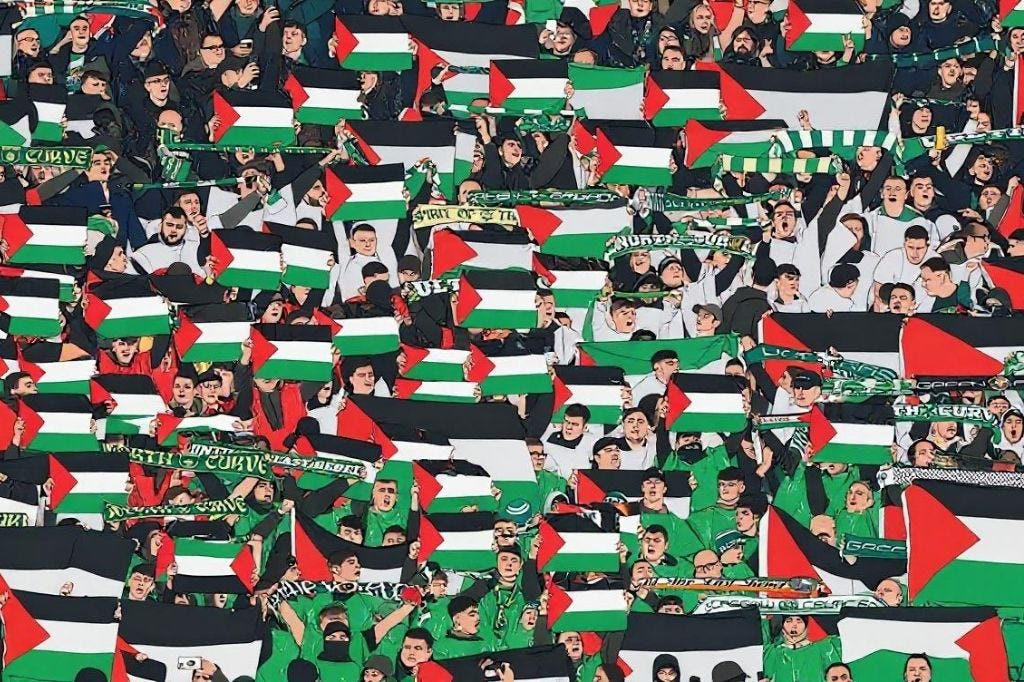
Celtic Football Club stands as a profound historical contradiction. A club built on the values of Irish anti-colonialism, Catholic charity, and social justice, home to one of Europe’s most vocal pro-Palestinian fan bases. Yet simultaneously, the Celtic board tried to suppress Palestinian flag displays, ban supporters groups, and invoke accusations of antisemitism to silence pro-Palestinian supporters on the terraces.
However, this fracture reflects a deeper history, as Celtic’s leadership has continued to harbour ties to Zionist movements and organisations, while the club’s supporters, stepped in Irish republicanism and anti-colonialism, have stood in support of Palestinians. The result is a cultural and political chasm that has only widened since 2023 - beyond the footballing fractures in place.
How Zionism Infiltrated Celtic
The infiltration of Zionist influence into Celtic began far earlier than most supporters realise. In 1932, at the height of the Depression and a decade before the founding of the state of Israel, two Celtic players (Peter McGonagle and Charles Geatons) attended a football charity lecture hosted by the Glasgow Jewish Institute. The lecture was delivered by Tom Maley, brother of Willie Maley, who had managed Celtic from 1897 to 1940 and was intimately connected to the club’s founding principles.
Willie Maley himself would, a decade later in 1943, host a Save the Children fundraiser at his restaurant, The Bank, on Queen Street. Maley claimed to have heard about the appeal “through some of his Jewish friends.” But the appeal was explicitly Zionist in character: the Glasgow Women’s Appeal Committee, which organised it, openly stated its goal was to rescue “youngsters from the darkness of Europe and giving them a fresh start in Erez Yisrael”- recruiting settler colonists for Palestine.
Among the donors to Maley’s fundraiser were members of the Sellyn, Barnett, and Goldberg families - the Caledonian Cousinhood: an elite network of Zionist families representing approximately 10% of Scotland’s Jewish population and exercising disproportionate influence over political and institutional affairs, including football.
Celtic’s founding-era leadership was already embedded in networks that explicitly promoted Zionist colonisation of Palestine more than fifteen years before 1948. This was not incidental contact, it was ideological alignment orchestrated through charity and social connection.
The Glasgow Jewish Institute and Irgun Connections
In 1947, British intelligence had become deeply concerned about the Glasgow Jewish Institute. Declassified MI5 files from the National Archives reveal that the Institute was identified as a meeting place for an Irgun terrorist cell [the Irgun being one of three Jewish terrorist organisations that would later merge to form the Israeli Defence Forces]. MI5 reported that members of the Institute were “increasingly bitter and resentful on the Palestine question” and warned of them “losing their patience and their tempers shortly unless some decision satisfactory to themselves is arrived at fairly soon.”
Yet, Celtic’s hierarchy chose to engage with the Institute and with Zionist networks. In 1957, Celtic attended a Glasgow Jewish Institute dinner and dance with the Israeli football club Hapoel Tel Aviv. Among those attending were Maurice Benzion Links, then-Chairman of the Glasgow Commission of the Jewish National Fund, and Leslie Diamond, President of the Glasgow Jewish Representative Council. Representing Celtic were Chairman Robert Kelly, manager James McGrory, and several players. The match that followed was billed as a charity game, though the beneficiary remains unclear to this day.
What is clear is that the club’s leadership, Kelly and McGrory, had established direct contact with Zionist organisational structures in Glasgow.
How Celtic Fronted a JNF Fundraiser
The most explicit evidence of Celtic’s hierarchy backing for Zionist fundraising comes from the 1962 Celtic vs. Real Madrid match, labelled the “Blue and White Trophy Challenge Match.”
The architect was Max Benjamin, a Glasgow businessman, tailor, bookmaker, and self-described Zionist who held the position of Entertainments Officer for the Glasgow Blue and White Committee of the Jewish National Fund. Benjamin initially sought to organise a JNF fundraiser between Celtic and Eintracht Frankfurt, but faced opposition from Glasgow’s Jewish community, which objected to hosting a German team so soon after World War II. Undeterred, Benjamin pivoted. Working with Glasgow Evening News football correspondent Gair Henderson, Benjamin eventually signed up European giants Real Madrid to come to Glasgow.
On 10 September 1962, the match took place at Celtic Park. It was not a minor fundraiser; it was a high-profile, club-sanctioned event. The match raised £11,000 explicitly for the JNF, described in fundraising materials as going toward “the rehabilitation of refugee women and children from Europe and North Africa” - coded language for the JNF’s land acquisition and Jewish settlement projects in Palestine.
The match programme itself reveals the full extent of institutional participation. Key sponsors included:
A. Goldberg and Sons Limited, the flagship Goldberg family firm that ran iconic Scottish department stores. The Goldbergs had supported Willie Maley’s 1943 Zionist fundraiser and would go on to place at least five family members as trustees of the Glasgow Jewish Community Trust (GJCT) founded in 1963, a year after the Real Madrid charity match.
Sellyn’s Menswear, run by the Sellyn family. Larry Sellyn remained a GJCT trustee as recently as April 2024. His nephew, David Sellyn, is described as a “patron of Celtic” today, maintaining the family’s institutional connection.
Lex Motors, run by Rosser Chinn of London, who was President of the Jewish National Fund in London at the time. In 1963, Chinn was honoured at a London dinner in connection with planting a forest in Israel bearing his name. He would later become the father of Trevor Chinn, who is effectively the leader of the British Zionist movement today and lobbying for Zionist interests.
Max Benjamin himself addressed the attendees as Convenor of the game, welcoming the team (managed by McGrory) and paying homage to “Chairman Robert Kelly and the Celtic Board for their role in organising a game which he hoped would go down in the annals of Scottish football.” Benjamin explicitly crediting the Celtic board for their participation in fronting a Zionist fundraiser.
This is not allegation or inference. It is documented in match programmes and contemporary newspaper accounts. Celtic, as an institution, lent its name, stadium, and legitimacy to raising money for the Jewish National Fund’s colonial/settler projects in Palestine.
Institutional Overlap and the Caledonian Cousinhood
The 1962 match was merely the beginning of a structural relationship. What makes this relationship durable and ongoing is the existence of individuals who straddle both worlds: Zionist organisations and Celtic Football Club.
The clearest contemporary example is Charles Barnett.
Barnett served as Treasurer of JNF KKL Scotland (Glasgow Commission of the Jewish National Fund) for decades, a role he held into at least the 2020s. He appears in committee photos, fundraising events, and JNF-linked activities across that entire period. Professionally, he was a partner and leading sports accountant at PKF (later BDO) in Glasgow.
At Celtic, Barnett’s roles included:
Lead external auditor of Celtic via PKF/BDO from approximately 1994 to 2013, meaning he personally signed off the club’s audited accounts for nearly two decades.
Key fundraiser and organiser for Celtic Charity Fund/Celtic FC Foundation events, appearing at and sometimes fronting high-profile dinners and golf days.
Treasurer of the SPFL Trust (Scottish Professional Football League’s charitable arm) since 2016, maintaining influence over Scottish football governance.
Barnett is simultaneously embedded in three institutional poles: the Zionist infrastructure (JNF), Celtic’s financial and fundraising apparatus, and Scottish football governance. His participation in “Scotland v Israel” events organised by JNF KKL Scotland, which leverage Scottish football relationships to raise money, illustrates how individuals create operational continuity between these worlds.
The Next Generation
Max Benjamin’s daughter, Maryon Benn, inherited both his Zionist ideology and his Celtic connections. A prominent figure in the Scottish Women’s International Zionist Organisation and Jewish Care Scotland, Benn became Business Development and Marketing Manager of Scotland’s first privately built hospital, the Bon Secours.
The Bon Secours, located in Glasgow’s Langside district (where many Cousinhood members lived), was run by Catholic nuns but was said to be “a favourite with the Jewish community.” It was funded by Cousinhood millionaires including the hard-line Zionist Isidore Walton and his son David, as repayment for “the many family kindnesses” the hospital had given them.
More significantly for this narrative, the Bon Secours became “a familiar port of call for footballers and other sporting personalities.” Celtic players Henrik Larsson, Stéphane Mahé, and Alan Stubbs were all treated there during their playing days with the Parkhead side. Benn was actively marketing the Bon Secours to Celtic through advertisements in The Celtic View, the club’s official newspaper, as late as 1998.
This illustrates how the relationship was sustained: through multiple channels of personal, commercial, and charitable connection, individuals with explicit Zionist commitments maintained presence within Celtic’s ecosystem.
The Contemporary Split
From the 1960s through the early 2010s, the relationship between Celtic’s hierarchy and Zionist networks remained largely invisible and uncontested by the support. Two factors changed this: the rise of social media and digital organising, and the radicalisation of Palestinian solidarity among a younger generation of supporters, with the watershed moment happeningin 2016, during a Champions League qualifier against Israeli side Hapoel Be’er Sheva.
Match the Fine for Palestine and the Birth of Aida Celtic
On 17 August 2016, Green Brigade members and supporters throughout Celtic Park flew the Palestinian flag during the match against Hapoel Be’er Sheva to show solidarity with the plight of the Palestinian people. UEFA subsequently charged Celtic for displaying an “illicit banner.” The fine was eventually set at £8,600.
What happened next was unprecedented as the Celtic ultras group mobilised a crowdfunding campaign called #MatchTheFinefoPalestine to raise money for Palestinian charities. The campaign raised £176,076 more than twenty times the UEFA fine imposed on the club.
But the fundraising served a larger purpose. The Green Brigade and supporters worked with the Lajee Centre, a cultural centre in the Aida refugee camp near Bethlehem, to establish Aida Celtic FC a youth football academy bearing Celtic’s name. To sustain the project, supporters produced and sold Aida Celtic football shirts, many designed in collaboration with high-profile supporters, including the Scottish band Primal Scream and football legend Eric Cantona.
Aida Celtic FC became more than a fundraising project; it became a symbol of institutional solidarity between Celtic’s supporters and Palestinian resistance. Every fundraiser for Aida, every display of the Palestinian flag at Celtic Park, and every campaign donation represented a direct transfer of resources and solidarity to Palestine, not from Celtic FC as a club, but from Celtic’s supporters as an organised, politically conscious collective.
Celtic’s board, meanwhile, faced UEFA fines and sanctions. The club’s initial response was to demand fans not to unfurl banners or flags on match days. But their responses soon escalated.
The Board Cracks Down
The escalation of fighting in Israel and Palestine in October 2023 brought matters to a head. On 7 October, Hamas launched coordinated attacks on Israel; before Israel retaliated with a devastating assault on Gaza. Within days, social media platforms, universities, and sporting venues became flashpoints for Israel-Palestine solidarity activism.
At Celtic Park, supporters organised to display Palestinian flags and banners during the club’s Champions League match against Atlético Madrid on 25 October 2023. The Green Brigade announced their intention to fly the flag for Palestine.
The Celtic board’s response was categorical. On 24 October, the club issued a statement: “Celtic Park is where we come to support our football club. Recognising this, respecting the gravity of the tragedy unfolding and its impact on communities in Scotland and across the world, and in line with other clubs, leagues and associations, we ask that banners, flags and symbols relating to the conflict and those countries involved in it are not displayed at Celtic Park at this time.”
The statement also added: “Celtic is a football club and not a political organisation. One of our core values from inception is to be open to all regardless of race, colour, politics or creed. That is why the club has always made clear that political messages and banners are not welcome at Celtic Park.”
This was a remarkably convenient use of “political neutrality,” given that Celtic players wore black armbands as a “show of respect” for all those affected by the conflict. The club’s hierarchy had sanctioned fundraising events for the JNF, a manifestly political Zionist organisation, for decades. The club also never objected to Ukrainian flags and support during the Russia-Ukraine war.
The Green Brigade proceeded anyway. Supporters distributed thousands of Palestinian flags outside the stadium and displayed them throughout the match. Celtic Park became a sea of Palestinian symbols.
UEFA investigated. Celtic was fined. The club then took further steps when the Green Brigade was banned from attending away matches and faced extended sanctions for repeated Palestine flag displays. To supporters, this felt like the club was choosing to discipline Palestinian solidarity more aggressively than it disciplined pro-Israel expression.
The Board’s Defense: Accusations of Antisemitism
When supporters continued to push back against what they perceived as selective enforcement and pro-Zionist bias, then chairman Iain Bankier deployed a potent rhetorical weapon, peddling unfounded lies and accusations of antisemitism.
In 2012–2013, Lord Ian Livingston, a Conservative peer and former BT CEO, joined the Celtic board as a non-executive director. Livingston’s parliamentary record was unambiguously pro-Israel and pro-austerity. When supporters at an Annual General Meeting objected to Livingston’s presence, framing their criticism around his voting record on welfare cuts and his stated support for Israeli government positions, Bankier responded by accusing sections of the support of “antisemitism.”
This move was profound. By equating political criticism of Livingston’s record with antisemitism, Bankier created a rhetorical barrier against discussing the board’s Israel-Palestine politics. Critics were silenced not through reasoned counter-argument but through the threat of being labelled antisemitic. Celtic’s hierarchy simply followed the Zionist playbook of weaponising antisemitism accusations to protect pro-Israel board members from accountability.
Livingston ultimately stepped down, but the precedent was set. Any challenge to the board’s relationship to anything related to Israel, and you would face accusations of prejudice.
Two Celtics
A 2025 investigative article by Jill Thomson and David Miller, published on UK Column and Tracking Power, provides the most comprehensive public accounting of Celtic’s Zionist connections.
What Thomson and Miller have established is that Celtic’s leadership in the 1930s to 1960s actively participated in Zionist fundraising. Elite Zionist families in Scotland maintained institutional influence at Celtic. The 1962 Real Madrid match was explicitly organised as a JNF fundraiser for settler communities.
Individuals like Max Benjamin and Charles Barnett maintained simultaneous roles in JNF and Celtic structures. These are documented facts visible in contemporary newspapers, match programmes, and official records.
The article’s significance lies in assembling these facts into a coherent historical narrative that had previously been fragmented or overlooked within Celtic’s long and storied history.
While none of the current Celtic hierarchy hold formal office in JNF, the Board of Deputies, or publicly support Zionist organisations. The direct institutional overlap evident in earlier eras appears to have become less visible, whether because it has diminished or have been well hidden it is clear that the behaviour of the board in recent years over its suppression of Palestine solidarity, its accusations of antisemitism against supporters, its differential treatment of pro-Israel vs. pro-Palestine expression suggests continuity in political orientation even if board ties are less public.
Meanwhile, Celtic’s supporters have emerged as one of Europe’s most consistently and materially pro-Palestinian fan bases. While the club hierarchy adopts a posture of “political neutrality” that in practice favours suppressing Palestinian expression, the supporters have mobilised Celtic’s identity and fan resources to materially aid Palestinian communities.
The chasm at Celtic Park in relation to Israel & Palestine is not primarily about individual board members’ personal beliefs. It reflects the legacy of Celtic’s leadership. It was embedded in networks and institutions that promoted Zionist colonisation of Palestine.
While Celtic’s supporters, influenced by Irish republicanism, see Palestinians as experiencing a struggle similar to Ireland’s fight against British rule and colonialism. By continuing to fly Palestinian flags, raising funds for Aida, and defying bans, Celtic supporters and the Green Brigade are representing what they believe to be the true values of Celtic. They see the board’s actions as a betrayal.
Celtic Football Club now contains two distinct institutions within itself.
The first is the board and executive: a corporate entity concerned with broadcasting rights, sponsorships, UEFA compliance, and the avoidance of controversy. This Celtic has historical ties to Zionist networks and currently adopts policies that suppress Palestinian expression while claiming political neutrality. It views supporters’ activism as a liability.
The second is the supporters, especially organised groups like the Green Brigade, a political and cultural community that sees Celtic as a vehicle for solidarity with the oppressed. This Celtic flies Palestinian flags despite fines, raises six-figure sums for refugee camps, and views Palestine as a continuation of the anti-colonial struggle that Celtic was built on. It sees the board’s suppression as collusion with the oppressors and the genocide they are committing.
These two Celtics are now in open conflict - not just from a football point of view. The board has banned, fined, and disciplined supporters for expressing solidarity with Palestine. Supporters have defied bans, continued fundraising, and issued statements accusing the board of hypocrisy and betrayal.
What remains to be determined is whether Celtic’s supporters, through sustained and disciplined activism, can reclaim their club from a compromised hierarchy or whether the board’s authority, backed by UEFA rules and corporate interests, will succeed in silencing Palestinian solidarity within the terraces at Celtic Park once and for all.
Ultimately it could shape the future of football as a site of political expression and solidarity in an era of deepening global injustice.
Brilliant article and deeply disturbing as a Celtic supporter who has much respect fir the supporter's position on Palestine.
I wholly underestimated the role the hierarchy has played in their prostituting themselves at the hands of the IDF and Israel.
I can't help but feel my attachment to Celtic FC going forward has been forever diluted, albeit my backing of the fan's Palestine support is unequivocal.
I've always been brought up to keep both politics and religion out of the personal discourse and common debate, and unfortunately this very public sectarian fracture between Celtic FC directors and their supporters and by extension, the currently banned Green Brigade is an open sore that is destroying the soul of Celtic FC, and giving succour and comfort to their footballing rivals, especially Rangers, whose very own fans are very pro Israeli and unionist orientated.