

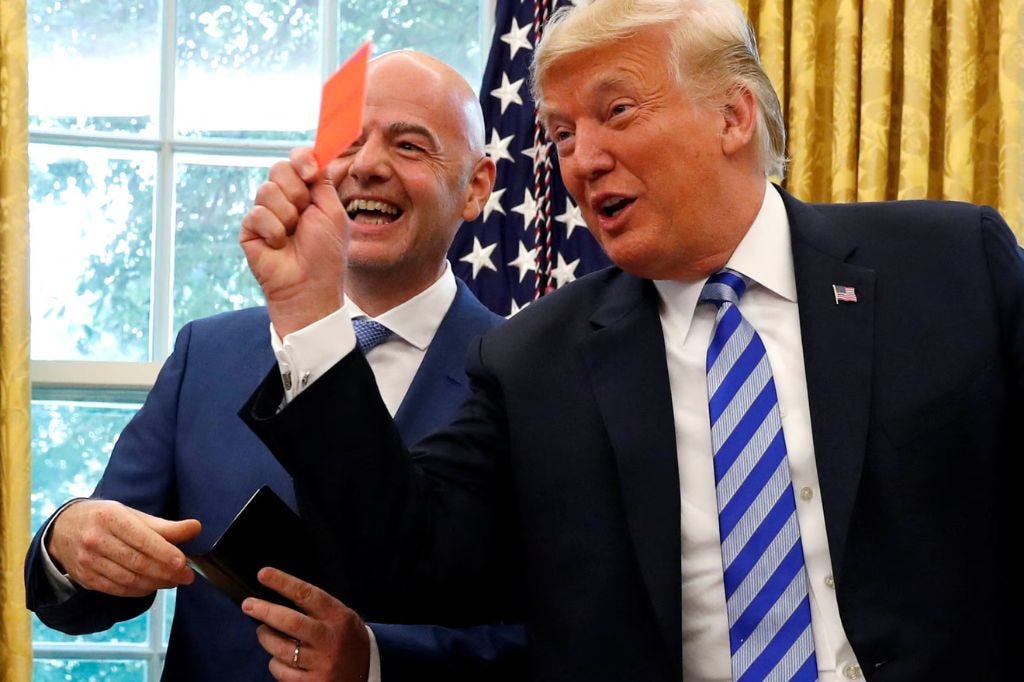
Football has always been more than a sport. It is a global language, a shared passion that transcends borders, classes, and cultures. From the streets of Glasgow to the favelas of Rio, from the parks of Manchester to the pitches of Tokyo, the beautiful game belongs to the people. Yet, under the stewardship of FIFA President Gianni Infantino, that ownership is being systematically stripped away. The latest proposal, to sell minority stakes in the World Cup and other FIFA competitions to private investors, is not merely a business decision. It is a fundamental betrayal of everything football stands for.
At the heart of this controversy is a plan that would see up to 20% of a new commercial entity, FIFA Forward Enterprise (FFE), sold to venture capitalists and private equity firms. The valuation? A staggering $20 billion. The anchor investor? Thrive Capital, led by Joshua Kushner, brother of Jared Kushner and son-in-law of U.S. President Donald Trump. That this deal is being orchestrated by a man whose family ties reach into the highest echelons of American politics should alarm anyone who cares about the integrity of the sport - albeit not surprising given the relationship between Infantino and Trump. It is no coincidence that Trump’s shadow looms over this transaction - directly or indirectly, the fingerprints of his inner circle are everywhere.
A Non-Profit in Name Only
FIFA was founded as a non-profit organisation with a clear mandate - to develop football globally and ensure that all funds raised are reinvested into the game. That mission has clearly been eroded over decades, but the current proposal marks a point of no return. Under Infantino’s plan, the soul of football will be commodified, packaged, and sold to investors whose primary concern is not the welfare of the sport but the return on their investment.
The hypocrisy is breathtaking. FIFA continues to present itself as a guardian of the game while simultaneously negotiating with venture capitalists to extract maximum profit from its flagship tournaments. The organisation’s own statement describes the plan as a way to “unleash the commercial potential and opportunity that FIFA has.” But whose opportunity? Certainly not the fans who fill stadiums, not the grassroots clubs that nurture young talent, and not the smaller national associations that rely on FIFA’s development funding. This is about enriching a select group of investors and, by extension, the FIFA executives - including Infantino - who stand to benefit from lucrative deals.
The figures involved are obscene. The proposed $4.2 billion initial investment would value FFE at $20 billion, with each of FIFA’s 211 member federations promised a one-off $20 million payment if the deal goes through. Infantino has set a September 19 deadline for members to accept this “singular and unique funding opportunity.” But this is not generosity; it is bribery - pure and simple. Support this proposal and we will give you a one-off payment of $20 million. It is an attempt to buy the support of federations that might otherwise question the ethics of selling the World Cup to private equity.
The Ticket Price Scandal: A Preview of What’s to Come
If anyone doubted that privatisation would lead to higher costs for fans, the 2026 World Cup has provided a grim preview. Ticket prices for the tournament reached levels previously unimaginable in football.
The backlash was immediate and fierce. The Football Supporters’ Association (FSA) filed a formal complaint with the European Commission, accusing FIFA of exploiting its position “to enforce exorbitant ticket prices and ambiguous, unfair purchasing conditions and processes on European supporters.” The complaint outlined six distinct abuses, including allegations of bait advertising - deemed illegal under EU consumer regulations - related to the subsequent release of cheaper tickets that were “so limited” that the advertised price was “not genuinely available.”
The situation became so toxic that the attorneys general of New York and New Jersey launched an investigation into FIFA’s ticketing practices. Jennifer Davenport, the attorney general of New Jersey, described the ticket purchasing experience as a “gauntlet of confusion, fake scarcity, and exorbitant prices.” FIFA was subpoenaed to submit internal documents, and the investigation is examining claims of “artificial price inflation” and “misleading fans.”
Even more egregious, FIFA was forced to cancel some legitimate tickets that had been sold below the expected price point, citing a “pricing inaccuracy.” In other words, fans who managed to secure tickets at what they thought were fair prices had them revoked because FIFA realised it had undercharged. This is not merely incompetence; it is a symptom of an organisation that views fans not as supporters but as revenue streams to be maximised.
How Could Private Investors Will Milk the World Cup
The ticket price scandal is just the beginning. If Infantino’s plan goes through, private investors will have every incentive to extract even more value from the World Cup and other FIFA competitions. Here are some of the ways they could do it:
Dynamic Pricing on Steroids: The 2026 World Cup already saw FIFA use variable pricing models that sent ticket prices soaring for most matches. Private investors would take this to the next level, using algorithms to adjust prices in real-time based on demand, much like airlines and hotels. A group-stage match between two popular teams could see prices double or even triple overnight. The final could become accessible only to the ultra-wealthy.
Exclusive Hospitality Packages: Investors could create ultra-premium experiences -private boxes, meet-and-greets with players, VIP lounges - with price tags reaching hundreds of thousands of dollars if not more. These packages would be marketed to corporations and high-net-worth individuals, effectively creating a two-tier system where the richest fans get the best access while ordinary supporters are relegated to the upper tiers or watching on the TV.
Merchandising Monopolies: The World Cup already generates billions in merchandise sales. Private investors could negotiate exclusive deals with brands, forcing fans to buy official products at increasingly inflated prices. Imagine a scenario where only Adidas or Nike products are allowed in stadiums, and all other brand products are aggressively policed.
Broadcasting Rights Auctions: The sale of broadcasting rights is already a major revenue stream for FIFA. Private investors could push for even more aggressive auctions, potentially limiting access to matches for viewers in certain regions if they cannot meet the asking price. Streaming services might be forced to pay billions for exclusive rights, leading to higher subscription fees for fans. Or even making every game at the World Cup pay-per-view.
Naming Rights and Sponsorship Overload: Stadiums, training facilities, and even sections of the pitch could be sold to sponsors. The World Cup final could be rebranded as the “Donald J. Trump World Cup Final”. Every moment of the tournament would be an advertisement, eroding the authenticity of the competition.
Data Monetisation: Investors could exploit fan data collected through ticketing apps, websites, and social media. This data could be sold to third parties for targeted advertising, further eroding privacy while generating additional revenue. If they aren’t do this already?
Club World Cup Expansion: The newly expanded Club World Cup is another cash cow. Private investors could push for more teams, more matches, and more tournaments, diluting the prestige of the competition and impacting on domestic competitions worldwide, while maximising profits. Ticket prices, sponsorship deals, and broadcasting rights would all be ramped up.
UEFA’s Hypocrisy: The Pot Calling the Kettle Black
When UEFA issued its scathing condemnation of FIFA’s plan, declaring that “the soul and governance of football are not assets to trade” and that “the World Cup is not FIFA’s to sell,” the irony was so thick you could cut it with a knife. Here was an organisation that has spent decades selling out the beautiful game, now pretending to be its moral guardian. The audacity is staggering.
UEFA’s criticism of FIFA rings hollow when you consider what the European body has done to its own competitions. The Champions League, once a tournament where champions from every corner of Europe could dream of glory, has been transformed into a closed shop for the wealthy elite. The big five leagues - England, Spain, Germany, Italy, and France - have been handed more guaranteed spots not because they produce better football, but because they generate more money from advertising, sponsorships, and television broadcast deals.
The numbers tell the story. Under the reformed Champions League format that kicked in from 2024, the top leagues received four guaranteed slots each, while champions from smaller nations were forced to navigate a treacherous qualifying maze with even fewer spots available. The allocation for champions from the 10th to 12th ranked leagues was diminished, and the number of spots available for teams from other leagues - those who must survive multiple qualifying rounds - was cut from five to four. This was not about sporting merit; it was about maximising revenue for UEFA’s biggest markets.
The European Professional Football Leagues (EPFL), representing 24 domestic leagues across Europe, slammed the changes at the time, calling them “detrimental to domestic soccer” and warning they would “increase the gap between the wealthiest clubs and the rest.” The EPFL accused UEFA of handling the process in an “unacceptable” manner for an organisation that professes to be the guardian of European football. But UEFA pressed ahead anyway, because the money was too good to ignore.
The new format, which expanded the competition from 32 to 36 teams, created 100 additional matches per season - all designed to generate more broadcast revenue. UEFA general secretary Theodore Theodoridis openly admitted that there would be a “significant increase” in broadcast revenue, with the competition adding four midweek dates exclusively for Champions League matches and scheduling games on Thursdays for the first time. This was not about improving the quality of football; it was about squeezing more money out of every available slot.
Meanwhile, the champions of smaller leagues - the actual winners of their domestic competitions - were left scrambling for scraps. Teams from Scotland, Austria, Czech Republic, Greece, and dozens of other smaller nations found themselves forced to jump through hoop after hoop, surviving multiple qualifying rounds just for the chance to compete in the group stage. Most never made it, eliminated by teams from bigger leagues that had failed to qualify through their domestic performance but were handed places through UEFA’s coefficient rankings.
The coefficient system itself is a racket. Two of the additional Champions League spots are designated for the highest-ranked teams according to UEFA’s five-year coefficient rankings, based on past performance in European competitions. This means that a team finishing fifth in the Premier League can leapfrog the actual champion of a smaller nation, simply because of historical performance. It is a system designed to entrench the elite and shut out the outsiders.
The financial distribution model is equally skewed. Under the current system, clubs in UEFA competitions receive the majority of the total revenue pot, which stands at €4.4 billion (£3.8 billion; $5.1 billion). The top five nations - England, Spain, Germany, Italy, and France - have historically received the lion’s share of this money, while smaller leagues get a fraction. UEFA has pledged to spread some surplus to lower-ranked clubs and leagues, but the fundamental imbalance remains.
The hypocrisy of UEFA’s position cannot be overstated. When FIFA proposes selling a minority stake in its commercial operations, UEFA suddenly becomes the moral arbiter of football’s soul? The pot is not just calling the kettle black - it is accusing the kettle of being dirty while covered in soot itself.
UEFA sold out football long ago. The Champions League is no longer a competition for champions; it is a cash machine for the elite. The Europa League and Conference League are consolation prizes for teams that failed to qualify for the real money. Domestic competitions are devalued, with weekend fixtures squeezed to accommodate UEFA’s midweek extravaganza. And ordinary fans? They are priced out of attending matches, forced to watch on pay-per-view streams, and treated as revenue streams rather than supporters.
When UEFA says “the soul of football is not FIFA’s to sell,” what they really mean is “we already sold it, and we don’t want competition.” UEFA has been selling the soul of European football for decades, one Champions League reform at a time. They have shat all over the ordinary fan, one exorbitant ticket price and one paywall at a time. And now they stand in judgment of FIFA, pretending to care about the very principles they abandoned years ago.
The reality is that both UEFA and FIFA are cut from the same cloth. Both organisations have prioritised revenue over sporting integrity. Both have favoured the wealthy elite over the grassroots game. Both have treated fans as customers to be monetised rather than supporters to be valued. The difference is that FIFA is at least being upfront about its intentions. UEFA pretends to care while continuing to enrich its biggest markets.
The Grassroots Betrayal
Perhaps the most insidious aspect of Infantino’s plan is its impact on grassroots football. FIFA has long claimed that its commercial success benefits the entire football ecosystem, from the World Cup down to local youth leagues. But the reality is that the vast majority of FIFA’s revenue is concentrated at the top, with only a small fraction trickling down to development programmes.
Under the new plan, private investors will demand returns on their investment. That means more money will be siphoned off to pay dividends and ‘administration’ fees, leaving less for grassroots development. The $20 million payments to member federations is a one-off bribe, it’s not a sustainable funding model. Once the money is spent, the structural problems will remain.
Meanwhile, the cost of participating in football will continue to rise. Youth clubs will struggle to afford equipment, facilities, and coaching. Talented young players from disadvantaged backgrounds will be priced out of the game. The dream of football as a meritocratic sport, where ability matters more than wealth, will become even more distant.
UEFA’s own record on grassroots development is equally poor. The organisation claims to invest in grassroots football, but the vast majority of its revenue goes to elite clubs and competitions. The Champions League generates billions, but how much of that money reaches the local parks and youth academies where the next generation of players learns the game? The answer is not enough.
The Path Forward
The fight against FIFA’s privatisation plan is not just about stopping a bad deal. It is about reclaiming football for the people who love it. Fans, players, clubs, and associations must unite to demand transparency, accountability, a return to football’s founding principles - principles that both FIFA and UEFA have long abandoned - and the sacking of Infantino and his inner circle.
UEFA’s threat of a boycott is a powerful lever, but it must be backed by concrete action. National associations must refuse to ratify the deal. Players’ unions must speak out against the commodification of their sport. Supporters’ groups must organise protests and campaigns to raise awareness. The players themselves must speak out.
While we try to hold FIFA to account, UEFA must also be held to account. The organisation cannot claim to be the moral guardian of football while continuing to structure its competitions to favour the wealthy elite. The Champions League must be reformed to give genuine champions from smaller nations a fair chance. The revenue distribution model must be overhauled to ensure that money reaches grassroots football, not just the boardrooms of elite clubs.
The media also has a role to play. Journalists must continue to investigate and expose the true nature of Infantino’s plan, the involvement of Kushner and Thrive Capital, are Trump’s grubby fake tanned little hands all over this, and the potential consequences for the game. But they must also hold UEFA to account for its own sins, exposing the hypocrisy of an organisation that pretends to care about football’s soul while selling it off piece by piece themselves.
A Call for Revolution: Removing Infantino and Rebuilding FIFA
The time for polite criticism has passed. Gianni Infantino must be removed from office immediately, and his re-election blocked. National federations and football associations around the world have a moral obligation to vote against him, to suspend him from his duties pending a full investigation into his private dealings with Donald Trump and his inner circle, the Qatari Royal Family, and the Saudi Royal Family.
This is not merely a conflict of interest, it is a web of corruption that threatens the integrity of the entire sport. The proposed $20 billion deal is just the latest chapter in a pattern of self-dealing that stretches back years. Infantino has consistently prioritised money and political connections over the welfare of football.
National federations must act now. They should demand that FIFA’s Ethics Committee launch an immediate investigation into Infantino’s financial dealings, his relationship with private investors, and the potential conflicts of interest arising from his ties to the Trump family. But FIFA’s Ethics Committee cannot be trusted to police itself. The investigation must be independent, transparent, and led by an external body with real teeth.
Interpol should be called upon to lead this investigation. The scale of the alleged corruption, the involvement of multiple jurisdictions, and the potential for financial crimes across borders make this a matter for international law enforcement. If there is evidence of bribery, money laundering, or other criminal activity, those responsible must face justice - not internal disciplinary hearings that result in token fines and suspended bans. Unlike the downfall of former FIFA President Sepp Blatter, who was brought down by the US Department of Justice and Swiss Authorities - the DOJ cannot be trusted given the fingerprints of Trump’s corrupt minions being all over the organisation now.
Infantino must be suspended from his duties as FIFA President with immediate effect. He cannot be allowed to continue lobbying member federations to accept his privatisation plan while under investigation. The September 19 deadline must be ignored, and the deal must be blocked until a full inquiry is completed.
Rebuilding FIFA: A Football United Nations
But removing Infantino is only the first step. FIFA itself must be fundamentally reorganised. The current structure, where a single president wields enormous power and makes deals with private investors behind closed doors, is untenable. FIFA must be transformed into a true Football United Nations, where all 211 member states have an equal voice and no single nation, association, or individual can dominate the organisation.
The new FIFA should be governed by a main Football Council, composed of representatives from all member nations, serving fixed terms. This council would make collective decisions on major issues like tournament hosting, commercial deals, and rule changes. No single president would have the power to unilaterally negotiate billion-dollar deals with venture capitalists.
Council members would serve staggered terms, with a maximum tenure of, say, three or four years. After their term, they would rotate off the council, making way for new representatives from their region. This would prevent the entrenchment of power and ensure that fresh perspectives are constantly brought to the table. No more presidents-for-life. No more cosy deals negotiated in secret.
The Football Council would be supported by specialised committees focused on specific areas - competitions, finance, ethics, grassroots development, and human rights. Each committee would include representatives from different continents, ensuring that decisions reflect the diversity of world football.
Crucially, all major decisions would require a supermajority vote - say, two-thirds of the council. This would prevent any single bloc of nations from dominating the agenda. The big national associations would not be able to steamroll smaller nations. The wealthy Gulf states would not be able to buy influence. Every member would have a genuine say.
There should even be places for Fan & Player Representation in the council - with their members voting to elect a representative every three or four years also.
Transparency would be baked into the system. All meetings would be minuted and published. All financial transactions would be audited and made public by an independent body. All commercial deals would be subject to open bidding and competitive tender. No more secret meetings with venture capitalists. No more sweetheart deals with political allies.
The revenue distribution model would also be overhauled. Instead of concentrating wealth among a small elite, FIFA’s income would be distributed equitably among all member nations, with a significant portion ringfenced for grassroots development. The World Cup would remain FIFA’s flagship tournament, but its profits would be used to develop football globally, not to enrich investors.
Hosting rights would be awarded through a transparent, merit-based process. Human rights records, infrastructure quality, and fan accessibility would be key criteria. No more World Cups in countries where workers are exploited, where women are oppressed, or where fans cannot afford tickets.
A Movement, Not Just a Proposal
This is not a call for reform. It is a call for revolution. Football belongs to the people, not to presidents, investors, or royal families. The current system has failed. Infantino must go. FIFA must be rebuilt from the ground up.
National federations must lead this movement. They must refuse to ratify the privatisation deal. They must demand an independent investigation into Infantino’s dealings. They must support the creation of a new FIFA, governed by a Football Council where every nation has an equal voice.
Players’ unions must speak out. They must refuse to participate in tournaments organised by a corrupt, privatised FIFA. They must demand that their representatives be included in the new Football Council.
Supporters’ groups must organise. They must protest, campaign, and make their voices heard. They must remind FIFA and UEFA that without fans, there is no football.
The media must continue to investigate and expose. They must hold both FIFA and UEFA to account. They must give a platform to the voices of ordinary fans, not just the executives who have betrayed them.
The Stakes Could Not Be Higher
The future of football is at stake. If Infantino’s plan goes through, the World Cup will become a playground for venture capitalists, accessible only to the wealthy.
But there is another future. A future where football is governed by the people who love it. Where the World Cup is a celebration of the global game, not a cash machine for investors.
That future is possible. But it requires action. It requires courage. It requires football to stand up and say enough is enough.
Infantino must go. FIFA must be rebuilt. And the beautiful game must be returned to the people before it is too late.
Your point regarding UEFA's hypocrisy over the Champion's League is totally valid mate.
The people's game is no more and hasn't been for years, I only watch the CL if Celtic are playing, the last 16/8 very rarely involves any teams from outwith the "top" 5 leagues, it is boring and has now become as corrupt as FIFA's World Cup.
Seedlings in tournaments has wasted all football tournaments whilst UEFA themselves have been as corrupt if not more than their big brother FIFA.
Football as I.know it has disappeared never to return, it is money driven which in itself brings corruption where the likes of Trump knows how, where and when to make his move, this world cup went exactly as I thought it would.
The baw's burst, the game is finished!