

Celtic Football Club has done it again. Faced with growing unrest, visible protests, and supporters literally staying away from pre-season fixtures in their tens of thousands, the board has issued a glossy, carefully worded statement on “supporter engagement”.
It announces a new Head of Supporter Engagement, a rebranded Fans’ Forum, a consultation on something called Celtic Connect, and a string of promises about digital transformation and matchday experience. On paper, it sounds progressive. In reality, it is more of the same. Talk, process, and consultation, with none of the hard decisions that fans are actually demanding.
The truth is simple, the time for talking is long gone. What Celtic’s supporters are calling for is not another forum, another liaison officer, or another online survey. They are calling for a fundamental shift in who runs the club, how they are held to account, and what ambition looks like in the boardroom. And until that happens, no amount of “engagement” will quell the anger that has been building for years.
A familiar script, dressed up as reform
Read the club’s statement closely and the pattern is unmistakable. The language is full of soft, non‑binding commitments: “we aim to continually look at ways to improve”, “we are committed to refreshing”, “we will take the Fans’ Forum on the road”. There are new roles and new groups, but no new power. There is consultation, but no obligation to act on the results. There is dialogue, but no mechanism for fans to say “no” to decisions they fundamentally disagree with.
This is not supporter empowerment; it is supporter management. The club is creating more channels through which fans can speak, while carefully ensuring that none of those channels can meaningfully constrain the board. And at the same time further dividing the supporter base and the groups that represent them. The new Head of Supporter Engagement, however well‑intentioned, is a management role, not a fan mandate. Celtic Connect is a forum, not a governing body. The Fans’ Forum, even “on the road”, remains advisory.
For a fanbase that has spent years attending meetings, filling in surveys, and raising concerns that then seem to vanish into a black hole, this is not reassuring. It is exhausting. It is more of the same.
The protests are not about niceties. They are about power.
The recent boycotts of pre‑season friendlies against Middlesbrough and AC Milan were not about poor communication or a clunky app. They were a deliberate, collective signal that a significant portion of the support no longer believes the current leadership is capable of delivering the club they want to see. Supporters turned their backs because they feel treated as cash cows, not stakeholders. They see a board that talks about “shared objectives” but makes decisions that, in their view, reflect caution, complacency, and a lack of footballing ambition.
When fans say “enough”, they do not mean “please talk to us more”. They mean: “We do not trust you to run this club in the way it deserves.” That is a political statement, not a customer service complaint. Not a suggestion box entry.
Yet the club’s response is framed as if the problem were simply one of process - more meetings, more digital updates, more structured dialogue. It ignores the substance of the fans’ grievance, that the people at the top are not the right people, and that the structures that keep them there is part of the problem.
The real issue is who runs Celtic, and in whose interest?
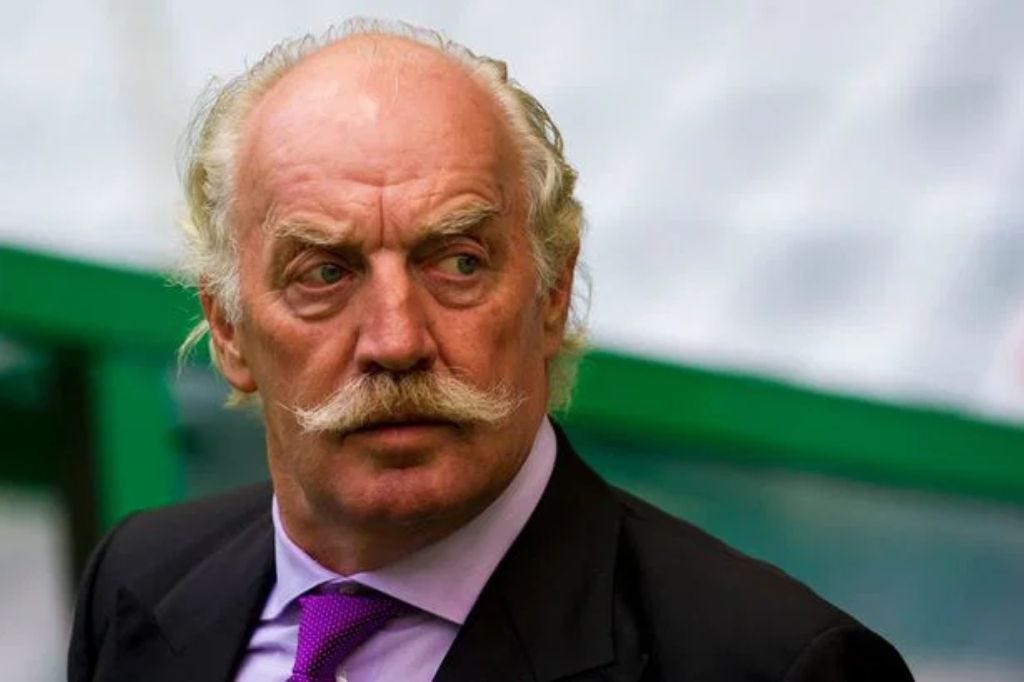
At the heart of the unrest is a question the board refuses to engage with is Celtic Football Club run primarily as a football institution with global ambitions, or as a financially conservative asset managed by accountants, bankers, and lawyers? For many supporters, the current leadership ofMichael Nicholson, Chris McKay, and the enduring influence of Dermot Desmond and his nepo baby son Ross - epitomises the latter.
These are not neutral figures. They are associated, in the minds of many fans, with:
A transfer policy that feels reactive rather than visionary.
A reluctance to invest aggressively in football infrastructure and squad depth.
A governance culture that prioritises risk management over footballing ambition.
A perception that family influence and internal networks outweigh merit and fresh thinking.
No amount of “engagement” will fix that if the same people remain in place. You cannot consult your way out of a crisis of confidence in leadership. At some point, the question has to be asked, are these the right people to steer Celtic through the next decade?
Fans who call for Nicholson, McKay, and the Desmonds to step down are not being unreasonable; they are applying the same logic that would be applied to any underperforming board in any other organisation. When trust is gone and results are not convincing, change at the top is the obvious remedy.
What genuine reform would look like
If Celtic truly wanted to reset its relationship with supporters, it would not start with a new job title. It would start with power.
Genuine reform might include:
Fan representation on the board, elected by a recognised supporter body, with real voting rights on key issues.
Clear, published metrics for football ambition - investment levels, squad targets, infrastructure plans, with regular public reporting.
An independent review of governance, with fan input, leading to concrete changes in how decisions are made and who makes them.
A timetable for leadership renewal, bringing in people with proven track records in modern football operations, not just finance and law.
None of this appears in the club’s latest statement. Instead, we get a Head of Supporter Engagement and a consultation on a fan forum. That is not reform; it is window dressing.
The danger of mistaking process for progress
The risk for Celtic is that the board convinces itself that this is enough. That by ticking the “engagement” box, they can move on while the underlying discontent continues to simmer. But protests do not disappear because a club launches a new app or takes a meeting on the road. They disappear when people believe the system is working in their interest.
Right now, too many supporters believe the opposite, that the system is designed to protect a small group of decision‑makers from accountability. Until that changes, every new initiative will be viewed through the lens of cynicism. Every “we hear you” will be met with “then prove it”.
The hard truth the board must face
Celtic is bigger than any individual on its board. Its history, its identity, and its future belong to the supporters, those on the board are mere custodians nothing more. When a critical mass of those supporters says the current leadership is no longer fit for purpose, the responsible response is not to offer more meetings. It is to listen to the substance of that demand and act accordingly.
That means having the courage to consider real change at the top. It means accepting that Michael Nicholson, Chris McKay, and the Desmond family’s grip on the club’s direction no longer serve Celtic’s best interests. It means opening the door to people with the ambition, expertise, and hunger to build a Celtic that matches the passion of its support.
Anything less is just talk. And after years of talk, Celtic’s fans have made it clear - they want action.
Fantastic article, Andy...your description of Celtic as "conservative financial asset" rather than a true football institution is painfully accurate.
There is a stubborn, ingrained patronising smugness at Board level...supporters are deemed unworthy of being possibly able to understand the shrouded mystery of the "business world"...where in reality there are legions of fans who undoubtedly deal with and manage much larger scale and more complex commercial organisations than a small Cap plc such as Celtic.
The board members are essentially mid-tier executive level people who have found a golden ticket - and they will never want to give that up willingly.
Right on brother. Now, get it done!