

Celtic’s interim chairman Brian Wilson has spoken out in the wake of another fan protest minutes into the club’s humiliating 4-1 defeat at home to VfB Stuttgart in the Europa League - and in doing so, has confirmed every supporter’s thoughts about this regime: they still do not get it, and they have no intention of trying.
A “whole lot of nothing” from the boardroom
Wilson’s latest statement in the aftermath of the 4-1 capitulation to Stuttgart manages the impressive feat of being both patronising and vacant at the same time. It speaks of disappointment, disruption and unity, yet says nothing of substance about what is actually wrong at Celtic and why tens of thousands of supporters are now in open revolt. It is the classic Celtic PLC communiqué - technocratic concern, corporate language, and not a single admission of culpability.
There is no attempt to understand why the fans are rebelling. No acknowledgement that the “atmosphere of conflict” is a direct consequence of the board’s actions, not the starting point. No movement whatsoever on the boycott of the Green Brigade, who remain effectively held as hostages, because the club hierarchy cannot accept organised dissent as a legitimate part of Celtic’s culture. The message is clear from the board: we will not change; it’s you that needs to pipe down.
If you set out to draft a statement that would further radicalise an already furious support, you would struggle to do better than this.
The Celtic Fan Collective is the club now
One of the most insulting subtexts of Wilson’s stance – and of the media chorus nudged along beside it – is the pretence that this is all about “ultras” or a noisy minority. That fiction is dead. The Celtic Fan Collective isn’t a boutique protest brand or a handful of fans behind a banner. It is a loose but powerful expression of something far bigger - a worldwide Celtic support that is fed up, sickened and angry at what the club has become under this regime.
This goes well beyond the Green Brigade. It goes beyond the regular at 111, the dad bringing his kids, the exile watching on a stream, the supporters’ club in Donegal or Dubai refusing to buy this season’s shirt. It is tens of thousands of people who feel that the current custodians see football as a necessary inconvenience between commercial partnerships and quarterly figures. The boycott of merchandise, the protests, the banners and the tennis balls are not fads; they are what happens when people realise that the only language the board respects is financial.
And that is why the Green Brigade remain ostracised: not because of some specific aggressive act, but because the board has calculated that breaking organised fan power is the first step in reasserting total control. Hostages, not stakeholders.
Bodo/Glimt’s ambition versus Celtic’s complacency
If you want a brutal, unforgiving mirror held up to Celtic’s decay, you don’t need to look further than Bodø/Glimt. Here is a club from a town of 55,000 people in the Arctic Circle, with an 8,000-capacity stadium and a squad valued at a fraction of Celtic’s, swaggering through a Champions League campaign taking points and scalps off the kind of sides we now talk about only in wistful, historic tones.
Results like Dortmund 2-2 Bodø/Glimt, Atlético Madrid 1-2 Bodø/Glimt, Bodø/Glimt 3-1 Manchester City, Bodø/Glimt 3-1 Inter Milan are not miracles. They are the output of a coherent football project. They come from a club that knows exactly what it is trying to be, that recruits with intelligence, that has a defined identity on and off the pitch, and that doesn’t confuse sitting on a cash pile with success. They are living proof that “we can’t compete” is a lie told by people who have run out of ideas but still want to draw the salary.
Celtic’s not‑so‑secret formula for failure is the precise opposite. A bloated wage bill on players the coach doesn’t trust. A squad stuffed with “assets” rather than footballers for a system. A transfer strategy outsourced to a Head of Football Operations who was hopelessly out of his depth and to a data model that appears to start and end with “loan signing”, “project player” and “sell‑on potential”. An obsession with balance sheets and resale values, while the team’s capacity to actually win football matches at any meaningful level ebbs away.
Bodø/Glimt show what is possible when a club is run for footballing achievement first and finances as the enabler. Celtic show what happens when you invert that.
Death by spreadsheet: Nicholson, McKay and a broken model
You do not need an MBA to understand how Celtic got here; you just need to watch how this board does business. Season after season, the same pattern plays out.
Key players are sold at the worst possible time – often on the eve of major qualifiers – because the overriding obsession is locking in the profit now, not maximising sporting success and the longer‑term financial upside that success brings. The Champions League qualifier against Kairat Almaty was the clearest example of that mentality. You gamble with the most important tie of the season, offload your best assets, and rock up undercooked with a squad light on experience and lacking first‑team ready reinforcements. When that gamble inevitably blows up, you shrug and brief the press that the “club can’t compete with the finances in European Football once again”.
On the recruitment side, the football department has all the authority of a middle manager in a call centre. Former Head of Football Operations Paul Tisdale – a man who looked out of his depth from day one – was tasked with identifying “Celtic quality” signings, and we got exactly what that deserved. Players plucked from some basic algorithm and from the CV pile, rather than from a clear footballing plan. The notion that a failed Stevenage manager should be the arbiter of who is good enough to wear the hoops would be funny if the consequences weren’t so serious.
Then there’s the negotiation style under Nicholson and McKay - following the Peter Lawwell class of negotiation. Time and again, we hear of targets being strung along, fees haggled over to the last possible minute, only for the player to go elsewhere or to be signed at an inflated price because the selling club knows we are desperate and out of options. This is not “hard‑nosed business acumen”; it is incompetence dressed up in a suit. Nicholson is earning a wage that would not look out of place in the lower half of the English Premier League, yet the actual execution is pure amateur hour. The club postures as a savvy operator while acting like a panicked punter chasing losses.
These aren’t isolated missteps. They are systemic failures – strategic, structural, cultural. And they sit squarely at the door of the board.
The price of failure: Europe, the league and beyond
The 4-1 doing by Stuttgart wasn’t just another bad night in Europe; it was a symptom of a deeper rot. The likely Europa League exit to a side sitting fourth in the Bundesliga doesn’t just damage pride – it has concrete consequences for Scotland’s coefficient and for Celtic’s future access to the Champions League.
Losing that second Champions League place is a disaster in waiting. If Celtic then fail to win the league this season, they are suddenly staring at a future where there is no Champions League money, where qualifying becomes a high‑wire act, and where the financial cushion that this board has treated as their safety blanket starts to fray. And this is not some unavoidable misfortune. It flows directly from the club’s decision to gamble with the Kairat tie, to underinvest in first‑team ready players in pre‑season, and to treat continuity and long-term planning as optional extras.
The irony is brutal. A board that prides itself on prudence and financial management has made decisions that could harm the club’s finances for years to come. The fixation on today’s balance sheet has undermined tomorrow’s revenues. Once again, short‑termism masquerading as stewardship.
Lawwell has already done his second disappearing act after doing it once before, slipping away when the 10‑in‑a‑row dream was torched under his watch, only to re‑emerge in another guise down the line. Nicholson and McKay now wear the day‑to‑day responsibility around their necks like a noose. But make no mistake: this is collective failure. No one in that boardroom is blameless.
They aren’t the club – and they need to go
At some point, even the most loyal shareholder and the most patient supporter has to confront the obvious: Celtic need a root‑and‑branch clear out at board level. Not a tweak. Not a cosmetic reshuffle. Not another “independent review” that disappears into the ether. A total reset.
Every single senior figure responsible for the direction of the club – chair, CEO, non‑execs, the whole football operations leadership – should be on notice. They are collectively damaging Celtic as a business, as a football club and as an institution. They have confused temporary custodianship with ownership, power with entitlement. They act as if Celtic is theirs to shape and exploit as they see fit, rather than something they are privileged to serve for a brief moment in a history that long predates them and will long outlast them.
They forget the one truth that matters: they aren’t the club. It isn’t their club. Strip away the fans and what are they? A handful of executives in an office, staring at a set of accounts with no income, no atmosphere, no banners, no songs, no meaning. The bank balance is only numbers on a screen because of the people they are now patronising and punishing.
If they will not change course, they must be removed – by shareholder action, fan pressure, and sustained refusal to bankroll a model that treats supporters as customers to be managed rather than as the very lifeblood of Celtic. Even then no business would treat customers the way that Celtic treat their fans.
The players are not off the hook either
All of this rage at the board does not absolve the squad of responsibility for what happened against Stuttgart and across this season. Thursday night’s farce highlighted not just structural weaknesses, but individual performances that are nowhere near Celtic standard.
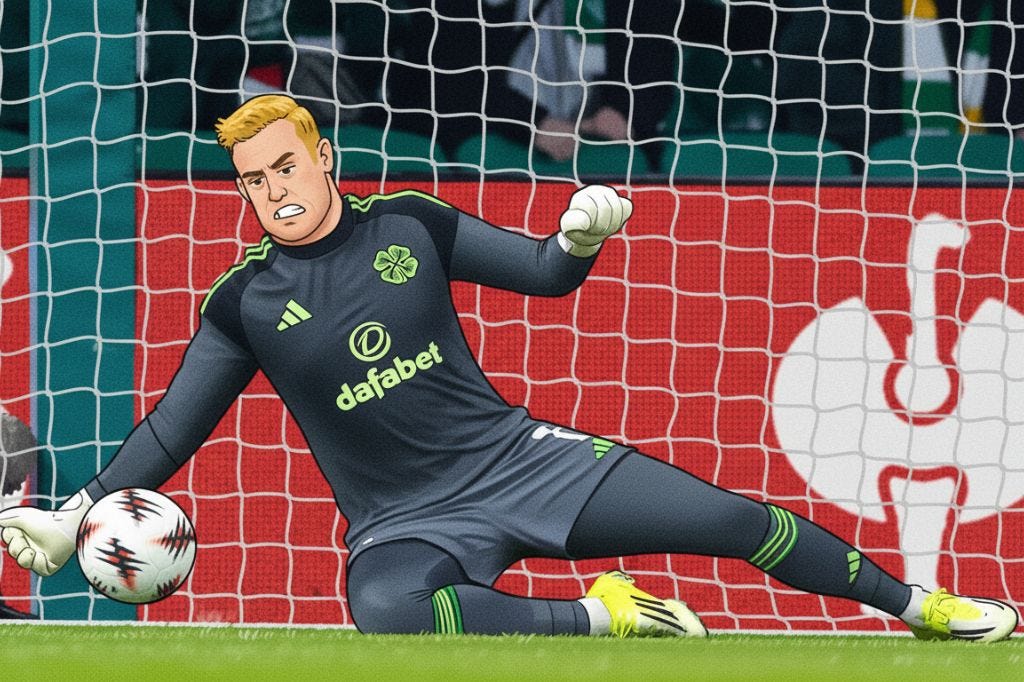
Kasper Schmeichel has become the most visible symbol of that. Watching him try to turn is like watching an oil tanker attempting a three‑point turn in a tenement close. His distribution is poor, his presence does not reassure his defenders, and his ongoing shoulder issues appear to have stripped him of the reflexes and agility required at this level. The name on the back of the jersey and the legacy of his father have given him an aura he doesn’t earn on the pitch. On pure footballing criteria, he should never play a competitive game for Celtic again.
Then there’s the Japanese core that once looked like the engine of our side. Hatate and Maeda now resemble players counting down the days until they can leave. Whether it is the hangover of blocked moves last summer, burnout, or simply a breakdown in trust with the club’s direction, the result is the same: empty jerseys. Hatate in particular has been at fault for multiple goals, switching off, failing to track runners, and playing with a casualness that bleeds into the rest of the team. You cannot build a serious side around passengers, no matter how talented they once were.
This summer, there needs to be a ruthless overhaul of the playing squad. Sentiment, reputations and resale value cannot be the primary drivers. The squad requires balance, hunger, athleticism and clarity of role. Too many players are either coasting or miscast.
I’ll be doing a full, in‑depth piece on every single member of the squad in a future article – because the clear out required on the pitch deserves as much forensic attention as the one that is needed in the boardroom.
Where do Celtic go from here?
The protests and boycotts are not the problem; they are the only rational response to a regime that has hollowed the club out from the inside. The football on the park is not an unfortunate blip; it is the natural consequence of years of treating the team as a cost centre rather than the core purpose of the organisation.
Brian Wilson’s statement was supposed to calm things down. Instead, it has crystallised the reality that this board will not change of its own accord. The question now is whether the people who truly are Celtic – the supporters – are prepared to keep up the pressure until those who have failed so spectacularly are forced to make way for something better.
It took me until 6 pm yesterday before I looked to Celtic news after Thursday's result, that has NEVER happened before, I was/am livid with everything that went on.
Today I've come to a worse conclusion, I hope I'm way off being right, I think the billionaire with the stupid tache is in the process of running the club into the ground.
Then I thought, why would he? He fckn detests the fans, hates being (as he sees it) dictated to by anyone particularly said plebians, then I thought hes not one to lose money on any deal so why wouldn't he sell his shares? That's easy, that's what the fans want so that'll be a non starter and maybe any buyer may actually run it correctly which wouldn't reflect well on him.
Then it hit me, he has invested a decent sum initially and has taken plenty cash out but to a double billionaire it is just chump change, so I think he is going to run it into the ground to spite the fans.
IS THERE NO MECHANISM TO GET THIS BASTARD OUT?
An excellent article, Andy