

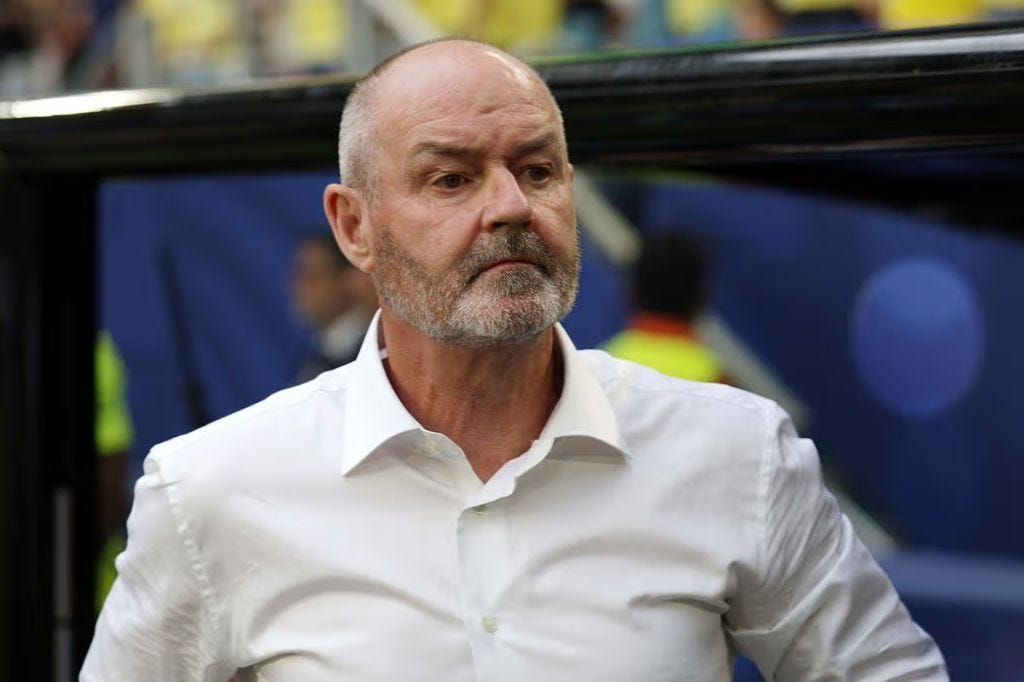
Steve Clarke’s Scotland tenure did not end with a bang, but with a familiar whimper, one that has echoed through too many summers of false dawns, limp performances, and managerial deflection. His resignation, confirmed within an hour of Scotland’s inevitable World Cup exit, felt less like a shock and more like the closing scene of a story we had all already read.
For all the talk of Clarke being Scotland’s “most successful modern manager,” his legacy will never sit comfortably alongside the greats of the national game. Not because he failed to qualify - in fact, qualification became his calling card - but because when it mattered most, when Scotland had the world watching, his teams consistently shrank, retreated, and ultimately embarrassed themselves.
Clarke’s Scotland didn’t just exit tournaments. They made a habit of arriving underprepared, underwhelming, and ultimately underachieving.
Qualification Was Never the End Goal
Let’s start with the defence that will inevitably be rolled out in the coming days. Clarke took Scotland to three major tournaments. He ended the long exile. He reconnected the national team with the fans. All of that is true. But it is also incomplete.
Scotland did not appoint Steve Clarke to simply qualify and make up the numbers. Even SFA president Mike Mulraney said it himself, qualification alone was no longer enough. The aim was progression. Competitiveness. Respectability on the biggest stage. Instead, what followed was a trilogy of near-identical failures.
At Euro 2020, Scotland exited with a whimper. At Euro 2024, they regressed further into passivity and confusion. And at the 2026 World Cup, the long-awaited return after 28 years, they managed one narrow win over Haiti and folded meekly against any opponent of real quality. One win in three tournaments. Not a single knockout match. That is not progress. It is stagnation dressed up as success.
The Haiti Game Said Everything
If you want to pinpoint where this World Cup campaign began to unravel, look no further than the opening match. A 1-0 win over Haiti, ranked 83rd in the world, should have been a platform. Instead, it became a warning sign.
Scotland created chances but refused to take risks. They did not push for a second or third goal. They did not chase the margin that would later define their fate. They played within themselves, as they so often did under Clarke, prioritising control over ambition. And when fans quite rightly questioned why Scotland didn’t go for the jugular, Clarke’s response was not reflection it was irritation. He hit out at criticism, as if supporters expecting their national team to attack Haiti with conviction were somehow unreasonable.
That moment encapsulated everything about his tenure, a manager unwilling to adapt, unwilling to engage with criticism, and unwilling to acknowledge that caution has a ceiling.
Tactical Timidity on the World Stage
If the Haiti game was frustrating, the matches against Morocco and Brazil were borderline humiliating. Against Morocco, Scotland conceded after 70 seconds and spent the rest of the match looking tactically confused. Two left-backs deployed in the same system, no coherent attacking structure, and a reliance on hopeful moments rather than designed patterns of play.
Against Brazil, it got worse. A 3-0 defeat that flattered Scotland. Lawrence Shankland isolated up front, chasing lost causes against one of the best defensive units in world football. Midfield leaders like McGinn and McTominay reduced to passengers. A team set up not to compete, but to survive and failing even at that. This was not pragmatism. It was fear. And fear, at this level, is fatal.
The Arrogance Problem
What made Clarke’s tenure increasingly difficult to defend was not just the results, but the attitude. There was a growing sense that he operated without accountability.
Post-match interviews were often curt, defensive, or avoided altogether. Legitimate questions about tactics or selection were brushed aside. Fans were told, implicitly and sometimes explicitly, that they should be grateful - grateful for qualification, grateful for effort, grateful for moments. But football does not work like that.
Supporters who travelled across the United States, spending thousands - even tens of thousands - to follow their country, were not asking for miracles. They were asking for bravery. For evolution. For evidence that lessons had been learned from previous failures. They got none of it. Instead, they got a manager who doubled down on the same risk-averse approach that had already failed twice before on the big stage - the hit out at the fans hitting out at them saying they didn’t have a clue about football, when they questioned why we didn’t go and score more against Haiti.
Loyalty Over Progress
One of Clarke’s defining traits was loyalty. In the early years, it helped build cohesion and belief. But over time, it became a liability. Players were picked not on form, but on familiarity. Systems remained rigid, even as opponents adapted. Younger, more dynamic options were often sidelined in favour of trusted lieutenants. Continuity, Clarke argued, was key. But continuity without evolution is just repetition. And repetition, in Scotland’s case, meant repeating the same mistakes at three consecutive tournaments.
The SFA’s Role in the Mess
Clarke’s resignation should not be treated as a neat ending. Because the truth is, he should not have been in charge at this World Cup in the first place.
After the debacle of Euro 2024, there was a clear opportunity for change. Instead, the Scottish FA doubled down handing Clarke a new four-year contract before a ball had even been kicked in America.
No external pressure forced that decision. No rival federation was circling. It was a choice and a baffling one. Mike Mulraney and Iain Maxwell must own that. They spoke about ambition. About moving beyond qualification. About raising standards. And then they rewarded failure with security and stability. You get what you pay for in football. And Scotland, ultimately, got exactly what they invested in - a solid, conservative club manager who was out of his depth on the international stage.
If there is to be any meaningful reset, it cannot stop with the manager. The leadership that enabled this cycle of mediocrity must also be held accountable. Frankly, it is time for Mulraney and Maxwell to go.
The “Most Successful Manager” Myth
There will be a temptation now to soften the narrative. To celebrate Clarke as a trailblazer. To frame his tenure as an unqualified success. He was, statistically, Scotland’s most successful modern manager in terms of qualification. But greatness is not measured in entry alone. It is measured in impact, in evolution, in how a team performs when the stakes are highest. On that front, Clarke falls short.
The great Scotland managers - the ones etched into footballing folklore - built teams that competed, that adapted, that rose to the occasion. Clarke’s teams did not rise. They retreated. And that is why, despite the milestones, he will never truly belong in that conversation.
What Comes Next?
This is the moment Scotland must get right. The next appointment cannot be another safe pair of hands. It cannot be another manager who views qualification as the ceiling rather than the starting point.
It must be someone who understands the modern game. Someone willing to impose a style, to develop players, to take calculated risks. In my view, there is one standout candidate - Ange Postecoglou.
A manager with a clear footballing identity. A track record of transforming teams. Experience on the international stage with Australia, where he not only qualified for a World Cup but reshaped the way the national side played.
At Celtic, he rebuilt a club’s entire footballing philosophy in a matter of months. At Tottenham, he showed he can operate at the elite level, implementing an aggressive, front-foot style that demands courage and clarity. Leading them to winning the Europa League - despite the failings in the English Premier League. Most importantly, Postecoglou does not do fear. And that is exactly what Scotland need.
Yes, he may prefer a return to club football. Yes, it would require ambition and a significant financial commitment from the SFA. But if the last seven years have taught us anything, it is that playing it safe gets you nowhere.
A Chance to Reset
Steve Clarke’s departure closes a chapter that began with optimism and ends in frustration. He deserves credit for reconnecting the national team with the fans. For restoring pride in the jersey. For making Scotland relevant again after years in the wilderness. But football does not stand still. And neither can Scotland.
The rest of the world is evolving - tactically, technically, mentally. Meanwhile, Scotland have been stuck in a loop, replaying the same cautious script and expecting different results. That has to change.
Because if there is one lasting image from the 2026 World Cup, it is not the win over Haiti or the sea of tartan in the stands or the Tartan Army taking over Boston and Miami - it is the sight of a team playing within itself, afraid to take risks, and ultimately paying the price for it.
That is Steve Clarke’s legacy.
Think you are being harsh on Steve Clarke. I'm trying to think of a dynamic Scotland Manager. Jock Stein alone and in combination with Alex Ferguson didn't produce a fearsome team . Ally McLeod was regarded as a clown by the players. Bobby Brown. 1967 beating England (carrying a few injuries) at Wembley. Think they lost or drew the other games. 1958 World Cup . Beaten by Paraguay and France (before they were a force majeur). 1974 and 1978 we had the players but not the manager or coach to get the best from them. Willie Ormond liked a drink and would have enjoyed drinking Boston dry. At the bare minimum at least we have a team that doesn't go out on the lash. Slow progress but progress nonetheless.