

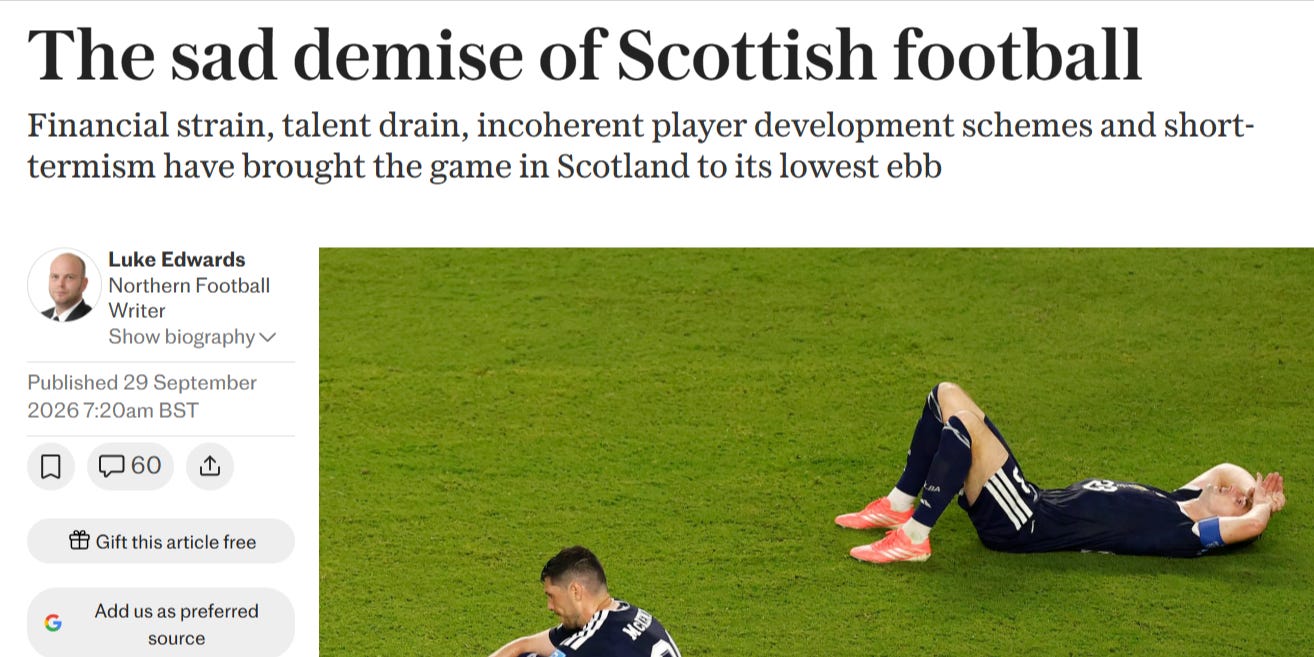
Journalist Luke Edwards’ portrait of Scottish football as a game in “the doldrums” is not merely ungenerous. It is a spectacular exercise in looking in the wrong direction. At the very moment English football is confronting the gravest credibility crisis of the Premier League era; at the moment Manchester City’s years-long financial case has produced guilty verdicts against the club on 114 out of 115 charges; at the moment Manchester United’s debt has climbed beyond £1.1bn; at the moment prices are pushing lifelong supporters out of the grounds that made English football famous, the Northern Football Writer of the Daily Telegraph has trained his telescope northwards, to a game that he has no knowledge of and no experience of, and announced that Scottish football is the one in trouble.
There are serious issues in Scottish football. There always have been and always will be. The pathway for young Scottish players is too narrow. The number of Scottish starters in the Premiership needs to increase. Clubs need more investment in coaching, facilities and long-term player development. Scotland’s World Cup was disappointing, and Steve Clarke ultimately paid the professional price for it. But troubled? In decline? Humiliated?
That is the language of a writer who has confused a difficult competitive environment with a dying football culture. Scottish football is not dying. It is noisy, inconvenient, argumentative, emotional, occasionally chaotic, and still deeply rooted in the communities that created it. It is everything that modern English football is ceasing to be.
The first problem with the Edwards’ argument is that the available evidence says something very different. Scottish football is attracting record crowds. UEFA’s latest figures show roughly six million admissions to men’s matches in Scotland across the 2025-26 campaign, including more than four million in the Premiership alone. Scotland’s top flight has the strongest attendances in Europe on a per-capita basis. Celtic’s domestic crowds rank 13th across Europe, while grounds throughout the league are fuller than they have been for years. That is not a small detail to be pushed beneath a pile of selectively highlighted qualifying results. It is the point.
Football is ultimately not a spreadsheet of coefficients, transfer fees and television contracts. It is a weekly act of being part of something. It is the walk to the ground, the familiar faces at the turnstile and in the seats beside you, the arguments over team selections, the suspicion of referees, the songs that carry the history of a town, a city, a community, a club. It is the knowledge that when your club is performing or not, you will still be there next Saturday. Scottish football understands this instinctively because it has had to.
It does not have the Premier League’s media money, its global marketing machinery or its ability to sell the same match simultaneously to broadcasters across several continents. Yet Scottish football fans still turn out. In Glasgow, Edinburgh, Dundee, Paisley, Motherwell, Kilmarnock, Perth, Dingwall and everywhere in between, the game matters because it remains woven into ordinary life.
There is a reason Scotland can draw six million admissions in a country of just over five million people. Supporters are not arriving simply to consume a sporting product. They are there because the club is part of who they are. If that is “the doldrums”, Scottish football should perhaps hope never to escape them.
The Premier League is a magnificent sporting competition. It has elite footballers, top coaches, global reach, and an intensity that still produces brilliant football on occasion. But it also has a growing problem that too many English commentators prefer to treat as background noise or ignore completely - it is becoming less accessible to the fans who built it.
Nineteen of the 20 Premier League clubs raised ticket prices for the 2026-27 season, with some increases reported as high as 28%. The Football Supporters’ Association says 115 top-flight supporter groups called for a two-year freeze on home ticket-price rises, warning that the traditions and values of the English game are under threat from escalating prices, commercialisation and corporate greed. This is not nostalgia. It is economics.
A football supporter who has followed a club for decades is not merely a potential customer to be monetised until they can no longer afford to attend. Yet that is increasingly how the Premier League operates. Season-ticket waiting lists are long, hospitality areas expand, dynamic pricing spreads, loyalty concessions shrink and matchday access is designed around maximum yield.
The numbers tell their own story. Liverpool’s expanded Anfield has a capacity of around 61,000 yet only 34,000 season tickets available, allowing almost half of tickets to be sold game by game [Compare that to Celtic Park’s stadium capacity of 60,411 with a season tickets numbering 53,000]. That makes commercial sense when a visitor flying in for a weekend is likely to spend freely on tickets, hospitality, food, drink and merchandise. It does not necessarily make sense for the supporter who has spent a lifetime travelling to the ground.
At Manchester City, premium hospitality for a match against Arsenal was advertised at £5,500. At Manchester United, supporters are dealing with successive price rises, reduced concessions, and life long season ticket holders being banned because they gave their family member their ticket a few times and are now being painted as ticket touts. Across the Premier League, average ticket prices rose by seven per cent last season. That is not a league broadening access. It is a league increasingly selling exclusivity.
The language is always soft. “Global appeal.” “Visitor experience.” “Premium matchday offering.” But football supporters know what it can mean in practice - fewer people who know the songs, fewer people who recognise the opposition’s historical significance, fewer local children who can dream of going every other week, and more seats populated by people filming the atmosphere on their mobiles rather than helping create it.
There is nothing wrong with an overseas supporter travelling to see their club. Football is global, and proudly so. The problem comes when the genuine local supporter becomes expendable because the tourist can be charged more.
A packed stadium is not automatically an atmospheric stadium. English grounds can still be magnificent, especially on major European nights or when local rivalries genuinely catch fire. But too often the modern Premier League spectacle is sanitised - corporate concourses, hospitality packages, phone screens held aloft, family sections stripped of noise, and ticketing systems that reward spending power rather than years of loyalty. The league may remain full. It is not full of the people who gave it its voice, its heart, its soul.
And then there is Manchester City.
This is not about cheap point-scoring at City supporters, who have every right to back their club and who have lived through their own history long before the Abu Dhabi ownership era. It is about the integrity of the competition.
Manchester City were charged by the Premier League in February 2023 with 115 alleged breaches of financial rules after a four-year investigation. The allegations covered multiple seasons and included claims concerning the accuracy of financial information, sponsorship income, operating costs, player and manager remuneration, and co-operation with the investigation.
An independent panel has now found City guilty of the majority of those charges, with 114 of the 115 had been upheld. The sanctions process remains unresolved, City maintain their denial of wrongdoing and an appeal is expected. This is not a final, closed case, and it should not be presented as one. But the scale of the affair is unavoidable.
A football league cannot spend years selling itself as the gold standard of world sport while one of its defining clubs is caught in a scandal of this magnitude. If the findings are ultimately upheld, the question will not merely be what punishment Manchester City receive. The question will be whether English football allowed financial power to reshape competitive history while everybody else was asked to admire the trophies. That is the scandal at the heart of the English game - not that money exists, but that money has become the competition’s central organising principle.
The Premier League speaks constantly about sustainability while clubs chase ever-higher revenues, more international visitors, more hospitality income and more commercial partners. It treats the supporter as both its moral foundation and its easiest source of additional income. It promotes competitive balance while its wealthiest institutions operate in a financial world far removed from the rest of the football pyramid.
Scotland has no need to pretend it is immune from inequality. Celtic and Rangers command resources that dwarf the rest of the Premiership put together. But at least the inequality is not routinely sold as a moral triumph of a supposedly perfect football league.
Manchester United are perhaps the clearest symbol of the modern English contradiction. One of the world’s biggest football brands, record revenues, global commercial power and debt now reported at more than £1.1bn after a further £90m in borrowing.
That is not a problem created by supporters. It is not a problem caused by lack of interest. Old Trafford remains one of football’s great stadiums because generations of fans made it one. It is a problem of ownership and extraction.
English football has spent decades celebrating itself as the richest game on earth. Yet some of its biggest clubs remain burdened with huge debt, dependent on continual growth and locked into an arms race that requires more broadcasting money, more sponsors, more tourists, more expensive tickets and more commercial compromises.
This is what the Premier League’s vast wealth has produced, a competition that can pay extraordinary wages and command extraordinary attention, but which too often cannot protect its own supporters from being priced out of the culture they created. It also produces a strange lack of perspective when English writers turn to Scotland.
Scottish football is judged against England’s financial firepower, then mocked for failing to match it. Scottish clubs are expected to compete in Europe with teams receiving television payments that eclipse their entire operating budgets. Scottish players are recruited by English academies at 16, then Scotland is criticised for not retaining enough domestic talent. Scottish clubs lose qualifying ties against Bundesliga or Portuguese giants, then the result is treated as a verdict on the entire game. That is not comparison. It is condescension.
The Telegraph article is right about one thing - Scotland needs more Scottish players playing meaningful first-team football. The concern over the proportion of domestic starters cannot be dismissed. But the comparison with England should be made honestly.
English-qualified or non-foreign players account for roughly 27.5% to 30.2% of Premier League minutes, while foreign nationals make up the vast majority of the playing pool. In Scotland, Scottish-born or locally trained Scottish players account for around a third of the Premiership’s player base and playing time. The figures are not a reason for complacency in Scotland; they are a reminder that England’s supposedly superior system has its own profound dependence on imported talent.
The difference is that Scottish football is now at least trying to address the issue. The SFA’s proposed youth measures, including a requirement for Scottish under-21 players to start cup fixtures and incentives around domestic under-21 minutes in league football, may need refinement. The danger of tokenism is real. Clubs should not be compelled to play youngsters simply to meet a target and I have my own criticisms of the SFA holding another review into the game - when they ignored much of the last one only to pick and choose bits.
Scotland has identified a structural problem and is debating intervention. It is trying to make the pathway from academy to senior football more viable. It has introduced loan arrangements intended to give younger players competitive minutes while maintaining their connection to parent clubs. It is not sitting still. And the wider picture is hardly one of national paralysis.
Scotland have qualified for three of the last four major tournaments. Yes, the World Cup campaign fell short. Yes, the side managed one win, against Haiti, and did not do itself justice against Morocco or Brazil. But Scotland were placed in the only group containing two nations ranked in FIFA’s top 10 at the start of the tournament. The disappointment was valid; the idea that it proved Scottish football had collapsed is absurd.
Steve Clarke left with his reputation higher than when he first took on the Scotland job. He restored belief in the national team, which had been missing for far too long. He made qualifying for tournaments normal again. He gave Scotland famous nights and an identity. Now Sébastien Pocognoli has the responsibility to build on that foundation, develop the next group of players and find a more progressive balance between organisation and ambition.
That is what football cycles look like. They are not always clean. They are not always upward. But they are not automatically evidence of decline.
The World Cup also made a point no spreadsheet can fully capture. The Tartan Army did not travel to the United States merely to watch Scotland play. Had that been the requirement, Scottish football would have lost much of its support long ago. They travelled because international football means something different in Scotland. It is collective. It is social. It is self-deprecating and defiant. It is the army of supporters who can turn a city centre into a carnival, who make friends in airports and fan zones, who understand that following Scotland involves both hope and the ability to laugh when hope turns against you.
The football on the pitch matters enormously. Of course it does. But the Tartan Army’s presence in the United States was a reminder that Scottish football’s value cannot be measured only by group-stage points or UEFA coefficients. It is a culture. That culture cannot be bought by wealth, broadcast packages or £5,500 hospitality tickets. It cannot be manufactured by a marketing department. It comes from history, local allegiances and the stubborn refusal to stop caring.
Edwards sees a difficult European qualifying campaign, a disappointing World Cup and a legitimate youth-development issue, then declares Scottish football to be in crisis. He sees the symptoms, ignores the health of the patient and announces the diagnosis anyway. The more revealing question is not whether Scottish football is in the doldrums. It plainly is not. The question is whether English football, in all its wealth and global glamour, is slowly pricing out the very supporters who made it worth watching in the first place.
Give me the packed, furious, imperfect, rain-soaked passion of Scottish football over that every day of the week.
Echoes of Trump also training his telescope northwards to lie about and belittle Canada, its citizens and its government, whilst the USA has done away with its checks and balances and is now mired in corruption, increased cost of living and a president who is the subject of ridicule.