

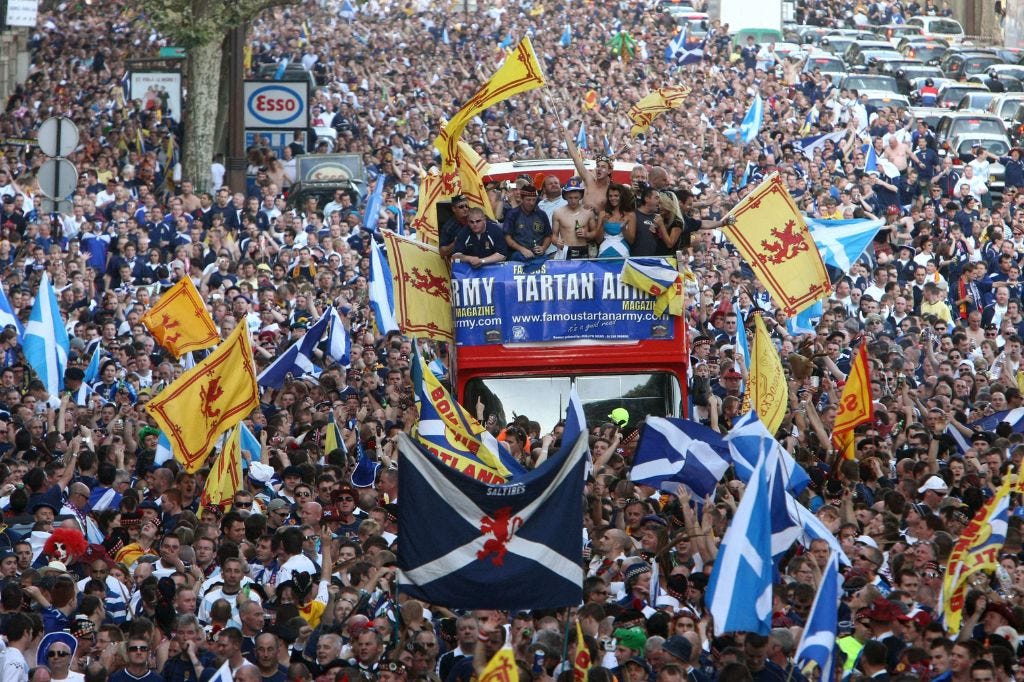
For 28 years, the World Cup has been something Scotland watched from the outside. 28 years of near misses, false dawns, playoff heartbreaks, and campaigns that faded before they ever truly got going. An entire generation has grown up without seeing Scotland at a World Cup. For many, France ‘98 is not a memory, it is a story passed down, grainy archive footage, a piece of football folklore that never quite felt real. Until now.
This is the first World Cup since 1998 with Scotland back where they belong, and that changes everything. It sharpens the anticipation, deepens the emotion, and gives this tournament a meaning that goes far beyond football. Because for Scotland fans, this is not just another football competition. It is a return. And with that return comes a familiar truth, one that sits comfortably alongside the pride, the excitement, and the sheer relief of being back on the global stage.
Scotland first. Then, as it has always been, and always will be, Anyone But England.
Let’s start where it matters most. Supporting Scotland at this World Cup is not a casual act. It is not something taken for granted. It is the culmination of nearly three decades of waiting, hoping, and enduring.
Every supporter has their own story of the journey back to world football’s greatest tournament. The campaign that almost got there. The goal that should have stood. The night it all fell apart. Over time, those moments stack up, turning absence into an identity.
So when Scotland finally step out onto that World Cup stage again, against Haiti on June 14th, it is not just about the players on the pitch. It is about everyone who stuck with it when there was nothing to cling to but belief. That is why Scotland will always come first. Because this has been earned. No freebies, no weak groups to comfortably escape from. Scotland fought tooth and nail to get to the party.
But the World Cup does not exist in a vacuum. It never has. And for Scotland fans, the wider tournament brings with it another layer of engagement, one shaped by history, rivalry, and a very specific kind of cultural resistance.
Anyone but England.
It is a phrase that will be repeated in pubs, living rooms, and fan zones throughout the tournament. It will be said with a smile, sometimes with a bite, always with understanding. And it will, as always, be misunderstood.
From the outside, it is often dismissed as bitterness or some going as far as labelling it racist. A small nation supposedly defined by its fixation on a larger neighbour. But that reading misses the point entirely. This is not about obsession. It is about context.
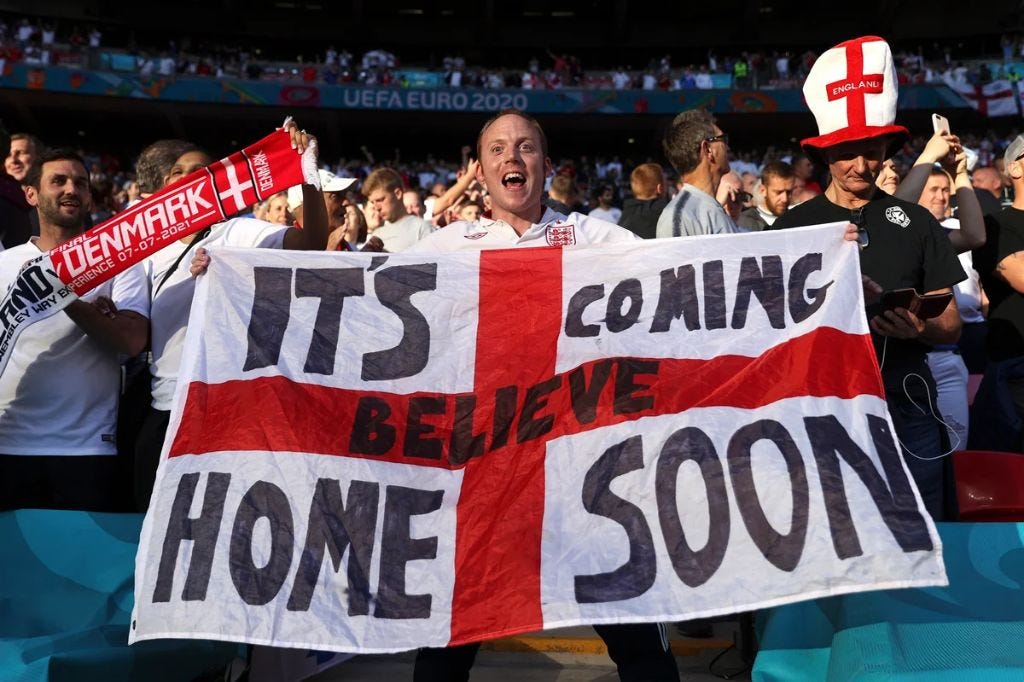
For nearly three decades, while Scotland were absent from the World Cup, England were not just participants, they were the story. Every tournament cycle came with the same swelling narrative. England as contenders. England as favourites. England were going to bring it home.
“It’s coming home” became the soundtrack of summers Scotland were not part of. And when you are on the outside looking in, that kind of dominance does not go unnoticed. It builds, year after year, into something that demands a response. Supporting Anyone But England is that response.
It is not about denying England’s quality. It is not about disliking individual players, many of whom are lauded across Scotland. It is about pushing back against the idea that one team’s journey should define the entire tournament. Because for 28 years, Scotland fans had to find their own way of engaging with the World Cup. Without a team to follow, the tournament became something different - a patchwork of allegiances, stories, and moments.
And within that, one constant remained. You picked your side. And if England were playing, you picked the other one.
That instinct did not appear overnight. It is rooted in the oldest rivalry in international football. Scotland versus England is not just a fixture; it is a thread that runs through the history of the football itself.
Even in Scotland’s absence from major tournaments, that rivalry never disappeared. If anything, it became more pronounced. Watching England navigate the Euros and World Cups while Scotland stayed home only sharpened the contrast. It reinforced the sense of separation.
So now, with Scotland back on the biggest stage for the first time since 1998, that dual identity comes into even sharper focus. There is the overwhelming pride of seeing Scotland compete again to hearing the anthem being belted out by tens of thousands of Scots, watching the Tartan Army take over another country, feeling part of something that had been missing for so long.
Then there is the familiar undercurrent. Anyone but England. It plays out in small, almost ritualistic ways. A glance exchanged when England concede. A cheer that is just a fraction louder when their opponent scores. A sense of collective amusement when the hype begins to wobble as it always does. It is not hatred. It is theatre. It is tradition. And it is shared.
Because football, at its core, is about more than just your own team. It is about identity, belonging, and the stories you choose to invest in. For Scotland fans, those stories have always existed in contrast to England as much as alongside them. The 28-year absence only intensified that dynamic.
While Scotland waited, England’s narrative grew louder. The coverage expanded, the expectations inflated, the sense of inevitability became harder to ignore. Every tournament felt like it revolved around the same axis. So the counterbalance became stronger too. Anyone but England was not just a throwaway line. It was a way of reclaiming space in a tournament where Scotland had no direct voice. Now they do.
And that changes the tone — but not the principle.
Because even with Scotland back, the imbalance in coverage and narrative remains. The English Premier League’s global reach, the media focus, the constant framing of England as central to the story, none of that disappears overnight. If anything, it becomes more noticeable when Scotland are part of the same tournament. Which is why the stance still holds. Scotland first. Then anyone but England.
There is also something uniquely Scottish in how this is expressed. It is rarely aggressive. More often, it is laced with humour, with self-awareness, with a sense that everyone involved understands the unwritten rules.
Watch a World Cup game in a Scottish pub when England are playing and you will see it unfold in real time. The mock groans, the exaggerated praise for the opposition, the quiet satisfaction when momentum shifts. It is communal. It is part of the experience. And it makes the tournament richer, not poorer.
Because here is the thing that often gets overlooked, this mindset does not diminish Scotland’s support for their own team. It enhances it. After 28 years away, every Scotland match will carry enormous weight. Every tackle, every pass, every goal will feel magnified. The emotional investment will be total.
But when those matches are done - whether Scotland progress or not - the tournament continues. And rather than fading into the background, Scotland fans remain engaged. They have a stake. They have a preference. They have a narrative to follow. That is what “anyone but England” provides. It keeps the World Cup alive beyond Scotland’s own results.
There is also a deeper layer to all of this, one tied to how Scotland sees itself in footballing terms. This is a nation that does not deal in entitlement. Success is not assumed; it is chased, often unsuccessfully, but always with belief. Moments matter more than medals. Nights matter more than narratives. Being back at a World Cup after 28 years is, in itself, a victory of sorts. It is proof that persistence counts for something, that history can be restarted, that the long wait was not for nothing. That perspective shapes everything.
It makes Scotland’s presence feel earned in a way that cannot be manufactured. And it makes the surrounding noise, the hype, the expectation, the relentless focus on certain teams feel even more distant. So when Scotland fans say “anyone but England,” it is not coming from a place of insecurity. It is coming from a place of clarity. They know exactly who they are supporting. And they know exactly why. Because this World Cup is different. This one is not about watching from afar. It is not about imagining what it might have been like. It is about living it, after 28 years of waiting. It is about seeing Scotland back where they belong. And once that part is honoured, once every bit of support has been poured into supporting Steve Clarke and the boys, the rest of the tournament unfolds as it always has. With a glance south. With a knowing smile.With a simple, time-honoured stance that needs no explanation among those who understand it.
First, Scotland. Finally, Scotland again. And then, without apology and without hesitation - Anyone but England.