

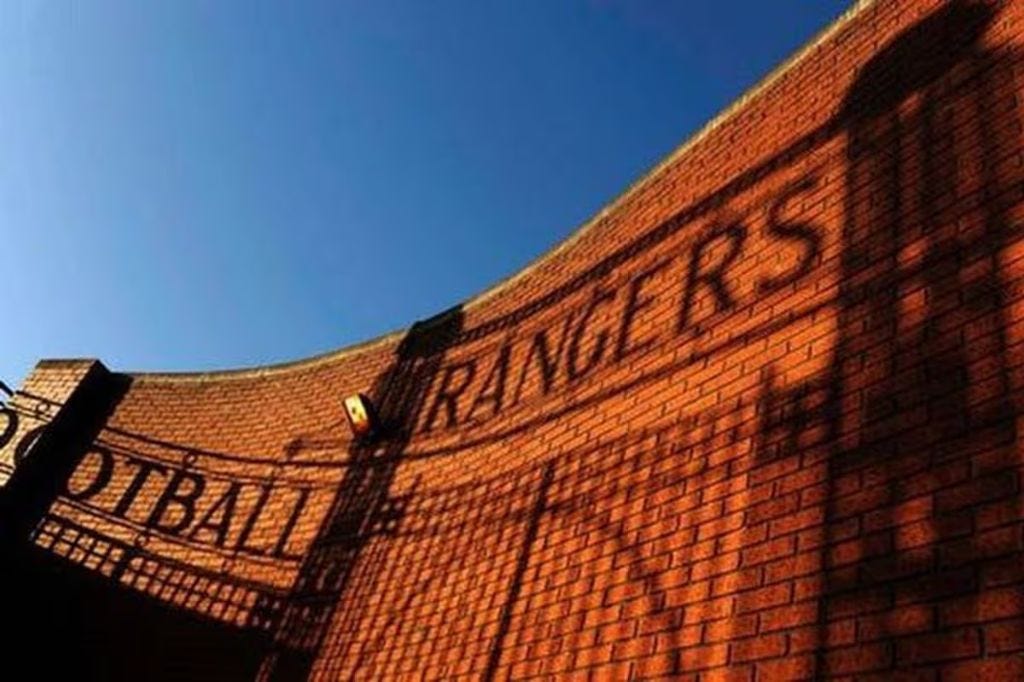
The story of the demise of Rangers Football Club in 2012 is not merely a take of a sporting rise and fall. It is the saga of institutional decay, where the lines between the terraces and the halls of justice became hopelessly blurred. It is a reflection of a Scottish justice system full of partisan, vengeful, and deeply corrupt individuals.
What began as the financial collapse of a sporting institution mutated into a constitutional crisis. At the heart of it lies a simple yet terrifying reality - the state used its coercive power to pursue innocent men, not because of the evidence, but because of an institutional desire for payback for the death of the old Rangers.
When Sir David Murray sold his stake in Rangers to Craig Whyte for a pound in May 2011. It was a deal made in desperation by Murray, with the shadow of the Big Tax Case - a multi-million pound dispute with HMRC over the use of EBTs at Ibrox - circled like a vulture waiting to pounce on its prey. Under a year later, and Whyte put the club into administration on Valentine’s Day 2012. Administration led to liquidation, before the assets were sold off to a consortium led by Charles Green, and a new company - Sevco Scotland Ltd.
For Rangers fans, it was now all about the ‘journey’ as the new club founded by Green looked to climb the divisions and secure promotion to the Scottish Premiership. For the Scottish legal establishment, the death of Rangers Football Club was a crime that needed a culprit. The subsequent police investigation was not a search for truth, it was a dragnet. In 2014, David Whitehouse and Paul Clark - the administrators from Duff & Phelps - were arrested. They were paraded in front of cameras, their reputations in tatters overnight. Along with them, Charles Green, Imran Ahmad, and Craig Whyte were also in the firing line.
Yet three years later, the state’s case disintegrated in spectacular fashion. Panto Villain Craig Whyte was cleared of all charges by a jury in just two hours. The prosecution’s theory, that Whyte had fraudulently acquired the club, could not survive the simple fact that Murray was so desperate to offload the club they hadn’t bothered to check where his money came from.
But the real scandal was only beginning. As Whitehouse and Clark fought back with civil lawsuits, the Crown Office was forced into a humiliating and unprecedented admission, the prosecutions were “malicious.” In legal terms, this is a nuclear confession. It means the state pursued these men knowing there was no “probable cause.”
The cost to the taxpayer has now surged past £60 million, with compensation being paid out to the men whose lives were nearly destroyed by a rogue prosecution service.
So why did it happen? To answer that, we must look at the “allegiances” that critics say poisoned the well of justice. The investigation was marked by a “perfect storm” of bias.
Sheriff Lindsay Wood, who signed off on 22 warrants - including an unlawful raid on a London law firm - was a Rangers shareholder. He had a framed photo of Ibrox in his chambers. When investigated, it was found he had submitted a “misleading report” to justify his actions.
Then there was the lead detective, DCI Jim Robertson, who was reported to have sung Rangers songs during Police interviews and allegedly wore Rangers cufflinks while interrogating suspects. He was described by a judge as providing evidence that was “patently untrue.”
And finally there was the prosecution themselves, with documents revealing a ‘need to nail’ the administrators. The state was actively acting as a proxy for the anger of the Rangers support, seeking to punish those they blamed for the club’s liquidation.
There is a distinct sense of irony when it comes to this scandal. Some Rangers fans believed that the justice system was out to get Rangers, yet the evidence suggests the system was actually populated by people so emotionally linked and invested in the Ibrox club that they abandoned all sense of professional standards and neutrality to seek revenge on those who oversaw their club’s demise.
Today, the Rangers scandal has entered a new phase. In 2021, then-First Minister Nicola Sturgeon promised a judge-led public inquiry. We are now five years on, and that inquiry has yet to begin. The current SNP administration in Holyrood, led by John Swinney, maintains that it must wait for all other legal proceedings to finish first.
The appointment of Shelagh McCall KC to “independently” consider criminal conduct within the Crown Office has done little to ease suspicions of a cover up. For many, this looks like the Crown Office investigating itself - turkeys voting for Christmas - with the Scottish establishment looking to circle the wagons and protect its own.
The “stench” is not just about football; it’s about the total lack of accountability. No police officer has been charged. No prosecutor has been fired. Sheriff Wood was allowed to retire with his pension intact, with the Lord President, Lord Carloway, deciding no formal action was “appropriate.”
The Rangers scandal is a warning. It shows what happens when a small, insular legal system becomes infected by the tribalism of the society it serves. Whether it is a political cover-up to protect the reputation of the Crown Office, or a judicial “closing of the ranks” to protect fellow law officials, the result is the same, the truth is being suppressed.
Until we have a truly independent inquiry - led by an independent judge from outside Scotland, free from the gravitational pull of Glasgow’s footballing divide and the Scottish legal system - the £60 million shadow will remain. Scotland cannot claim to be a modern democracy if it allows the state to “maliciously” destroy lives with impunity due to their allegiances to a football club, then hides the evidence behind a wall of bureaucratic delays.
The fact that not one person ended up in prison for this scandal proves how corrupt the system is Andy. Celtic are complicit in this as well by signing the five way agreement that Peter Lawell insists he's never even seen but the document allegedly has his signature on it. It's twelve years on from the event now so I wonder if the statute of limitations would come into play as far as convictions go but we'll never find out the real story that's all well hidden. If someone tried to get access to the paperwork under the freedom of information act they'd get short shrift from the authorities as it's got the potential to blow a massive hole in the criminal justice system and how corrupt it all actually is, it's a disgrace that the police and judges were acting with impunity to bring malicious charges against these guys just trying to do their job just because they needed a scapegoat. Why weren't David Murray and Gavin Masterton asked some very serious questions? There's so much more I could say on the matter but I can get carried away so I'll leave it at that.
There's no such thing in Scotland as a neutral judge who isn't part of the masonic brotherhood.
They could bring in someone from down south but as the laws are different an English judge would have to rely on a masonic Scottish judge to interpret things. Back to square one