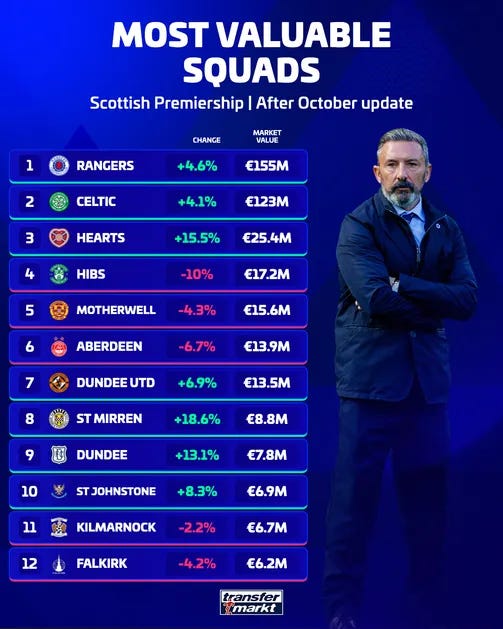
The latest Transfermarkt squad valuations have been treated by parts of the Scottish media as though they are audited financial statements. Rangers’ rising total has been rushed into headlines as proof of a dramatic power shift, while Celtic’s comparative figure has been used to frame a familiar argument between the two Glasgow sides.
It is neat, easy to understand and perfectly designed for a headline.
But there is an obvious problem, Transfermarkt valuations are not real transfer values. They are estimates created through subjective criteria, editorial judgement and community discussions - not evidence of what a club would actually pay or what players are actually worth.
Transfermarkt itself is clear on the matter, even if much of the coverage built around its figures is not. The website says its market values are calculated through various pricing models and substantial community involvement, with users contributing to detailed discussions around player values. It explicitly states that these figures should not be equated with actual transfer fees or player valuations. Its stated aim is not to predict a price, but to provide an expected value. That ought to be treated as an important disclaimer rather than a minor technicality buried beneath another Rangers-versus-Celtic debate in the struggling world of Scottish mainstream media.
A player does not carry a fixed price tag around his neck. He is worth whatever a club is willing to pay, another club is willing to accept, and the player himself is willing to facilitate. Everything else is guess work. Football transfers are not conducted by dragging a player from a database into a shopping basket. They are negotiations shaped by timing, leverage, finance, contracts, ambition, wages and circumstance.
The gap between a public valuation and a real-world transfer fee can be enormous. A player deemed to be worth £18 million by Transfermarkt may have enjoyed a strong start to the season, scored a few goals, impressed in a European tie or collected a first international cap. That may raise his profile, and it may well make him a more attractive proposition. But none of it means a club is prepared to put £18 million on the table for him.
Perhaps his contract is running down. Perhaps he is on wages that make the overall deal unappealing. Perhaps he has an injury record that concerns potential buyers. Perhaps the clubs with the money do not need his position. Perhaps his best performances have come in a league whose standard is viewed with caution by scouts elsewhere. Perhaps there is simply no market for him at that price.
The reverse can be true as well. A player with a modest Transfermarkt figure can command a premium because several clubs want him at once. A club in England may be desperate for a particular profile before the end of a transfer window. A selling club may be under no pressure to move him. A long contract, an urgent buyer, a bidding war or a desire to replace a departing player can all drive a fee far beyond the value attached to a database entry.
Transfermarkt acknowledges much of this itself. Its explanation of market values includes age, performance, future potential, reputation, the financial standing of leagues, marketing appeal, injury susceptibility, the number and reputation of interested clubs, broader market trends and the different economic conditions facing clubs. It also lists the individual details that can affect a deal - sell-on clauses, bonuses, release clauses, loan fees, buy-back options, contracts, player swaps and the acquisition of partial rights.
Then there are the less tidy factors that decide transfers in the real world. A club can refuse to sell to the highest bidder. A player can refuse a move. A side in financial difficulty may accept less than it would otherwise demand. A club under pressure to sign a replacement may overpay. A player can force a move, while another can sit tight on a lucrative contract. None of this sits neatly in a squad-total graphic shared online by those desperately wanting to believe the figures as fact.
And yet Scottish football coverage repeatedly treats Transfermarkt numbers as though they settle arguments. The reason is obvious. The figures are wonderfully useful for creating a story where one does not exist - desperate to fill column inches and produce clickbait articles to provide as much money as possible to keep their dwindling and struggling news publications alive.
A straightforward rivalry can be constructed from them in minutes. Rangers’ squad is valued at one amount, Celtic’s at another, and a conclusion is immediately offered about who is recruiting better, who is catching up, who is falling behind, or who has assembled the more valuable team. Just because the team is more valuable doesn’t mean they will win games nor win the title come May.
It is the kind of content that encourages reaction rather than thought - perfect clickbait material. Supporters will share it, opponents will dismiss it, and the debate will roll on because the numbers carry the appearance of authority. Pound signs are persuasive, particularly when attached to footballers, even when there is no actual transaction behind them.
That does not mean Transfermarkt has no use. It is an excellent resource for browsing player histories, checking contracts, tracing career paths and getting a rough indication of how a player is perceived within the site’s own framework. Used carefully, it can be a helpful starting point. The trouble comes when a starting point is passed off as a final judgement - as the Scottish mainstream media and a certain fanbase are doing.
There is a difference between saying that Transfermarkt estimates a player’s market value at £18 million and stating that the player is worth £18 million. The first is accurate. The second is speculation dressed up as fact.
Celtic and Rangers operate in a market where the numbers are often inflated by emotional investment. Every signing is either a coup or a disaster before he has played a full season. Every strong run of form can become proof that a player belongs in a bigger league. Every comparison becomes a question on which club is moving forward and which is being left behind.
The reality is more complicated. The strength of a squad is not measured by the total of a website’s subjective valuations. It is measured by performances, results, recruitment success, development, depth, wage control and the ability to generate real demand from credible buyers. It becomes visible when offers arrive, when sales are completed and when clubs reinvest successfully.
If Rangers sell a player for a major fee, that is evidence of value. If Celtic receive serious interest in a key player from clubs with the means to buy him, that is evidence of value. If either club consistently develops players, performs in Europe and turns recruitment into real profit, that tells us something useful about the quality of the operation.
Until then, Transfermarkt’s squad figures are little more than a talking point. They may be entertaining, they may flatter one support or annoy another, and they may provide the Scottish media with an easy angle to produce content when they can’t think of anything else to write about. But they should not be mistaken for proof.
A website’s valuation is not a transfer bid. It is not a completed sale. It is not a guarantee of demand. And it certainly is not a reliable measure of whether Rangers are suddenly “great” again or whether Celtic’s squad has somehow lost its value and are on a downward spiral.
The only number that truly counts is the one written into the deal when a buying club decides a player is worth paying for and what happens come the end of the season and who is sitting top of the table lifting the league trophy.