

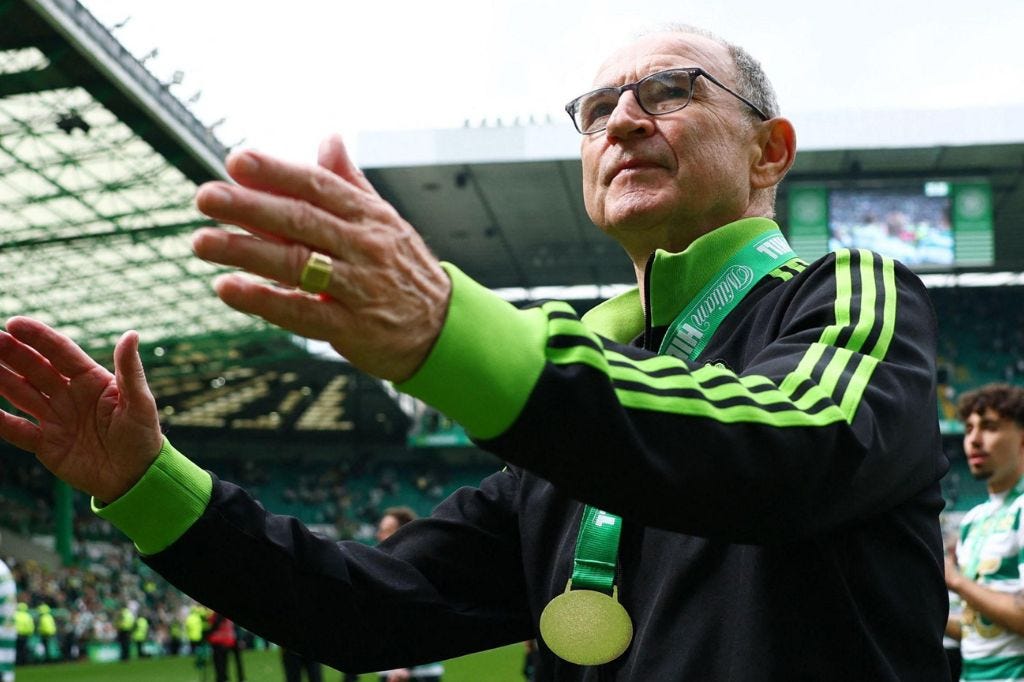
For the first time in what feels like an age, Celtic’s powerbrokers have made a decision that actually reflects the will, the intelligence, and the emotional pulse of the support. The appointment of Martin O’Neill as permanent manager is not just a footballing decision, it is a course correction after years of drift, arrogance, and tone-deaf leadership from the top of the club.
Let’s not sugarcoat it, this is the first genuinely smart move Dermot Desmond and the Celtic board have made in years. After flirting with yet another ill-fitting, uninspired appointment in Robbie Keane - a move that sparked fury across supporter groups, ultras, and ordinary fans alike - the board have finally listened. Or perhaps more accurately, they have been forced to listen. The backlash was not mild, it was not a minority, and it was not going away. Banners, statements, supporter group mobilisations, this was a fanbase drawing a line in the sand and saying no chance!
And crucially, they were right.
The idea of Robbie Keane walking into Celtic Park under those circumstances was not just questionable, it was combustible. This is a club built on identity, on values, on solidarity. You cannot ignore that reality and expect unity. You cannot pretend Celtic exists in a vacuum where football decisions are detached from the club’s cultural and political DNA. The support made that crystal clear, and for once, Dermot Desmond and the board did not bulldoze ahead regardless.
Instead, they turned to a man who embodies Celtic in a way very few ever have. Martin O’Neill is not just a safe pair of hands. He is not just a nostalgic nod to better days. He is a proven winner, a commanding presence, and a figure who understands exactly what Celtic demands, and what it does not tolerate.
His return this season, initially framed as a temporary fix, has already delivered silverware and stability in the middle of chaos. A domestic double in the midst of managerial upheaval, structural dysfunction, and fan boycotts is not something to be shrugged off. It is evidence that O’Neill still has what it takes at the ripe auld age of 74.
And make no mistake, this Celtic side needed him.
After Brendan Rodgers’ sudden exit [cannot confirm or deny him leaving in a Honda Civic], followed by the disastrous and frankly laughable Wilfried Nancy experiment that collapsed after just 33 days, the club looked like it had completely lost its way. There was no direction, no authority, no coherence. It was a football club being run on fumes and reactions rather than planning, structure, and strategy.
O’Neill walked into that mess and did what he has always done, he imposed order, demanded standards, and delivered results.
Now, with a one-year deal - with an option of a second - Celtic have bought themselves something they have been desperately lacking. Time. Time to stabilise. Time to rebuild. Time to finally address the deep-rooted issues behind the scenes that no managerial appointment alone can fix. Because let’s be clear, this is not just about who sits in the dugout. The problems at Celtic run far deeper than that.
The football operations structure is outdated. The scouting system lags behind modern European standards. Data analytics, recruitment strategy, succession planning all of it feels reactive rather than proactive. Celtic have been operating like a club clinging to past success rather than building for future dominance.
O’Neill’s appointment does not solve those problems. But it gives the club breathing space to start solving them properly. That is the real significance of this decision.
With O’Neill in charge, Celtic are not starting from scratch this summer. There is continuity. There is clarity. The players know what is expected. The management team already knows the squad, who can handle the pressure, who can deliver, and who simply isn’t good enough. And that last point is critical.
This is shaping up to be one of the biggest rebuilding jobs in recent Celtic history. Despite retaining the Premiership title, this is not a squad without flaws. There are gaps in quality, in depth, and in consistency. There are players who have coasted, players who have failed to step up, and players who simply do not fit what Celtic need going forward. O’Neill will not tolerate passengers. He never has. That ruthlessness, that clarity, is exactly what Celtic need heading into a season that will offer no margin for error.
Because the timing here is brutal.
A Champions League playoff looms in just two months. The financial stakes are enormous. Qualification is not a luxury - it is a necessity. Missing out for a second year in a row would be calamitous. At the same time, the World Cup will disrupt the season, compress schedules, and test squad depth like never before. There is no room for bedding-in periods. No patience for experimental phases. No tolerance for confusion.
It is straight down to business.
And that is precisely why Martin O’Neill is the right man, right now. He does not need time to understand Celtic. He does not need time to grasp the pressure. He does not need time to learn the league. He continues with full authority and immediate credibility.
Contrast that with what could have been. A Robbie Keane appointment would have walked into immediate division. Every result would have been scrutinised through the lens of controversy. Every setback amplified. Every misstep weaponised. It would have been a circus before a ball was even kicked.
Instead, Celtic have unity. Or at least, the closest thing to it they have had in a long time. That matters more than the board seem to realise.
Because when Celtic are aligned, when the support, the manager, and the players are pulling in the same direction, the club becomes a different animal entirely. History has shown that time and again. And Martin O’Neill knows how to harness that energy better than most.
But while this appointment deserves credit, it does not absolve the hierarchy of their wider failures. Far from it. If anything, it raises the stakes. Because now there are no excuses left.
The board must back O’Neill properly in the transfer market. Not with panic buys. Not with short-term gambles. But with targeted, strategic recruitment that addresses the squad’s weaknesses and raises the overall level to do battle domestically and in Europe.
They must modernise the football operation. Invest in scouting networks that identify talent before it becomes obvious. Integrate data analytics into recruitment and performance analysis in a meaningful way, not as a token gesture, and not using some custom software from a two-bit English lower league flop of a manager masquerading as a football doctor.
They must build a structure that outlasts any single manager. And perhaps most importantly, they must start thinking about the future - properly.
Because Martin O’Neill, for all his qualities, is not a long-term solution in the traditional sense. At 74, even with the option of a second year, this is clearly a short-to-medium term appointment. That is not a weakness. It is an opportunity.
An opportunity to genuinely plan for what comes next. No more scrambling. No more reactive appointments. No more last-minute decisions driven by convenience or familiarity. The next Celtic manager should be identified, evaluated, and prepared well in advance.
That process should already be underway.
Because if there is one lesson the last few years have taught us, Celtic cannot afford another cycle of chaos.
O’Neill’s return is a stabilising force. A reset button. A chance to rebuild not just a team, but a football club that has drifted too far from the standards it once set.
And yet, for all the analysis, all the structural talk, all the criticism of the board, there is something else at play here. Hope. Real, tangible hope.
The kind that comes from seeing a familiar figure stride back into the dugout and knowing, deep down, that he understands. That he gets it. That he will demand what needs to be demanded and deliver what needs to be delivered.
The challenge is enormous. The expectations are relentless as ever. The margin for error is non-existent. But Celtic are no longer stumbling into the new season blind. They have a leader. They have continuity. They have, for the first time in a long time, a sense of direction.
Martin O’Neill is back. And now, finally, Celtic can get to work.
It's a smart move only in comparison to the other 2 contenders.
The Board has no excuse in not identifying other options as they've known since January.
I'm hope I'm wrong, but MON was in charge and okayed the signings for the shambles of the January transfer window and no-one has taken responsibility for that fiasco. It doesn't inspire me for future signings.
Of equal importance is the appointment of a Director of Football to reorganise a division that hasn't functioned for years. Hopefully they won't appoint Maloney.
The Continuity Manager.
Has to be said, there is a lot going for it, and it avoids the unholy mess and tangle of an explosive Keane appointment. Now get on with modernising the club, initiating transfers and releases, and building a renewed bond between the Board and the support.