

Sir David Murray discussing Manchester City’s financial misconduct is not merely ironic. It is an invitation to forget how recklessness, debt and disastrous ownership decisions consumed the Rangers he left behind.
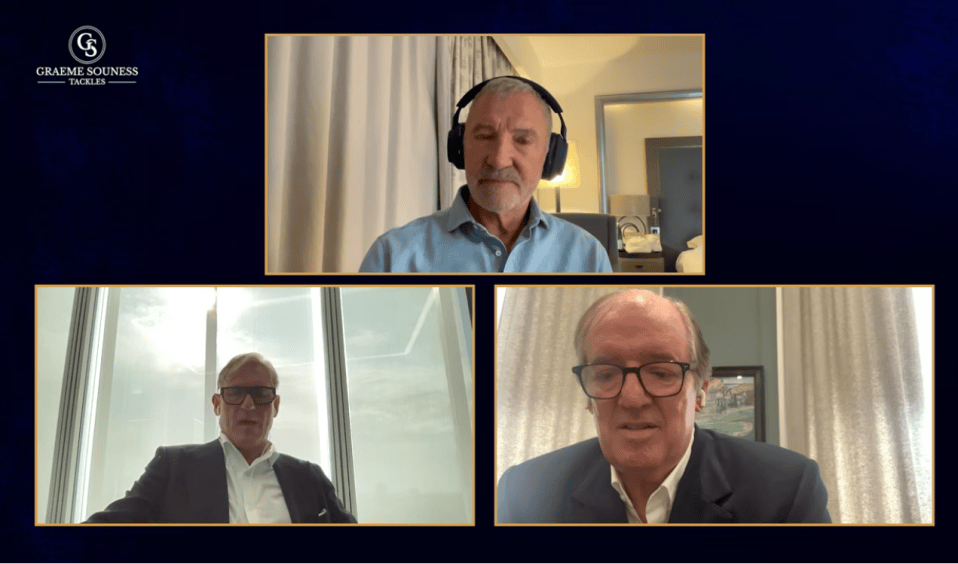
In fact, there is something almost magnificently shameless about Sir David Murray appearing on Graeme Souness’s podcast to discuss financial governance in football, specifically Manchester City being found guilty of 114 of the 115 Premier League charges against them.
City’s financial scandal demands serious scrutiny from people with credibility, independence and a consistent attitude towards financial wrongdoing. Instead, football has been given us Murray, Souness and Simon Jordan in an ownership podcast special featuring two former club owners whose financial records ought to make them witnesses for the prosecution rather than expert commentators.
Murray talking solemnly about City is the equivalent of inviting arsonists to host a seminar on fire prevention.
Murray’s financial legacy
Murray’s Rangers cultivated an image of limitless wealth. The reality was a football club built around borrowing, escalating expenditure and the belief that tomorrow’s income would somehow justify today’s extravagance. By 2004, Rangers’ debt had reached £73.9 million. A £52 million share issue intended to reduce it was almost entirely underwritten by Murray himself, effectively moving much of the burden elsewhere within Murray International Holdings rather than demonstrating broad investor confidence in the club. The famous “for every fiver Celtic spend, we’ll spend a tenner” boast was not simply bravado. It became the governing philosophy of his era.
That era may have delivered trophies, famous signings and nights Rangers supporters will never forget. But it also left a financial structure incapable of surviving when easy credit disappeared when the financial collapse happened.
Murray now admits that some of his decisions were based on “vanity and not sanity”. Yet he continues to present the collapse as something that primarily happened to him - the financial crisis struck, Bank of Scotland failed, HMRC targeted Rangers and events escaped his control. It was a convenient version of history because it transforms his long-term mismanagement of Rangers into an unforeseeable act of God.
The banking relationship
The more uncomfortable question concerns Murray’s longstanding relationship with Bank of Scotland and the extraordinarily accommodating lending practice from which his business empire benefited.
Gavin Masterton, the bank’s former managing director, retired in 2001 shortly after the merger with Halifax. Murray was regarded within Bank of Scotland as one of its “favoured sons”, while the borrowing attached to his wider business empire increased enormously during the following years.
It is fair to distinguish documented lending from allegations of personal favours. Friendship alone does not prove that loans were improper. But it is equally fair to ask whether Murray’s football model could ever have existed without a bank prepared to tolerate levels of borrowing that a more sceptical lender might have challenged much earlier.
When HBOS was swallowed by Lloyds Banking Group in 2009, the atmosphere changed dramatically. Lloyds forced Murray to reduce the bank’s exposure to Rangers and the Murray Group, Rangers’ debt fell by about £10 million between 2009 and 2011, as the bank was heavily involved in efforts to have its money repaid. Donald Muir joined the Rangers board during the restructuring period, while Walter Smith publicly complained that the bank was effectively running the club.
Murray describes the banking crash as one of the great misfortunes that overwhelmed him. Another interpretation is less flattering, as the crisis exposed a business and football model under Murray that had become dependent on continued banking indulgence. Once a new owner of the debt began applying conventional scrutiny, the supposed financial powerhouse had nowhere to go. Losing the old Bank of Scotland and Gavin Masterton relationship did not create Rangers’ underlying problems. It revealed them.
The EBT reckoning
Then there were the Employee Benefit Trusts. More than £47 million was paid to Rangers players, managers and directors through EBT arrangements between 2001 and 2010. In 2017, the Supreme Court unanimously ruled in HMRC’s favour, concluding that the payments represented earnings and should have been taxed accordingly.
Murray told Jordan that he approved the scheme because auditors and professional advisers had signed it off. That may explain why he believed it could be used, but it does not absolve him of responsibility for authorising and profiting from it - as he was the biggest recipient of the scheme with over £6m paid to him. Chairmen cannot claim every trophy earned under their stewardship and then outsource every disastrous decision to accountants, bankers, tax advisers or successors - despite how much Murray tried to do it and yet neither Jordan or Souness took the former Rangers supremo to task over his comments. Certainly not his best pal Souness who labelled Murray his best pal and the greatest chairman in British football history. I think I actually laughed and vomited a little at the same time hearing Souness give Murray the podcast soundbite equivalent of a reach around.
Despite an independent Scottish football commission finding that Rangers had failed to disclose side-letter payment arrangements, imposing a £250,000 fine. Murray still depicts Rangers as a selected target and a victim of HMRC. HMRC has explicitly rejected claims that it miscalculated the tax liability, stating that it won the avoidance case in the Supreme Court. The eventual settlement was lower than HMRC’s original claim, but that does not turn the underlying scheme into prudent financial management or make the tax liability imaginary.
The Whyte escape hatch
Murray eventually sold his controlling Rangers stake to Craig Whyte for £1 in May 2011, who drove the final nail in the coffin. Murray may have jumped ship before it sank but he certainly handed Whyte the hammer.
Murray presided over the debt accumulation, the unsustainable spending culture and the EBT arrangements. He then approved a sale to a buyer about whom Rangers’ independent board committee had expressed serious concerns. Whyte inherited the crisis and accelerated it catastrophically; he did not conjure it from thin air.
Murray has apologised for selling Rangers to Whyte, but an apology is not the same as accountability. “I was duped” remains one of the most useful phrases in British business, it allowed Murray who chose Whyte as the club’s buyer to recast himself as a victim, when he was as much of a perpetrator as Whyte was.
Jordan’s glass house
Simon Jordan at least asked Murray about the EBTs and revealed that he had considered but rejected a similar arrangement at Crystal Palace because he feared HMRC would eventually challenge it. That was a pertinent question and a better decision.
But Jordan is hardly an immaculate authority on sustainable ownership. Crystal Palace entered administration in January 2010 at the end of his decade in control, following cash-flow problems, delayed wages and an unsuccessful search for new investment or buyers. Jordan was reportedly the club’s largest creditor, so he lost substantially too, but Palace’s collapse remains part of his ownership record.
That is what makes the whole spectacle so ridiculous. Souness is hosting a discussion about City’s financial offences with Murray, whose Rangers model collapsed amid debt and tax liabilities, and Jordan, whose Palace tenure ended in administration. All the while Souness sat fidgeting and looking lost during the conversation between Jordan and Murray.
These men are entitled to discuss Manchester City. Experience includes failure, and people can learn as much from ruin as success. But the failures must be acknowledged honestly rather than polished into wisdom after the event or trying to play the victim card to escape your own part in the downfall of the clubs you used to own and manage.
The missing interrogation
Murray’s problem is not that he lacks experience. It is that his retelling of that experience always seems to contain a remarkably generous allocation of blame for everyone except David Murray.
The bank collapsed. HMRC targeted Rangers. Advisers approved the EBTs. Whyte duped him. Supporters demanded success. The financial crisis made survival impossible. All of those factors can form part of the history. None of them erases the central fact that Murray controlled Rangers for more than two decades and made the decisions that created the club’s vulnerability.
So yes, Murray wants to be remembered for Gascoigne, nine-in-a-row and 35 trophies. Fair enough. Football history should remember the success. But he must also be remembered for how he financed Rangers, what he left behind and the fact he opened the door for Craig Whyte.
If he wants to discuss Manchester City, let him. But before Murray comments on another club’s financial scandal, someone should have asked him why Rangers required such enormous borrowing, why the model depended upon continued bank support, why he authorised the EBT arrangements and why he sold to Craig Whyte despite the warnings surrounding the takeover.
The podcast should have been an interrogation of Murray’s stewardship, but that was never going to happen with his pal Graeme officiating proceedings. Instead, it became another opportunity for him to blame a banking crash for exposing financial decisions made long before the banks finally started paying attention to the dealings orchestrated with Gavin Masterton.
Manchester City’s reported guilt does not cleanse David Murray’s record. It merely gives him another scandal to hide behind.
I'm of the exact same as Larry. I read as much as I could until you mentioned Swiness was licking Sir Skinty's arsehole. I had to desist from your words mate.
I understand the Orcs not wanting to admit their club cheated, we'd all probably do the same, however had the club admitted they were cheating it wouldve brought some closure to these mug punters who refuse to believe anyone other than Skinty.
Nimmo Smith should not escape his part in this circus, how someone, who's supposed to be neutral, could not see the sporting advantage in this case, then he should've been removed from the bench. He was just another one protected by the funny haunshake brigade.
At the end of this joke of a case the worst part? Our fckn board who gave the nod to the 5WA whilst disallowing those titles being removed and replaced by asterisks. They cheated, everyone else got cheated out of trophies and much needed cash, and why were they desperate for the cash? To keep up with the cheating club!!
SHUT THE FCK UP SWINESS
There's not a blow torch hot enough to leave a mark on the brass neck of these three Andy. What a lack of self awareness. I'm grateful for your summation as I certainly couldn't stomach listening to these cnuts.