

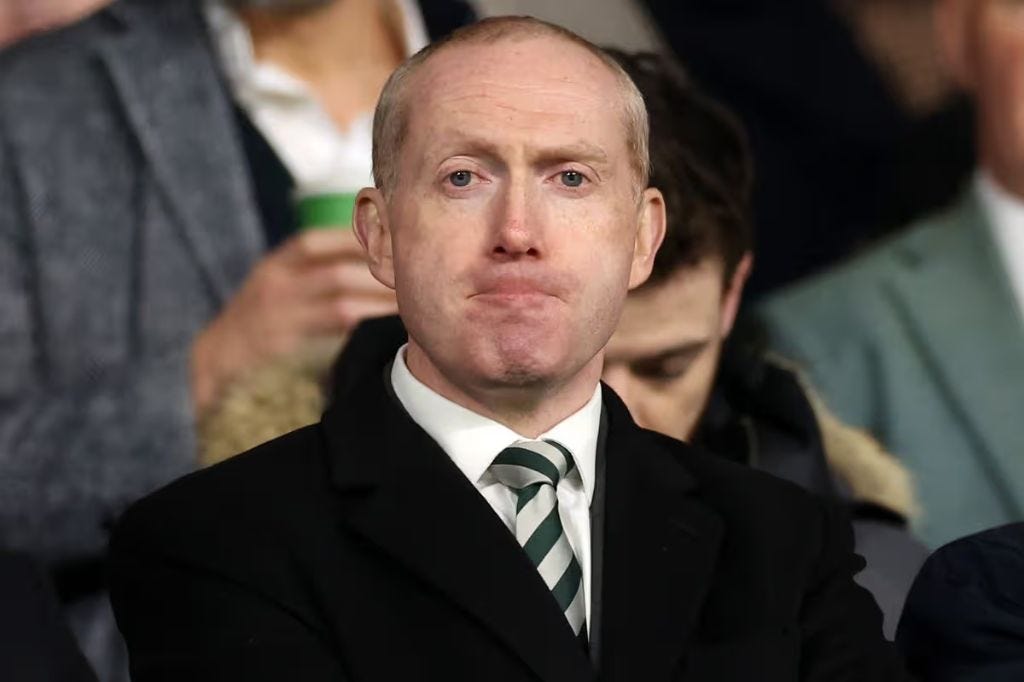
At a club the size of Celtic, an institution that trades not only on domestic dominance but on its place within the wider European football system, the chief executive should be a visible, authoritative figure. Not necessarily a showman, but someone who understands the theatre of football, the politics of the game, a reputation, a standing, and the necessity of presence. Instead, what Celtic have is a CEO, in the guise of Michael Nicholson, who feels more like an seat filler at the Oscars than a driving force. A man whose public persona carries all the dynamism of a newt, and whose reputation has settled into that of Peter Lawwell’s quiet successor rather than his own man.
Say what you want about Lawwell and how his tenure ended, and there is plenty to say, but he was undeniably a figure within the game. He had standing. He had relationships. He had a personality, a presence that could operate within boardrooms, negotiation tables, and the corridors of UEFA with equal confidence. Lawwell may not have been universally liked, but he was known. That matters in football. It matters when deals are being struck, when pressure is applied, when credibility is currency.
Nicholson, by contrast, feels anonymous in a high-powered, high-paid role at a football club that does not permit anonymity.
Recent reports that he has spoken about the difficulties of dealing with player agents and competing financially with English Premier League and Championship clubs should not come as a revelation to anyone remotely familiar with Celtic’s operating environment. These are not new challenges. They are the structural realities of Scottish football, and they have been for decades. The gap between Celtic and even mid-table English clubs has long been a defining constraint and yet, successful periods at Celtic have come when the club has worked around that limitation, not simply acknowledged it. Complaining about financial disparity is not a strategy. It is stating the obvious.
Celtic’s recurring problem is not that they cannot outspend English clubs, it is that they continue to behave as though they are competing in the same marketplace without a sufficiently differentiated approach. Recruitment should be the club’s great equaliser identifying undervalued talent, moving quickly, and building a coherent player trading model that anticipates rather than reacts. Instead, what we see year after year is hesitation, delay, and a sense that the club is permanently one or two steps behind its own needs.
If Nicholson is indeed the central figure in negotiating with agents, clubs, and players, that raises a deeper concern. Football transfers are not legal exercises; they are human negotiations. They require persuasion, relationships, and, above all, presence. A deal is rarely won on contract terms alone it is won in the margins, in the trust built between parties, in the confidence a player or agent has in the person sitting across the table.
Celtic have placed a lawyer by trade and by disposition at the heart of a process that demands far more than legal competence. And while legal expertise has its place, it is not a substitute for footballing authority. The optics, rightly or wrongly, are that of a man out of his depth in a role that requires instinct as much as intellect.
In any other industry, leadership presence is non-negotiable. Across business, corporate strategy, or client-facing business, the most effective CEOs share a common trait - they can command a room. Not through bluster, but through clarity, conviction, and the ability to articulate a vision that others buy into. They set the tone. They drive momentum. They make decisions that signal intent.
Nicholson, by comparison, often appears like the proverbial substitute teacher dropped into a French class without speaking a single word of the language or even knowing where the classroom is. There is an air of detachment, of uncertainty, of someone reacting rather than leading. And in football, where timing is everything and perception shapes reality, that is a dangerous place to be.
The current transfer window only sharpens that concern. A month into one of the most critical periods of the season, Celtic have signed a single player - Camilo Duran - and handed a new contract to 33 year old Alex Oxlade-Chamberlain. Meanwhile, deals that should, in theory, be straightforward have stalled or drifted. Nicholson himself suggested that out-of-contract signings are easier to finalise, and yet the much-discussed move for Kelechi Iheanacho remains unresolved. A relatively modest £2 million deal for Saracchi hangs in the balance despite Boca Juniors making it clear he is surplus to requirements.
At the same time, the squad is far from settled. Four or five first team players are reportedly seeking exits, leaving gaps that will need to be filled not just numerically but strategically. With less than a month until a Champions League play-off and likely against opposition far more formidable than last season’s Kairat, the sense is not of a club building momentum, but one struggling to tread water.
And yet, off the pitch, the commercial machine rolls on uninterrupted. Three new playing kits. Multiple merchandise drops. A steady stream of retail activity designed to maximise revenue before a ball has even been kicked in anger. There is nothing wrong with strong commercial performance indeed, it is essential in the modern game but it becomes increasingly difficult to ignore the imbalance when football operations appear stagnant and unimportant to the club’s powerbrokers.
Supporters are not blind to this. They understand the financial realities. They accept that Celtic cannot outmuscle English clubs in the transfer market. What they struggle to accept is a lack of urgency. A sense that the club is repeating the same cycle -entering crucial qualifiers unprepared, weak, reacting to setbacks rather than pre-empting them, and ultimately paying the price on the pitch.
This is where leadership matters most. Because the role of a CEO at a club like Celtic is not simply to manage budgets or oversee operations. It is to set direction. To ensure that recruitment, football strategy, and commercial activity are aligned. To create an environment where decisions are made early, decisively, and with a clear understanding of the club’s competitive position. That is clearly missing under Nicholson.
The broader question is whether Celtic’s current structure is fit for purpose in a rapidly evolving football landscape. The club continues to operate within a model that is increasingly outdated - one that prioritises caution over ambition, process over proactivity, safeguarding Dermot Desmond’s control above everything else. Without a clear, modern recruitment strategy that leverages data, scouting networks, and market inefficiencies, Celtic risk repeating a pattern of perpetual catch-up.
And if the man tasked with overseeing that structure lacks the presence or authority to challenge it, then the issue is not just individual it is systemic.
There is still time in this window. Deals can be done. Squads can be strengthened. Narratives can shift quickly in football. But that requires decisiveness, clarity, and a willingness to act with intent rather than hesitation. That is not Nicholson.
If Celtic supporters thought last season was a mess, the early signs suggest this one could be worse. Not because the challenges are new or that our opponents are stronger, which they undoubtedly will be, but because the response from Celtic’s hierarchy to them feels all too familiar.
Celtic FC need a new CEO and Transfer Middle Man.
This has now gone from the sublime to the ridiculous.
Nicholson should be sacked immediately for corporate negligence. He is obviously not up to the job and deserves the boot NOW.