

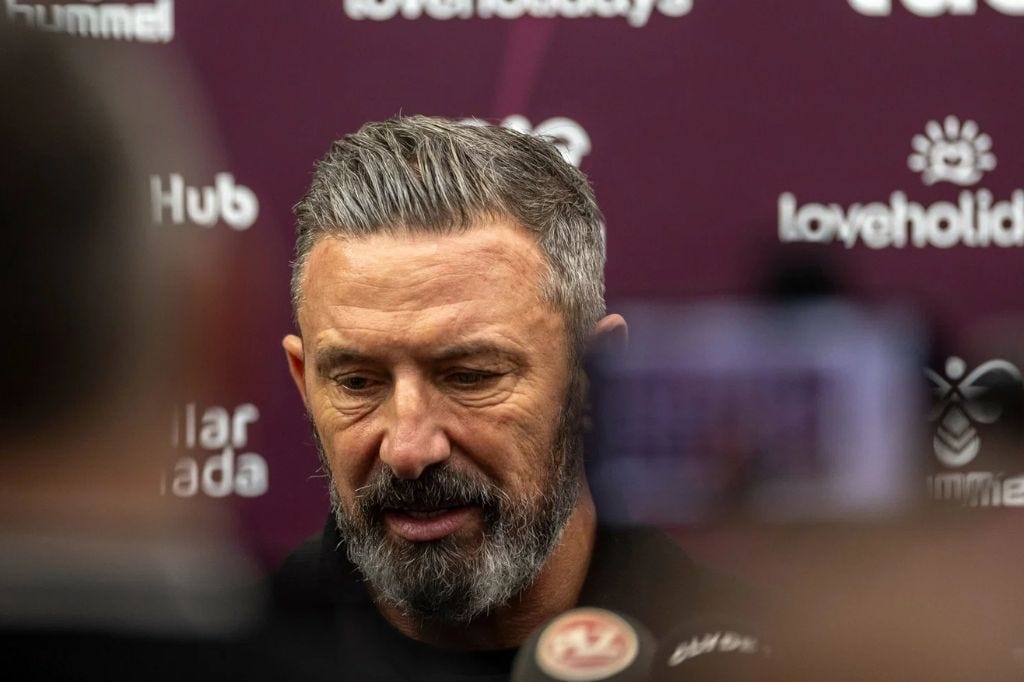
Derek McInnes has always fancied himself a steady hand. A man of structure, of graft, of “doing things the right way.” But if his farewell statement to Hearts fans, published in the Hearts Standard, was meant to cement that image, it has instead exposed something far less flattering, a manager high on his own narrative and low on accountability.
Because strip away the birthday card nostalgia, the emotional padding, the obligatory “special club” lines, and what you are left with is not a dignified goodbye. It is a masterclass in deflection, revisionism, and, frankly, brass-necked delusion.
Let’s start with the biggest howler.
“Hearts came so close to completing one of the greatest seasons in the club’s history… the team didn’t get what they deserved in the end.”
Didn’t get what they deserved?
Over 38 games, you don’t get what you “deserve.” You get what you earn. That’s the entire point of a league campaign. It is not decided by vibes, by effort levels, or by how hard you felt you tried. It is decided by results, week after week, home and away, when the pressure builds and the margins tighten.
And when the dust settled, Hearts were not top of the table. Celtic were. Celtic deserved to win the title.
The idea that Hearts somehow deserved the title despite failing to secure it is the kind of emotional comfort blanket that managers reach for when the reality is too uncomfortable to confront. It’s easier to talk about injustice than it is to admit you fell short.
Because here’s the truth McInnes dances around, Hearts didn’t lose the title because of fate, or conspiracy, or a couple of refereeing decisions in the run-in. They lost it because they weren’t good enough across the full season. Nine away games in the second half of the campaign. Three wins. Two draws. Four defeats. That is not title-winning form. That is not even close.
You can point to a refereeing call here or there. You can stew over moments that didn’t go your way in the final weeks. But when your away record reads like that, you are not the victim of injustice, you are the author of your own downfall. And this is where McInnes’ statement starts to veer from reflective into downright insulting.
“I was so angry and devastated… the decisions that had a huge impact on the outcome were hard to take.”
Of course they were. Every manager in football can point to decisions that went against them. It is part of the job description. But to focus on two moments in the run-in as decisive, while conveniently ignoring the months of inconsistency that preceded them, is selective memory at its finest.
Funny how those “huge impact” decisions never seem to balance out, isn’t it? Ask St Mirren about that. Ask their fans how many decisions went against them over the course of the season. Ask how those calls shaped their campaign, their results, their final position. Because over 38 games, the breaks tend to even themselves out. That’s what fans are always told when they complain about refereeing decisions. You get some, you lose some. That is football.
What you don’t get is a title decided solely by two refereeing calls, unless you are desperate for an excuse. And McInnes is desperate. Desperate to frame the narrative. Desperate to protect his own reputation. Desperate to avoid the far simpler explanation staring everyone else in the face, when it mattered most, Derek McInnes and Hearts bottled it.
There is no polite way to dress that up. They had the lead on the final day. The title was within touching distance, they just needed a draw to win the title. And then, under the brightest lights, against a Celtic side that was arguably one of the worst in recent memory, they folded. Not narrowly edged out. Not cruelly undone. Beaten. Tactically second best. Reactively managed. Outthought by a 74-year-old in a trackie. And that, more than anything, is the part McInnes cannot bring himself to say.
Because to admit that would require ownership. It would require standing in front of the media, taking the questions, and explaining why his team buckled when the pressure mounted and it mattered most. Why his substitutions failed to shift the momentum in the game. Why a side that had led the race for so long suddenly looked like it didn’t believe it belonged there.
Instead, he disappeared. No post-match reckoning. No immediate accountability. No facing the cameras after the biggest game of the season. Just silence. And when he did finally re-emerge, it wasn’t to dissect the performance or hold his hands up. It was to offer a carefully worded statement that tiptoed around the central truth. Even his explanation for that silence is telling.
“Trying to process it all was part of my thinking as to why I didn’t speak.”
Processing it all?
This is elite-level football management, not a wellness retreat. You don’t get to vanish when it goes wrong and reappear once the narrative has softened. The job, especially at a club chasing a title, is to front up in the moments that hurt the most. Particularly when those moments define your tenure. But perhaps McInnes knew exactly what was waiting for him had he faced the media. The obvious questions. The uncomfortable ones.
Why did Hearts collapse from such a strong position?
Why did they twice squander nine-point leads?
Why did they fail to beat a Celtic side in transition, in turmoil, and ripe for the taking?
Why, when the title was on the line, did they look like the team with everything to lose rather than everything to gain?
And most damning of all, why did the manager, in the biggest moment of his season, come up short?
Those are not questions you can answer with platitudes about effort and injustice. So he just didn’t bother to answer them at all. Instead, we get the badge-kissing prose. The emotional sign-off. The “I felt like one of you” routine that lands a little hollow when you consider what came next. Because for all the talk of connection, of belonging, of wishing he’d arrived sooner and stayed longer, McInnes did what he has done throughout the majority of his career when another opportunity presents itself. He left. Quickly. Without hesitation. The Rangers job appears, and suddenly that deep emotional bond with Hearts has an expiry date of roughly 12 months.
“I wish I’d got to Hearts sooner and that my time at the club was more than 12 months.”
You could not script a more unintentionally comical line. You had the chance to make it more than 12 months. You chose not to. That is the reality.
And despite Hearts fans peddling the same conspiracy theories that Rangers fans were peddling at the end of the season, they really aren’t a stupid bunch. They can see the contradiction. They can read between the lines. They understand that in modern football, managers move on. That part is not the issue.
The issue is the performance of loyalty followed by the immediate act of disloyalty. It is the emotional sales pitch that is abandoned the moment a more attractive offer lands. It is, in short, the “badge-kissing pish” that means absolutely nothing when tested.
The reaction from supporters has been as blunt as it has been revealing.
“Serial loser.”
“Shitebag.”
“Pre-emptive flounce.”
“Disingenuous.”
These are not the words of a fanbase united in gratitude. They are the words of people who feel they have been sold a story that does not quite match the evidence in front of them. And while some of that anger is undoubtedly fuelled by the timing of his departure and where he left for, much of it stems from the content of that statement itself. Because McInnes did not just leave.
He left while reframing the season in a way that absolves him of responsibility. He left while suggesting external factors cost Hearts the title. He left without acknowledging the glaring weaknesses that ultimately defined their campaign.
Had he come out and said, plainly, “We fell short. I fell short. We didn’t handle the pressure when it mattered,” the tone of the response might have been very different.
Instead, he offered a version of events in which Hearts were the nearly-men undone by forces beyond their control. It is a narrative that might comfort him as he enjoys a world-class breakfast at Auchenhowie in his Rangers manager’s fancy dress. It does not convince anyone else.
And now, as he walks into Ibrox, he carries that same narrative with him. Rangers fans are fed and believe they are getting a proven manager. A builder. A man who can restore order and deliver success. But there is a growing body of evidence that suggests otherwise.
A manager who consistently gets close, but not close enough. A manager who constructs competitive teams, but struggles to push them over the line. A manager who, when faced with defining moments, too often ends up on the wrong side of them.
Aberdeen. Kilmarnock. Now Hearts. Different clubs. Different contexts. Same lingering question. When the stakes are highest, does Derek McInnes have the edge required to win?
Because effort alone is not enough. Structure alone is not enough. Even a “brilliant season” is not enough if it ends with someone else lifting the trophy. That is the brutal clarity of football at the top level.
You either get it done, or you don’t. And no amount of post-season spin can change which side of that line you fall on.
So by all means, McInnes can reflect fondly on his year at Tynecastle. He can talk about atmosphere, connection, and progress. Those things have their place. But he cannot rewrite the ending. He cannot claim a title that was never won. He cannot shift the blame entirely onto referees and misfortune. And he certainly cannot expect supporters to swallow a farewell soaked in birthday card pish while the reality of his exit, and the manner of his failure, sits so starkly in contrast and so fresh in the minds of Hearts fans.
Because in the end, the season will be remembered for what it was. A huge opportunity. A commanding position. And a collapse when it mattered most. Not stolen. Not denied. Lost. Bottled.
And deep down, beneath all the carefully chosen words and emotional framing, Derek McInnes knows it.
It will be interesting to see how the Badger fares at Ibrox. He has a managerial CV of failure, so of course he was not recruited by Rangers FC on the basis of his success, rather on his staunchness, and animated nastiness on the touchline. The rumours are, he is looking to steal Claudio Braga away from Hearts now, with Shankland already firmly ensconced with the Light Blues.
What a writer! Refreshes the parts Hearts can’t reach.