

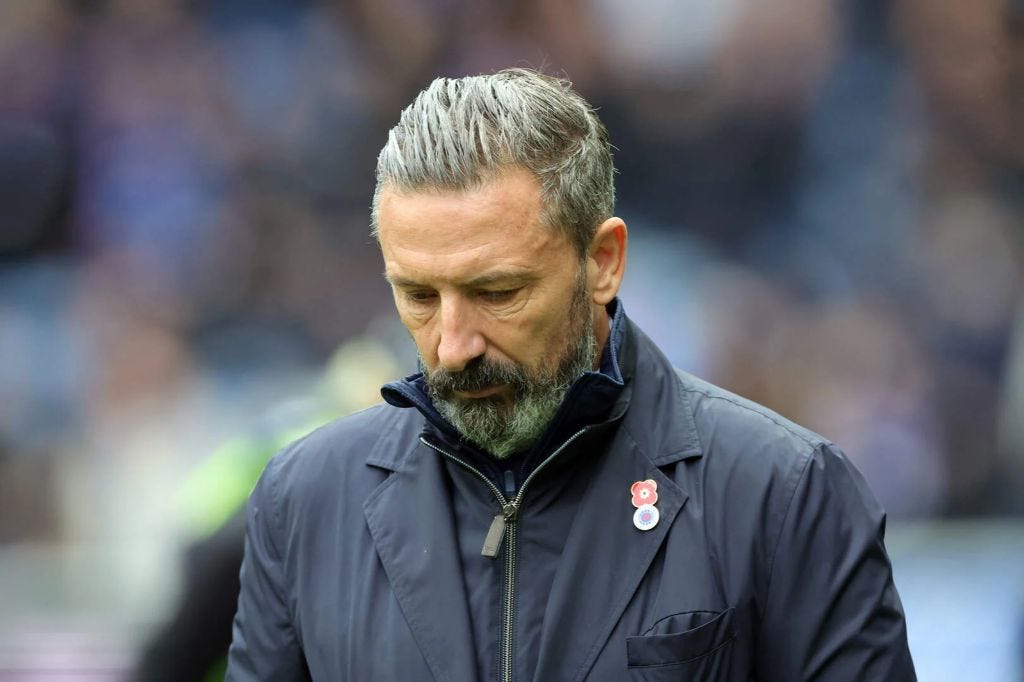
Derek McInnes can dress it up however he likes, but there was no grand injustice at the end of last season. There was a team that led the Premiership by 10 points, then spent months throwing away the advantage and a manager who, when the title was finally there to be seized at Celtic Park, bottled it.
McInnes now says Hearts “should have won a title” and that “for a few contentious decisions” they would have done. It is a convenient story for a man preparing to walk back into Tynecastle as Rangers manager, frame the failure as something done to Hearts rather than something Hearts did to themselves.
But football titles are not decided by a highlights reel of refereeing grievances. They are decided across 38 games, by squads, nerve, tactics, away form and the ability to win when the pressure is at its most suffocating. On every one of those measures, Hearts failed when it mattered.
Hearts were not victims of a cruel twist of fate. They were, at one stage, 10 points clear of Celtic. That is not a marginal lead snatched away by one or two bad calls by referees; that is a commanding position surrendered over a sustained run of matches.
If a team is genuinely the best side in the country, it does not need perfection from officials. It needs to keep collecting points while the chasing side is under pressure. Hearts did not. Celtic did. That is the difference. Which Hearts fans and Derek McInnes continue to ignore - along with their brethern along the M8 struggling to third spot.
McInnes points to 80 points and a bottom-six team transformed into title challengers. Fine, credit where it is due. But 80 points is also the number Hearts finished on after failing to convert one of the greatest opportunities any non-Old Firm side has had in years to end Celtic’s dominance this century.
The most damning fact is simple, Hearts did not win a single away league game from the end of January until the final day of the season at Celtic Park. That is not the form of a champion. That is the profile of a team whose title challenge had already begun to rot long before decisive afternoons at Fir Park and Celtic Park.
Titles are won on the road. They are won at grounds where the surface is poor, the crowd is hostile and the opposition smells blood. Hearts could not do it. They kept dropping points, kept letting Celtic and Rangers back into the race, and then arrived at Celtic Park needing a result they had spent months proving they could not get.
To now claim that “a few contentious decisions” were the decisive factor is to ignore the months of self-inflicted damage that put Hearts in that position.
The final-day trip to Celtic Park was the greatest opportunity of McInnes’ managerial career. Hearts needed only to draw. The title was in their hands and with three minutes to go Hearts were going to be Scottish champions. Instead, Hearts lost 3-1, despite the attempts of a linesman calling the worst offside decision in recent memory against Daizen Maeda - thankfully VAR was in place to show clearly why the technology was needed in Scottish football.
Losing the title was not an injustice. It was a failure of nerve, game management and big-moment authority. Celtic went for it; Hearts choked. McInnes had spent a season building a side capable of leading the league, yet when the one match arrived that would have made history, his team played like a side hoping to survive rather than one determined to win.
A manager who truly believed his side had been robbed would have demanded more at Parkhead. Instead, Hearts were outfought and outthought in the game that defined the season.
There is also something especially hollow about McInnes invoking “guilt” over leaving Hearts while simultaneously rewriting the ending of his tenure. He wants sympathy for the hurt of missing out, but he also wants to soften the criticism and negative atmosphere that he will face over the manner of his departure in the summer, by insisting the title was effectively stolen. It was not.
Hearts had the lead. Hearts had the opportunity. Hearts had the schedule, the momentum and, the better position even on the final day. And yet they blew it, not because of one or two games, but through winning just once out of seven away games, including final-day collapse at the death, at the only ground where they needed to really stand up and be counted.
McInnes can call it an “injustice” all he wants. But those of us who don’t have our heads buried up our arses can see it for what it was, a monumental bottle job dressed up as martyrdom.
And yet five months on, the allegations of a conspiracy against Hearts within the Scottish FA - despite the Hearts CEO at the time being the Scottish FA Vice President - lingers because Hearts fans can’t admit to themselves that their team and its manager bottled it big time.
Celtic did not win the title because of a conspiracy, a favourable refereeing decision in in one game, or a few contentious moments across the season. They won it because they kept winning at the same time as Hearts stopped doing so. They won it because they applied pressure, took advantage of every slip up and then delivered when the title was on the line. That is what champions do.
Hearts had the title in the palm of their hand on the final day of the season, with three minutes to go and they blew it. No amount of retrospective grievance from Derek McInnes - now safely installed at Ibrox among the biggest conspiracy theorists of the 21st Century - changes that.
Sorry I wrote one win out of 7. Must have slipped there.
They didn't win a league game, outside Edinburgh, since January. They won at Easter Road.