

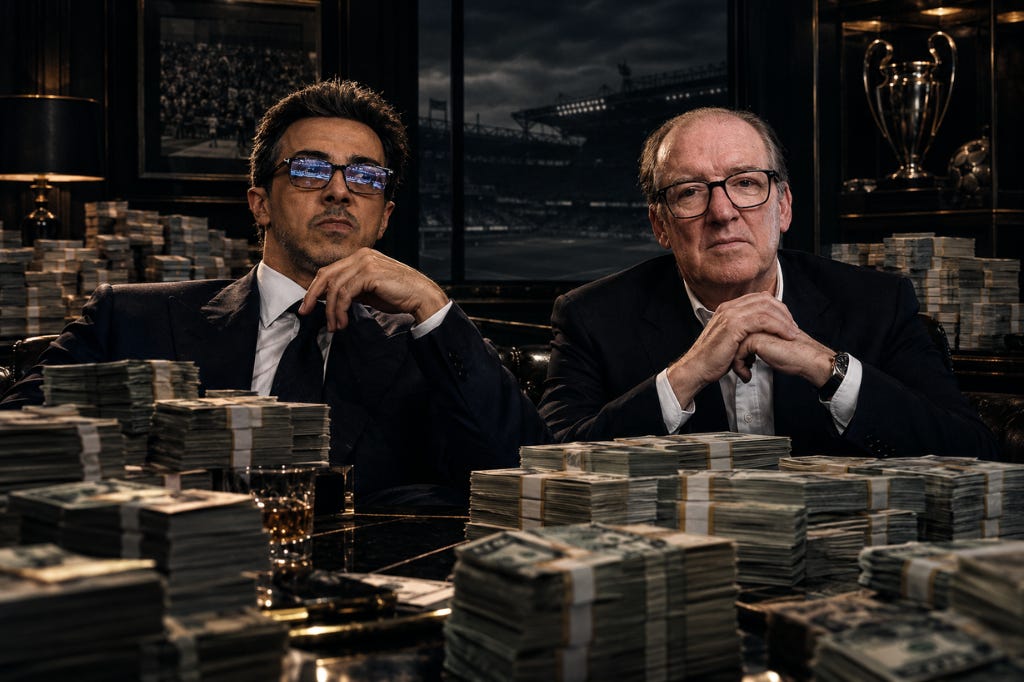
When Manchester City are ultimately sanctioned over the news that they were found to have breached 114 of the Premier League’s 115 financial-rule charges, English football could face a serious credibility crisis. For Scottish supporters - particularly those of us who followed the Rangers EBT scandal - the situation may revive an old and uncomfortable question - why was “sporting integrity” deemed sacrosanct in one case, yet seemingly open to compromise in another?
The crucial caveat is that City’s process is not complete. The reported findings remain subject to confidentiality, sanctions have not yet been imposed, and Manchester City are expected to appeal; the club continues to deny wrongdoing. The available range of possible penalties includes a fine, a points deduction and removal from the Premier League. Yet the debate already extends beyond the precise punishment. It is about what football believes titles are worth, whether competitive advantage can ever be retrospectively disentangled from financial wrongdoing, and whether the game has the courage to apply its principles consistently.
A Verdict That Changes Everything
Oliver Holt’s argument in his Daily Mail column is intentionally uncompromising. If a club is found to have manipulated its financial position over years, he contends, the consequences cannot be reduced to an accounting penalty or a technicality. The real damage is sporting - the rivals denied titles, Champions League places, prize money, transfer capacity, prestige and the irreplaceable joy of winning in real time.
That is the force behind his demand for City to lose every Premier League title won in the relevant period - 2012, 2014, 2018, 2019, 2021, 2022, 2023 and 2024 - and to be relegated. His case is not merely punitive. It rests on the belief that if financial rules exist to regulate competitive balance, then sustained breaches that create an unfair advantage contaminate the sporting outcomes built upon them.
The reported verdict has been described as one of the most consequential moments in Premier League history. City were charged in February 2023 after a four-year investigation, with the hearing beginning in September 2024 and ending around 12 weeks later in December of that year. An independent commission has now found against the club on all but one of 115 alleged breaches, although the written judgment and sanction have yet to be published.
The distinction matters. A finding of liability does not automatically mean titles are removed. Nor does a points deduction automatically follow. The commission’s disciplinary powers are broad, but precedent is limited and every likely outcome will face legal argument. City’s appeal means a final resolution could still take considerable time.

Still, Holt’s wider point cannot simply be dismissed as a columnist’s flourish. Football has spent decades creating rules around ownership, spending, reporting, financial sustainability and competitive integrity. If the richest and most successful clubs can breach those rules on a systemic basis yet retain all the sporting rewards, those rules risk becoming performative - expensive paperwork for some, optional inconvenience for others.
This is why the issue cannot be separated from history. Titles are not simply entries in a record book. They shape reputations, managerial legacies, players’ careers, supporter memories and the commercial future of clubs.
Manchester United’s 2011-12 defeat to City, sealed by Sergio Agüero’s extraordinary final-day last minute goal, would be viewed differently. Liverpool’s near misses in 2013-14, 2018-19 and 2021-22 would be viewed differently. Sir Alex Ferguson, Brendan Rodgers, Jürgen Klopp, José Mourinho, and thousands of supporters would all have reason to ask what was taken from them - not emotionally, but competitively.
The Rangers Tax Scandal Parallel
For many in Scotland, this argument carries a particular sting because the Rangers EBT controversy was not treated with anything like the same moral clarity.
Rangers’ use of Employee Benefit Trusts formed part of a broader financial model during the David Murray era. EBT arrangements, in simple terms, involved payments made through trusts rather than being fully treated and disclosed as ordinary employee earnings. Rangers’ tax case became one of the defining scandals in modern Scottish football history, particularly after the club’s financial collapse and liquidation in 2012.
The question at the centre of the football debate was straightforward - did Rangers obtain a sporting advantage by using financial arrangements which enabled them to recruit or retain players they otherwise could not afford?
David Murray’s own evidence at the Craig Whyte trial went to the heart of that question. He told the court that the EBT arrangements had given Rangers the opportunity to sign players they would otherwise have been unable to afford. That is not a minor admission. It goes directly to competitive advantage.
It challenges the comforting line repeatedly advanced in the aftermath that the players won trophies only through “skill, hard work and commitment,” and therefore the trophies should remain untouched. Of course players worked hard. Of course footballers perform on the pitch rather than balance tax accounts. But that argument evades the issue.
No one argues that a player who was improperly paid is automatically untalented, or that a team’s football ceased to exist because its financial arrangements were flawed. The question is whether the squad was assembled and retained under conditions unavailable to competitors who complied with their financial and tax obligations. If the answer is yes, then competitive advantage is not speculative. It is the point.
That is why the idea that title-stripping would insult Rangers players and supporters was always morally shallow. Rival players and supporters also committed themselves to their clubs. They paid to follow teams. They bought season tickets, travelled to away grounds, endured defeats and invested their lives in competitions that were meant to be governed on equal terms.
Sporting integrity cannot mean protecting only the feelings of the club found to have broken the rules. It must also mean acknowledging the people whose opportunity to compete fairly was diminished.
How Rangers Escaped Sporting Consequences
The Scottish Premier League commission that considered Rangers’ failure to disclose EBT-related payments imposed a £250,000 fine but did not strip honours. Its reasoning was that the payments themselves were not irregular under SPL or SFA rules, that the relevant players were not ineligible, and that Rangers had not gained an unfair competitive advantage from the disclosure breaches. That conclusion remains the central point of contention.
It was always difficult to reconcile with the reality of Rangers’ financial conduct, the club’s tax exposure and Murray’s later admission regarding player recruitment. Rangers’ use of EBTs covered payments to employees over a long period, while the tax dispute ultimately reached the UK Supreme Court. The final legal position established that the EBT payments were taxable earnings.
The football authorities’ response, however, was defined by narrowness. The disciplinary focus was not on the full sporting effect of financial arrangements. It was centred on the particular registration and disclosure framework available to the commission. This distinction may have provided a legal route to retain the titles, but it did not settle the sporting argument.
The outcome was not merely that Rangers kept trophies. It was that Scottish football sent a message that a club could exploit financial mechanisms, build a squad beyond the reach of properly run rivals, collapse under unsustainable liabilities, and still preserve the historic rewards generated during that period. That is why the debate has never gone away.
The authorities later acknowledged that title removal could be a possible sanction in a future case involving clubs that failed to disclose tax defaults while winning a league. That admission makes the historical refusal to revisit Rangers’ honours all the more revealing. It shows that title stripping was never beyond football’s conceptual reach. It was a choice not to use it. Scottish football chose finality over accountability. It chose to preserve the official record over examining whether the record had been earned under equal conditions.
“Much Ado About Nothing” Was Never Enough
The language used by influential figures in the aftermath of the Rangers EBT scandal reduced an institutional failure to a cultural squabble. Former SPL chief Roger Mitchell’s framing of the dispute as “fans’ bragging rights” represented the most dismissive version of that position.
But football is built on bragging rights because football is built on competition. The trophies, the league tables, the rivalries and the accumulated historical claims are not side issues. They are the product being sold to supporters, broadcasters and sponsors. If a club secures an advantage through financial rule-breaking or concealed remuneration, the consequences strike at the credibility of that product. To dismiss the issue as a dispute between rival supporters is to misunderstand why regulation exists.
Rules do not exist merely so clubs can be punished in a courtroom. They exist to protect the competition itself. They aim to ensure that success is not determined by which owner can stretch, disguise or evade the financial boundaries more effectively than everyone else.
That does not mean every breach should result in titles being vacated. Football must distinguish between an administrative error, a late filing, a minor breach and conduct that allegedly reshapes the competitive landscape over years. Proportionality matters. Evidence matters. Due process matters.
But the Rangers case was not treated as a proportionate response to a serious sporting question. It was treated as an inconvenience to be contained because confronting the consequences would have been commercially disruptive, politically divisive and deeply uncomfortable for Scottish football’s cowardly institutions.
The fear was obvious - damage Rangers and you damage the commercial appeal of the league; challenge the mythology and you inflame the country’s most combustible football rivalry; pursue the issue robustly and you risk a protracted legal battle. Those pressures may explain caution, but they do not justify the complete abdication of principle.
In fact, they make the need for independence stronger. The larger and more powerful the club, the more tempting it becomes for authorities to turn enforcement into a calculation of commercial risk. That is precisely when a regulator has to demonstrate that its rules apply to everyone.
The Media Test
The Manchester City scandal will now pose a difficult test for certain individuals of the Scottish sports media.
There were journalists and commentators who argued fiercely against stripping Rangers of titles. Some portrayed it as vindictiveness, historical revisionism or an attack on players and supporters rather than a necessary consequence of financial wrongdoing. Others accepted the narrow legal rationale offered by the SPL commission without properly interrogating the sporting implications of a squad made stronger by arrangements unavailable to rivals.
Those same voices cannot credibly demand the harshest sanctions for Manchester City while insisting Rangers’ honours are untouchable.
There are, of course, legitimate differences between the cases. Manchester City’s alleged Premier League breaches concern a different regulatory framework, a different set of charges, a different jurisdiction and a process that has not yet reached a final sanction. The reported City findings also span allegations around financial reporting, compliance, cooperation with the investigation and potentially the accuracy of sponsorship and remuneration information. The cases should not be lazily treated as identical.
But different is not the same as unrelated. Both cases raise the same fundamental principle - what should happen when financial conduct gives one club an advantage over competitors operating within the rules?
A journalist who argues that City must be stripped of titles because financial wrongdoing distorted competition must explain why Rangers should retain theirs despite a financial structure that, by Murray’s own account, helped the club sign players it otherwise could not afford.
Conversely, anyone defending City’s right to keep its titles should be honest about what that entails. They are making an argument against retrospective sporting sanctions, against historical redistribution of trophies and possibly against the idea that financial misconduct can invalidate sporting achievement. That position can be argued, but it must be argued consistently.
What cannot be defended is selective outrage - integrity for Manchester, indulgence for Ibrox.
The Real Cost of Inconsistency
The danger for English football is not simply that Manchester City may be punished. It is that the scale of the reported findings could reveal how slowly and inadequately football regulates its most powerful clubs.
The danger for Scottish football is that it has already lived through a comparable crisis of confidence and largely refused to learn from it. Rangers’ collapse did not just damage Rangers. It damaged trust in the Scottish football authorities. It left rival supporters with the knowledge that the authorities had made accommodation for a powerful institution and tried to bully clubs into doing their bidding. It created years of argument over continuity, honours, debt, governance and sporting legitimacy. It also normalised the idea that football’s biggest clubs might be treated not as members bound by rules, but as assets too valuable to discipline properly.
A credible competition cannot promise equality while allowing the size, history or commercial importance of one club to determine whether enforcement is meaningful. Nor can it ask supporters to care passionately about league tables and trophies, then tell them the fairness of the contest is an embarrassing technicality once serious breaches are exposed.
If City’s guilty verdict leads to expulsion, a severe points deduction, title stripping or some combination of sanctions, England will face a long argument about whether the punishment is fair. That argument is inevitable. So is City’s right to appeal and defend itself through the process. But whatever happens, Scottish football should pay close attention.
If titles are removed from Manchester City, the contrast with Rangers will be glaring. It will reinforce the belief that Scottish football failed to impose the consequences that sporting integrity demanded. If City keep their titles despite major sanctions, it will not vindicate the Rangers decision either; it will simply show that football across Britain is still unwilling to decide whether its rules genuinely mean what they say and that rich clubs can do what they want when they want.
Football Must Choose Its Principles
Oliver Holt is right about the essential point, a football competition cannot endure if it treats integrity as expendable when enforcement becomes inconvenient.
Whether English football is “broken irretrievably” will depend on what follows the Manchester City findings. The Premier League must publish as much reasoning as the confidentiality rules allow. It must explain the nature of the breaches, the basis for any sanction and how it has assessed sporting advantage. It must not hide behind vague statements or let the issue disappear into years of procedural delay.
The process must be fair to City. A club cannot be condemned by headlines, rival resentment or retrospective moral panic. Findings need to be tested through proper appeals, and punishments must be legally defensible. But fairness to City also means fairness to every club that competed against them.
That is the lesson Scottish football failed to absorb in the Rangers era. The argument was never about erasing history. It was about recording history truthfully. A title is not merely a medal presented on a day in May. It is the final entry in a competition that promises every participant the same rules, the same obligations and the same chance. When that promise is breached, football authorities face a choice. They can protect the record, preserve the powerful and call the rest of it “bragging rights.” Or they can defend the competition, even when the cost is uncomfortable.
For too long, Scottish football chose the first path. The Manchester City case may now expose how untenable that choice always was.
But how can they take titles away from the "club" when it was employees of the City Football Group Ltd "the company" who allegedly carrired out these breaches to the rules 😉
Sky Sports stated last week live on the telly since 2012 it’s not the Old Firm they are not known as Rangers it’s now the RE-BRAND