

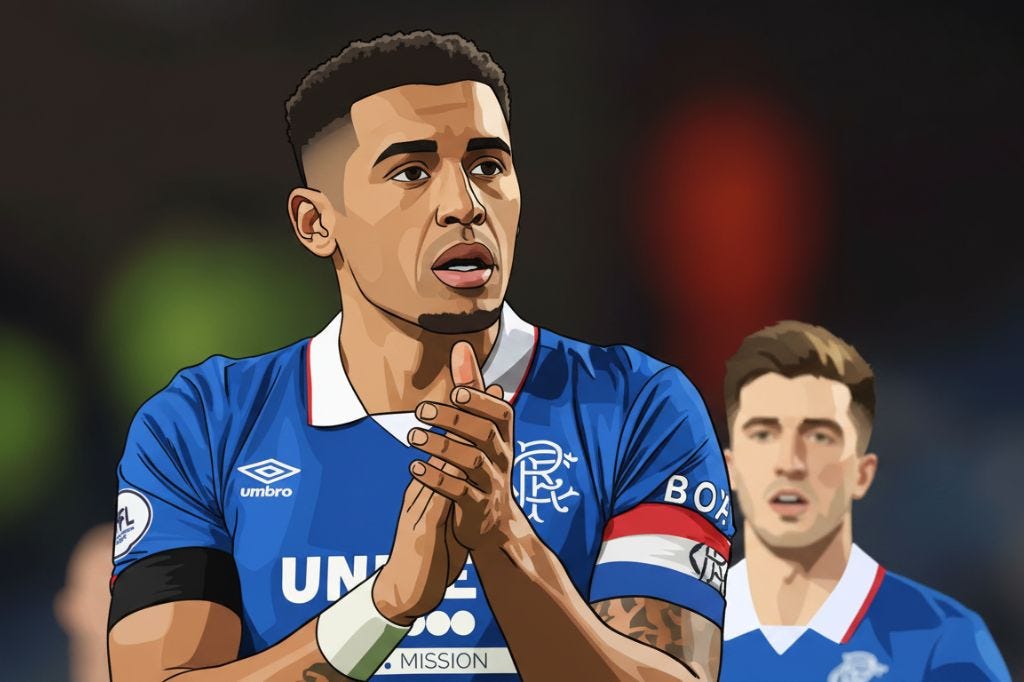
James Tavernier will leave Rangers this summer the way he spent much of his Ibrox career - to a backdrop of noise, numbers, and a nagging sense that none of it quite adds up.
A “modern legend,” we’re told. A “Hall of Famer.” A right-back with the scoring record of a set-piece-obsessed attacking midfielder and the defensive instincts of a man late for a bus. Tavernier’s Rangers story is, depending on your persuasion, either one of remarkable individual output or a masterclass in how to look busy while history happens around you.
And what history it’s been.
As captain, Tavernier has had the distinct honour of leading Rangers through one of the most one-sided eras in Scottish football. While Celtic quietly (and sometimes not so quietly) hoovered up trophies with industrial efficiency, Tavernier was often stationed somewhere looking disappointed, hands on hips, watching another green-and-white ribbon get tied onto another trophy.
There are, of course, the numbers. Always the numbers. Goals from penalties, free-kicks, and the occasional cameo appearance as Rangers’ most advanced attacking threat. If football were played exclusively in statistical spreadsheets, Tavernier might already have a statue at Ibrox. But it isn’t, and therein lies the problem.
Because for all the goals, assists, and carefully curated highlight reels, Tavernier’s Rangers career will ultimately be defined by what happened when it mattered most and more specifically, what didn’t happen. Big games came and went. Finals slipped by. Title races evaporated. And through it all, the captain remained a constant ever-present, ever-productive, and ever short of turning influence into dominance.
Celtic supporters, never knowingly charitable, have long settled on a simpler interpretation. To them, Tavernier isn’t a Rangers legend - he’s a symbol. A reliable, recurring character in a story where the ending rarely changes. A man who has, season after season, stood on the pitch as Celtic celebrated yet another milestone, another medal, another treble.
It’s not entirely fair, of course. Football rarely is. One player doesn’t win or lose trophies alone, and Rangers’ broader failings over the past decade run far deeper than one right-back’s positioning or leadership. But football, like all good drama, thrives on narrative. And Tavernier’s narrative has been written in bold, looping letters - prolific, persistent, and perpetually second best.
There was that one league title, of course - the Covid season, the anomaly that Rangers fans will cling to as proof that the Tavernier era wasn’t entirely devoid of silverware. A season when every other team were hit hard by Covid outbreaks not Rangers though. But even that triumph feels less like the beginning of a dynasty and more like a brief interruption in Celtic’s ongoing procession.
As Rangers look ahead to the future, the numbers offer one final, deliciously bleak framing - one league title in the Tavernier years. Potentially two in fourteen seasons of existence, should things fall kindly to them this season. Progress, of a sort - but not the kind that fills trophy rooms or silences rivals.
And so, Captain Disappointment departs. Not without achievements, not without moments, and certainly not without debate. But also not with the kind of legacy that escapes the gravitational pull of context.
Because in Glasgow, context is everything. And Tavernier’s context will forever be this - while he led, Celtic conquered.
Relentlessly. Repeatedly. Ruthlessly.
Hall of Famer? Perhaps.
Era-defining? Absolutely.
Just maybe not in the way Rangers supporters would have hoped.
And at the other end of the great football divide that is Glasgow, step forward their own version of a light blue's legend I suppose, James Tavernier ! He also has shown tremendous loyalty to his own club, and I always like to be fair, and for a full back, he must hold some kind of footballing record for the number of goals he has scored from that defensive position, notwithstanding his undoubted number of assists from an advanced forward attacking position. He will be a hard act to follow at Ibrox, especially his voluminous number of converted penalties, many of them it has to be said, from highly controversial and disputed circumstances, from referees for the want of a better word, were inclined to be generous to the blue noses.
To be fair, Tavernier has been a great Ranger's player, regardless of your persuasion, and it would be amiss of me not to recognise his immense contribution to his club Rangers, albeit as a penalty king, which is an art in itself, the only other ones I can remember being so proficient from the penalty spot, were Kris Boyd, Paul Hartley, Barry Robson and Jorge Albertz. He has one last chance to win a second league title this year, if the chips fall his way, which would take the rough edge off his dubious nickname of Captain Disappointed.