

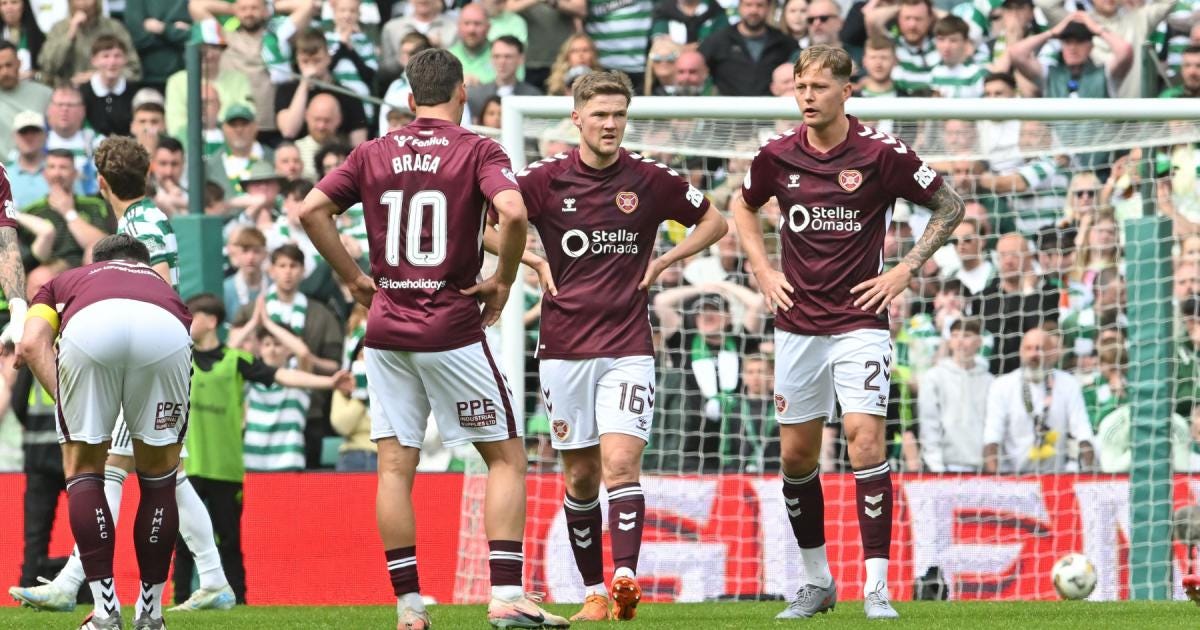
Celtic win the league. Again. Five in a row. Done. Sealed. Finished.
And yet, instead of talking about what actually happened on the pitch, Scottish football has spent the last week drowning in a swamp of paranoia, bad faith, and outright fiction fuelled by a club that should know better and a media class that, frankly, should be ashamed of itself.
Let’s not dress this up. What unfolded after Celtic’s 3–1 win over Hearts was not confusion. It was not misunderstanding. It was not even emotion spilling over in the heat of the moment.
It was calculated. It was cynical. And it was dangerous.
Hearts’ statement on Wednesday night wasn’t just wide of the mark it was a deliberate attempt to keep a lie alive long enough for it to take root. They questioned the ending of the match, raised the spectre of a “troubling precedent,” and pushed the idea that the game had somehow been cut short improperly due to a pitch invasion.
All of this, every last word of it, was said despite the fact that the truth was already known.
That referee, Don Robertson, did not randomly blow the whistle early. He spoke to Derek McInnes. McInnes agreed to end the game. The game was effectively over at 3–1, with seconds left and no realistic path back for Hearts.
That’s not opinion. That’s not interpretation. That’s fact, now backed up by the released audio between Robertson and the other match officials.
So what, exactly, were Hearts playing at?
Because there are only two options, and both are damning. Either the club is in such disarray that its manager, its executives, and its communications team don’t speak to each other, which would be laughable if it wasn’t so serious. Or, and this is the far more believable version, they knew the truth and chose to ignore it.
They chose outrage instead.
They chose to feed a narrative they knew would spread like wildfire among their own support and the usual online echo chambers. They chose to throw match officials into the firing line, fully aware of the climate Scottish football is operating in right now. And make no mistake that climate is toxic.
We are not operating in a vacuum here. Just days before the final day of league action, referee John Beaton needed police protection because his home address was circulating online. Let that sink in. A referee in Scotland couldn’t go about his daily life without fearing for his safety, because of the hysteria whipped up around officiating decisions by pundits, politicians, journalists and others who should know better.
And into that environment, Hearts decided to lob in a statement questioning the integrity of how a match was handled, despite knowing the reality for days.
That’s not just irresponsible. That’s incendiary. It is insidious.
But if Hearts lit the match, large parts of the Scottish media gleefully poured on the petrol.
For days, the narrative being pushed was clear, something didn’t add up, something wasn’t right, Celtic had benefited from a questionable call once again. The insinuation hung heavy in the air, they were never quite stated outright, but never challenged either.
And the usual suspects were right at the front of the queue.
Keith Jackson and the Daily Record cabal. The Herald’s Rangers fan blogger pack. The Scottish Sun’s professional agent provocateur . The same names, the same angles, the same leading questions while carefully avoiding the truth.
So instead, they ran with it. They fed it. They let it grow legs.
And then, only then, when the Scottish FA released the audio and the whole thing collapsed in on itself, we got the quiet pivot.
Graham Spiers suddenly telling us that, actually, Derek McInnes had been happy for the game to end. That this was known for days. That it just couldn’t be “said openly” before.
Couldn’t be said? Or wouldn’t be said? Because that distinction matters.
If journalists knew the truth or even had strong indications of it, then choosing to sit on it while a false narrative spread is not caution. It’s complicity.
It allowed days of lies to flourish. It allowed conspiracy theories to take hold. It allowed officials to be painted, once again, as corrupt.
And for what? Engagement? Traffic? The approval of a baying horde that demands outrage on tap when it comes to Celtic and their supporters?
That’s not journalism. That’s performance and it comes with consequences.
Because while column inches were being filled and hot takes were being fired out, real people were dealing with real fallout. Officials already under pressure were dragged deeper into the mud. The temperature after the game, already far too high, was cranked up another notch. All based on a version of events that simply wasn’t true.
Then, as if that wasn’t enough, along came Hearts co-owner Tony Bloom to add another layer of smoke.
“One or two” Hearts players allegedly assaulted during the pitch invasion, he claimed.
One or two. Think about that. Days after the event, with access to footage, reports, and internal briefings, that’s the level of clarity we’re getting? Not a definitive number. Not a specific incident. Just a vague, floating accusation that sounds serious enough to alarm but vague enough to avoid scrutiny.
It’s textbook. Because “one or two” doesn’t need to be proven. It just needs to be heard. And once it’s out there, it does the job. It feeds the narrative. It adds another log to the fire.
Celtic, to their credit, did what adults do in these situations. They reviewed the footage. They looked for evidence. They stated clearly that nothing had been found to back up such claims. Even manager Martin O’Neill came out and addressed it head-on - if something happened, it would be taken seriously. But as things stand, it hasn’t been proven. That’s called responsibility.
What Bloom offered was something else entirely. And here’s the bigger issue, why should anyone take these claims at face value anymore?
Why should Hearts be trusted after putting out a statement that doesn’t align with reality? Why should unverified allegations be given oxygen when they arrive wrapped in ambiguity and without proof? Credibility isn’t a given. It’s earned.
And over the past few days, Hearts have burned through a significant chunk of theirs.
From the moment the title slipped away, this has felt less like a club processing blowing another final day title decider and more like a club trying to rewrite the narrative. The quick exit from Celtic Park. The dramatic language about safety. The refusal to front up and face basic questions about the match itself.
All of it points in one direction - deflection.
Because the truth is brutally simple. Hearts lost. They lost a title decider. They lost control of the game. And when it mattered most, they blew it once again.
Celtic didn’t cheat. The officials didn’t conspire. There was no grand plot. They were just a better team, managed by a better manager, delivering under pressure, again.
Everything else is noise. Manufactured, amplified, and irresponsibly broadcast. But here’s the problem with that noise, it doesn’t just disappear. It lingers. It poisons. It shifts the baseline of what’s considered acceptable in public discourse. It makes it easier, next time, for even more extreme claims to be taken seriously.
And that’s where Scottish football is heading if this continues unchecked. A place where facts are optional. Where narratives are decided first and evidence is hunted later. Where officials operate under a cloud of suspicion that has been built not on reality, but on repetition.
And the media, already struggling for relevance, already haemorrhaging trust, are choosing to accelerate that decline. Circulations are falling. Advertising is shrinking. Readers are tuning out. And still, instead of doubling down on accuracy and credibility, too many outlets are chasing the quick hit. The easy outrage. The story that spreads fastest, not the one that stands up.
It’s short-term thinking of the worst kind.
Because every time they get it wrong, every time they push a narrative that collapses under basic scrutiny, they lose a little more of what authority they have left. And eventually, that runs out.
This episode should be a line in the sand.
Not just for Hearts, who need to take a long, hard look at how and why they chose to handle this the way they did. Not just for Tony Bloom, who should understand that serious allegations demand serious evidence. But for the journalists who allowed this to spiral. Who amplified before verifying. Who hinted without proving. Who, when the truth finally emerged, quietly adjusted course without ever really owning the role they played in spreading the allegations and conspiracy theories.
Because accountability cannot be selective.
If players, managers, and referees are expected to answer for their performances, then so too should those who shape the narrative around them. No more hiding behind “questions.” No more shrugging and moving on when a story falls apart.
If you get it wrong, especially on something this serious, you say so. Clearly. Publicly. Without spin. Anything less just confirms what more and more fans already suspect, that too much of Scottish football coverage isn’t about truth at all. It’s about outrage.
But through all of it, one thing remains unchanged. Celtic are champions. Again.
No statement can alter that. No column can twist it. No amount of outrage can bury it.
Five in a row league title winners.
And all the shouting in the world won’t change a single second of it. Suck it up buttercups!
Hehe mate, it does feel rather like we were vindicated. Again. Here's why it doesn't feel good; it should not be this easy for one organisation to whip up the media into such a frenzy and turn them against another organisation. Whether it's football or not, whether it's Celtic or not, the media should have a higher standard than this. It's been a shameful week for them and now we've found out that all of it was predicated on a lie. Which they knew to be a lie. And that elevates their disgrace to a whole other level. We should feel like this is a win. And it is. But I do feel a bit queasy and a bit sick to my stomach just the same.
A very good article and more importantly, the truth .