

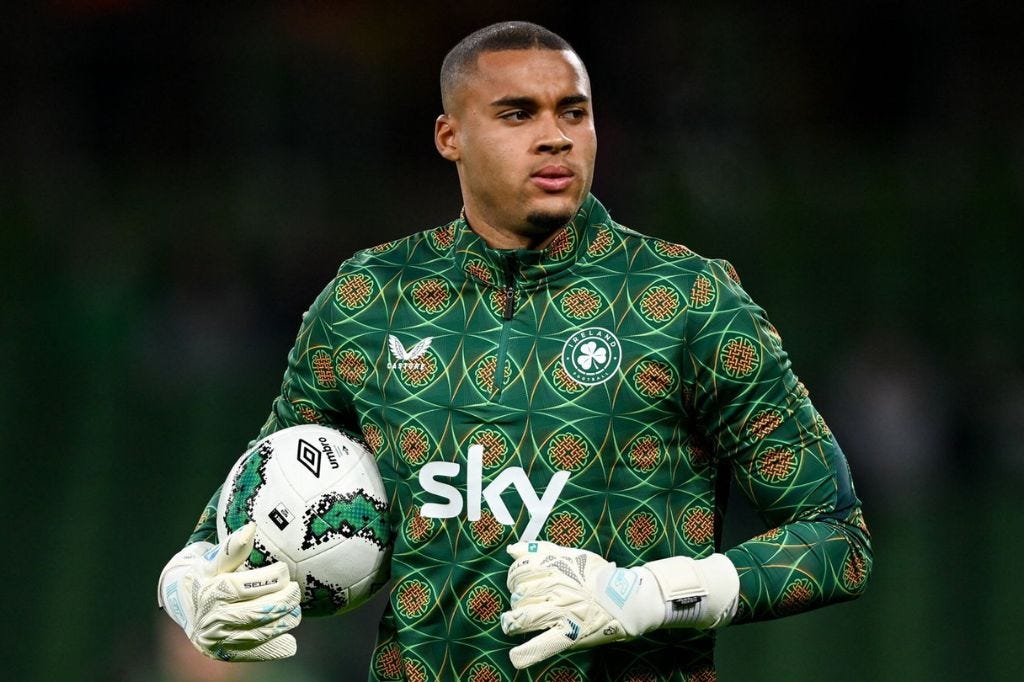
Gavin Bazunu has done what too few footballers are willing to do, he has put conscience ahead of convenience. In withdrawing from the Republic of Ireland squad rather than participate in the Nations League matches against Israel, he has made a clear, peaceful and deeply personal stand against the mass killing of civilians in Gaza and the wider atrocities committed against Palestinian people by the State of Israel.
His statement did not attack Israeli people or Jewish communities. It did not trade in hatred. It simply asserted a basic moral truth - the killing of innocent people is wrong. In an era when football institutions prefer empty gestures and carefully worded neutrality, that clarity deserves respect.
Bazunu’s decision matters precisely because it carries a cost. International footballers are routinely instructed to keep their heads down, follow the schedule and leave moral questions to administrators. Withdraw, and you invite scrutiny, hostility and the inevitable accusations that sport and politics should never mix. Unless Ukraine and Russia are involved.
But sport and politics have always mixed when it suits those in power. Flags are raised, anthems played, national identities marketed and major tournaments used to polish reputations. To insist that an Irish player must participate without question while civilians are being systematically murdered in a genocide is not neutrality. It is a choice to protect football’s routine from the discomfort of moral consequence.
Bazunu has rejected that choice. He has recognised that, at certain moments, the normal rules of public life cannot be allowed to carry on untouched. He is not refusing to play because of the nationality of his opponents. He is refusing to lend his presence to a match that risks normalising business as usual while the world confronts genocide, war crimes and crimes against humanity in Gaza.
Human Rights Watch has said that Israel’s actions in Gaza include the use of starvation of civilians as a weapon of war, while a UN Commission of Inquiry reported that Israel committed genocide in Gaza. The International Court of Justice case brought by South Africa under the Genocide Convention remains ongoing; its provisional measures have not decided the ultimate merits of genocide, but they underline the severity and urgency of the allegations.
Bazunu’s words are therefore not inflammatory. They are restrained. If anything, they are the minimum a person of his position should be able to say when confronted with such suffering.
The Football Association of Ireland’s response in contrast has been depressingly familiar. They acknowledge the sensitivity, permit symbolic gestures, then proceed with the fixture. Ireland’s players will reportedly wear black armbands, and donations are planned. Those gestures may be sincere, but they are no substitute for the action the moment demands. The action that Bazunu took.
A black armband says loss is regrettable. A boycott says the circumstances producing that loss cannot be treated as normal.
The FAI had already shown that it understood the issue. In November 2025, its General Assembly voted 74–7 to submit a motion seeking Israel’s exclusion from UEFA club and international competitions. The motion cited the Israel Football Association’s alleged organisation of clubs in occupied Palestinian territory without Palestinian FA consent, along with concerns about enforcement of anti-racism rules. UEFA rejected the request, and the FAI later opted to fulfil the Nations League fixtures; an EGM motion backing that approach passed 75 votes to 32, with three abstentions.
That sequence of events is hard to defend. The association identified a matter of principle, formally brought it to UEFA, then found itself facing the practical consequence of that principle and retreated like cowards behind procedure.
FAI chief executive David Courell said the team took a vote and that a “significant majority” wished to play; the association then confirmed the fixtures would proceed. A player’s vote can explain a decision, but it cannot absolve the governing body of responsibility. The FAI is not merely a messenger carrying out a dressing-room poll. It is the institution charged with representing Irish football and, by extension, the values it claims to uphold.
The decision also placed a disproportionate burden on individual players. Bazunu had to choose between his international career and his convictions because the FAI refused to make a stand that its own membership had previously urged. That is not leadership. It is sheer cowardice.
As for Europe’s governing body, UEFA, they cannot credibly present itself as a guardian of human rights, anti-racism and sporting integrity - as they tried to do with FIFA over the controversy surrounding this summer’s World Cup - while allowing the normal football calendar to continue around Israel as though they were not committing a genocide against a people.
The contrast with Russia is impossible to ignore. Following Russia’s full-scale invasion of Ukraine in February 2022, FIFA and UEFA suspended Russian national teams and clubs from their competitions. The governing bodies acted quickly because they recognised that football could not continue as normal in the face of an illegal war of aggression. That principle should not depend on the identity of the state carrying out the violence, the geopolitical alliances involved or the anticipated commercial and diplomatic backlash.
If football authorities could conclude that Russian participation was untenable after the invasion of Ukraine, why has UEFA not applied a comparable standard to Israel amid mounting evidence and findings from human-rights organisations, UN bodies and international legal processes concerning Gaza? Why should Palestinian lives be subject to a lower threshold of outrage?
UEFA’s defence amounts to a bureaucratic shrug - associations should fulfil fixtures; sport must remain separate from politics; sanctions are complex. Yet UEFA has repeatedly proved that it is willing to make political and moral decisions when it chooses to do so. Excluding one country while preserving normal competition for another is not apolitical consistency. It is selective enforcement.
The human cost makes that selectivity intolerable. Human Rights Watch’s 2026 assessment cited more than 69,000 Palestinians killed in Gaza, including more than 19,000 children, alongside mass injury, starvation and the destruction of essential services - including 22 hospitals.
A football match does not cause those atrocities. But it can help obscure them. It can offer a televised image of normality - flags, handshakes, anthems, kick-off, points on the table. Bazunu understood that participation is never wholly detached from the context in which it occurs.
Bazunu’s stance will not stop the genocide in Gaza. No individual athlete could. But that is not the point. His withdrawal is significant because it restores an idea football has spent decades trying to erase that players are citizens before they are assets, and human beings before they are representatives of a federation.
His stance is especially notable because he has taken care to distinguish opposition to atrocities and state policy from hostility toward Israelis or Jewish people. That distinction is essential. Collective blame, antisemitism and hatred have no place in any campaign for Palestinian freedom or accountability. The target must be the policies, military actions and institutional impunity at issue - not an entire people or faith.
Ireland has a long history of identifying with peoples denied justice, representation and self-determination. That tradition means little if it is celebrated only in retrospect, when taking a stand is safe and the consequences have passed. Bazunu has acted in the present tense. He has chosen his conscience over complicity, principle over professional convenience, and humanity over the hollow demand that football simply carry on.
The FAI can hide behind a vote. UEFA can hide behind regulations. But neither should be allowed to hide from the moral question that Bazunu has faced directly - when a genocide is being enacted on a people who have no way of defending themselves, what does it mean to act as though everything is normal? For Gavin Bazunu, the answer was clear. It would be wrong. For the FAI, commercial interests seem to be more important.
Couldn't agree more. What a horrible world we now live in . God Bless Gavin Bazunu .Wish there were more people like him . HH
Exactly that.
Well said, well written.