

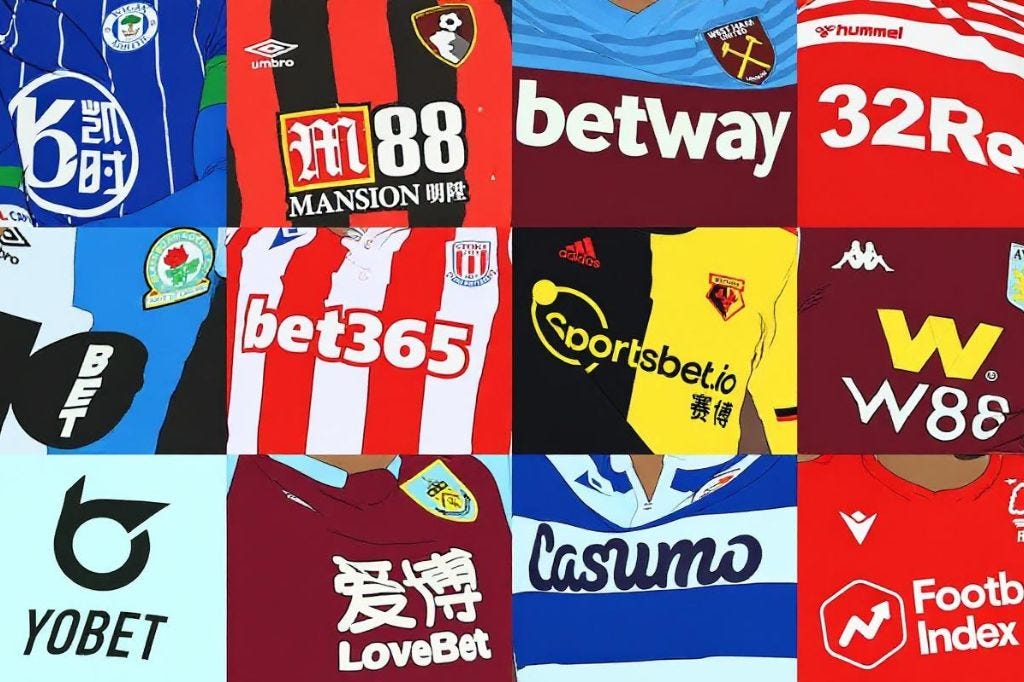
Every weekend, football fans across the UK settle in for matchday only to be bombarded by betting logos plastered across shirts, pitchside boards, and every TV ad break, the sport we love is now inseparable from the betting industry. This isn’t just background noise; it’s a multi-billion-pound relationship reshaping clubs’ finances, fans’ habits, and entire communities.
But at what cost? Lower league teams depend on these sponsors to survive, while problem gambling referrals to NHS clinics have surged 130% in recent years. Young fans grow up thinking betting is part of the game, and safer gambling warnings like GambleAware’s “Take Time To Think” barely register and is nothing more than paying lip service to a mental health epidemic. With the Premier League banning front-of-shirt betting sponsors from 2026-27, the stakes have never been higher.
So let’s break down the real numbers: the revenue lifeline for clubs, the brand wins for bookies, the mental health crisis hitting fans and families, and what a full ban would actually mean for the beautiful game.
The Ubiquity of Gambling in Modern Football
The presence of gambling companies in professional football has become so normalised that it’s easy to forget how transformative this relationship has been. Today, gambling logos aren’t merely advertisements they are woven into the fabric of the sport itself, adorning players’ chests, dominating stadium advertising, and saturating television broadcasts. In August 2024, during the opening weekend of the Premier League season, fans were exposed to more than 29,000 gambling messages across all platforms. A single West Ham versus Aston Villa match contained 6,500 gambling messages, with over 4,000 appearing on pitchside hoardings alone, meaning viewers saw approximately 30 gambling messages per broadcast minute. This saturation reflects a commercial relationship that now defines modern football financing and raises profound questions about the costs of this partnership that extend far beyond balance sheets.
Financial Impact on Football Clubs: Essential Revenue or Unsustainable Dependency?
For football clubs, particularly those outside the top tier, gambling sponsorships represent a financial lifeline. The numbers are staggering with Premier League clubs collectively generate approximately £60 million annually from front-of-shirt gambling sponsorships. West Ham’s partnership with Boyle Sports, valued at approximately £12-13 million for one year, exemplifies the scale of these deals. At Championship level, the financial importance becomes even more pronounced, with gambling sponsorships generating over £40 million annually across the English Football League, and more than half of clubs maintaining partnerships with gambling operators.
For Championship and League One clubs, these partnerships often prove decisive for financial survival. Clubs in lower divisions rely on gambling sponsorships as critical revenue sources to fund player wages, maintain competitive squads, and invest in academy infrastructure. The financial disparity between clubs with and without gambling sponsors has become stark with clubs securing £6-10 million annually from casino company sponsorships, enabling major player acquisitions that would otherwise be impossible.
However, this financial dependency carries significant risk. The Spanish example provides a sobering cautionary tale. When La Liga implemented a gambling sponsorship ban for the 2021-22 season, Spanish clubs collectively lost an estimated €90 million in revenue. Seven La Liga clubs, including Valencia and Sevilla, lost sponsorship deals worth millions of euros annually. Spain’s experience demonstrates that when regulatory changes arrive, the financial pain is immediate and severe, particularly for smaller clubs dependent on these arrangements.
For the Premier League, some suggest the incoming 2026-27 season front-of-shirt ban could create substantial disruption. Multiple clubs face losing over half of their fair market sponsorship value. AFC Bournemouth, whose reported £8 million annual deal with gambling sponsor BJ88 is 185% above fair market value, exemplifies the overvaluation of these partnerships. Research indicates that when non-gambling sponsorship alternatives are the only benchmark, sponsorship values drop on average by 38% across gambling-sponsored clubs. For clubs like Fulham and Wolverhampton Wanderers, projected losses exceed 50 percent of current deal value.
The financial reality is that gambling companies are currently propping up the Premier League sponsorship market. These firms pay approximately 40% above fair market rate for front-of-shirt sponsorships, a premium that non-gambling brands are unlikely or unwilling to match. Whilst betting firms are expected to shift investment to sleeve sponsorships, if current premium rates translate to those platforms, clubs could recover a significant portion of losses. However, this represents no guarantee, and the broader commercial landscape will become more competitive as betting companies compete for alternative advertising inventory with reduced support.
Brand Exposure for Gambling Operators: Calculated Risk or Proven Strategy?
From the gambling industry’s perspective, football sponsorship has been remarkably effective. The justification is straightforward betting operators invest millions because it works. These partnerships provide direct links to audiences defined by passion, loyalty, and competitive engagement - precisely the psychological characteristics that drive betting behaviour. Team sponsorships forge emotional associations between betting brands and beloved clubs, creating symbolic links that translates to credibility and trust among supporters.
Sponsorship effectiveness isn’t limited to simple brand awareness. Gambling operators use sports sponsorship strategically to normalise betting as entertainment, reduce perceived risk, and develop customer loyalty with target demographics. During major tournaments, integrated activations create betting experiences that pull consumers deeper into gambling rather than merely raising awareness. Analysts candidly state that sponsorship effectiveness is proven by the willingness of gambling companies to spend substantial premiums for these partnerships with the 40% premium above market rates reflecting genuine commercial value, not charitable giving.
Young people represent a particularly valuable demographic for gambling brands. Research shows that Gen Z has grown up with social media, making them especially vulnerable to gambling advertising from celebrity endorsements, influencers, and bloggers. Gambling companies strategically exploit this exposure through sports sponsorship, understanding that young fans exposed to gambling marketing normalise betting and develop more favourable attitudes toward gambling earlier in life. The investment is calculated, current exposure shapes future customer acquisition.
However, the brand exposure mechanism has become problematic precisely because it works. Gambling advertising effectively creates the conditions for public health harm, as increased exposure to gambling advertising predicts greater likelihood of betting among non-gamblers and significantly elevated gambling among those already experiencing problems.
The Mental Health Crisis: From Individual Suffering to Systemic Trauma
The human cost of gambling’s integration into football is becoming increasingly visible. The UK is experiencing a documented surge in gambling-related mental health crises. NHS gambling clinics have seen referral rates increase by 130 percent, with the NHS treating 1,914 people at gambling clinics between April and September 2024, compared to 1,389 in the previous financial year and just 775 in 2020-21. NHS England has had to double the number of specialist gambling clinics nationwide, from 7 to 15, to attempt to manage escalating demand. NHS Scotland seems to have no specialist gambling clinics at all and refer those looking for help to third party charities instead.
Problem gambling affects an estimated 2.5% of the adult population in the UK, with approximately 1.4 million people experiencing harms from gambling. Football fans face particular vulnerability. Research from the Professional Footballers’ Association found that 15% of professional footballers report gambling as detrimental to their mental health, a figure that experts believe substantially underestimates the true prevalence given the difficulty of identifying gambling addiction compared to visible substance abuse. Suggesting that athletes’ competitive drive and access to betting platforms create heightened vulnerability.
The mental health impacts extend far beyond financial loss. Problem gamblers experience depression, anxiety, insomnia, suicidal thoughts, and complete financial devastation. Research from Sheffield Hallam University found that 99% of family members of problem gamblers reported mental health harms, with 77% experiencing depression and stress. The House of Lords noted that for every person experiencing problem gambling, approximately six other people (family members, partners, children, and friends) are negatively affected by gambling-related harm, affecting approximately 2.5 million people in the UK.
For affected family members, the impacts are severe and multifaceted. Almost all family members (83%) of problem gamblers report significant emotional and psychological harm. Family relationships deteriorate substantially with 89% of family members experience greater tension, whilst 82% report increased conflict with the problem gambler. Approximately 68% of family members threaten separation or ending the relationship, with 33% following through on relationship dissolution. Family members also neglect their own medical needs (29%) and require emergency health treatment (21%) for health issues caused or exacerbated by the loved one’s gambling.
Most disturbing are the suicide implications. Estimates place gambling-related suicides between 117 and 496 annually in England alone, with problem gambling described as killing people and playing a role in hundreds of deaths each year by NHS experts specialising in gambling addiction. Dr Matt Gaskell, head of the NHS Northern Gambling Service, has stated that “gambling harms can affect anyone” and represents one of the most underrecognised public health crises facing Britain today. I could not find any relevant information related to gambling-related suicides in Scotland.
Gambling Advertising on Television: The Amplification Problem
Television exposure to gambling advertising occurs at unprecedented levels and with documented mental health consequences. The most common form of gambling advertising exposure is television, with research showing those surveyed reported exposure levels averaging 3.5 on measurement scales, higher than retail outlets, internet advertising, newspapers, and direct marketing. During sports broadcasts, gambling advertising is ubiquitous, television gambling advertisements were shown in 75% of live televised sporting events across football, rugby and other sports in research spanning December 2018 to July 2019.
The critical finding from mental health research is that gambling advertising disproportionately affects problem gamblers. Studies with clinically-diagnosed gambling disorder patients found that greater gambling severity was directly associated with higher perceived impact of gambling advertising on their behaviour. Those experiencing gambling problems reported that gambling advertising triggered them to gamble (46% of those studied), and exposure to direct gambling marketing (texts, emails, telephone calls) was directly associated with gambling severity.
Among problem gamblers specifically, the impact is severe. Those experiencing harm from gambling are 40 times more likely to spend more money and time gambling as a result of seeing gambling ads compared to those who gamble without problems. This represents not incidental exposure but genuine behavioural activation. For vulnerable populations, those experiencing gambling problems, those with emotion dysregulation, or those with high impulsivity, gambling advertising functions as a direct trigger for problematic gambling behaviour.
Critically, advertising affects young people differently than adults. Research found that 96% of people aged 11-24 had seen gambling advertising in the past month, with saturation particularly evident during sports programming. Young people who reported more positive attitudes towards gambling advertising and more frequent sports watching scored higher on problem gambling screening instruments. Yet young people are largely unaware of the range of gambling harms beyond financial losses, with many viewing gambling sponsorship of sport as natural and appropriate.
The financial architecture of this advertising exposure is revealing. Broadcasters including the BBC, Sky Sports, and others receive approximately £200 million annually from gambling companies such as William Hill, Ladbrokes, Paddy Power, and Sky Bet for advertising during and around football broadcasts. This creates a financial incentive structure where broadcasters benefit directly from maximising gambling advertising volume, creating a misalignment between broadcaster commercial interests and public health.
The GambleAware Campaign: Does the Warning Label Make Any Difference?
GambleAware, funded partly by voluntary contributions from the gambling industry, has become synonymous with safer gambling messaging. The organisation’s campaigns, particularly the “Take Time To Think” slogan, have become common place on gambling advertisements. However, research into GambleAware’s messaging effectiveness has revealed that these warnings are largely ineffective and, in some cases, counterproductive.
In May 2024, GambleAware commissioned independent research involving over 7,000 people to evaluate the effectiveness of current safer gambling messaging. The findings were damning: the widely-used “Take Time To Think” (TTTT) slogan was the least effective messaging option tested, with research concluding that this message “does not give people a reason to change their behaviour” and “failed to land the jeopardy of gambling harms.” The research demonstrated that the campaign had poorer performance than alternative messaging on critical metrics including cut-through, memorability, and behaviour change, such as setting deposit limits.
The research identified three substantially more effective alternative messages: “Gambling comes at a cost” (drawing 22% versus 12% for TTTT), “Gambling can be addictive” (46% cut-through versus 35% for TTTT among problem gamblers), and “Gambling can grip anyone.” Crucially, the study found that including a clear GambleAware health warning at the end of a 30-second advertising advert was more than twice as effective as TTTT at showing people where to get support - 72% versus 30% effectiveness.
A broader assessment of gambling public messaging messaging interventions concluded that whilst existing messaging can raise awareness of gambling harm reduction, evidence is “limited” in demonstrating actual behaviour change. This represents the core problem: the gambling industry’s self-regulated messaging framework has created a system where warnings are deployed but documented as ineffective at preventing harm.
Additionally, research identified serious misuse concerns. GambleAware’s own logo is being misused by operators who place the logo in isolation without accompanying clear signposting to support services, which dramatically reduces the likelihood that people will search for help when concerned about their gambling. This represents a form of advertising co-option, where safety messaging is integrated into marketing without meaningful support signposting.
The evidence suggests GambleAware’s current approach represents risk mitigation for the industry rather than genuine harm prevention. Researchers at the University of Bristol and independent academics have explicitly called for GambleAware to move beyond industry-produced messaging toward genuinely effective evidence-based warnings, with strict regulation on operator behaviour rather than reliance on self-regulation. The reality is that GambleAware warnings exist primarily as a liability shield - they demonstrate industry “responsibility” whilst doing nothing to meaningfully prevent gambling-related harm.
Local Community Impact: The Hidden Social Cost
Beyond individual mental health, gambling sponsorship creates documented impacts on local communities. Research has identified that the presence of gambling sponsorships in local professional football teams may exacerbate gambling harms, particularly in less stable households and economically disadvantaged communities. Gambling sponsorships normalise betting within communities and create environmental reinforcement for problematic gambling behaviour.
The financial toll on public services is substantial. Estimated costs of gambling harm in the UK range from £260 million to £1.16 billion annually when accounting for health services, criminal justice, welfare, and employment impacts. In Wales alone, estimates place gambling harm costs between £40 million and £70 million annually. In Scotland it is reportedly up to £60 million each year. The NHS bears disproportionate costs, with problem gamblers twice as likely as the general population to consult GPs for mental health concerns and five times as likely to be hospital inpatients for mental health treatment.
From a community development perspective, it has been documented that whilst some sponsorships include community programs and CSR initiatives, these benefits must be measured against the backdrop of community-level gambling harms. Football clubs’ community engagement programs, often funded through gambling sponsorships, occur in contexts where the primary commercial relationship - gambling advertising and sponsorships - actively contributes to gambling harms in those same communities.
Communities with lower societal status experience disproportionate gambling harms. Gambling advertising’s targeting of vulnerable populations, combined with the normalisation effect of seeing gambling sponsorship on beloved local football teams, creates conditions where communities with fewest resources to manage gambling-related crises experience the highest concentration of gambling harms. The income generated through gambling sponsorships at the club level often fails to offset the community-level costs borne by public health and social services.
Young People and Children: Setting the Trajectory for Future Gambling
The impact on young people deserves particular emphasis. A comprehensive study titled “Code Red: Young People and their Exposure to Gambling Sponsorship in Sport” documented that gambling marketing exposure has reached saturation levels on televised sports programming, with intensive supplementary campaigns across social media. Young people aged 14-24 report constant exposure to gambling marketing through sports, before matches, during broadcasts, and after matches in advertising breaks.
Gambling logos appear in 56.8% of dedicated children’s sections of football club programmes, with incidental exposure to gambling logos appearing 42.7 times per programme. Gambling messages were 13 times more common than alcohol marketing or safer gambling messages in children’s program sections. Many young people report normalising the relationship between betting and sport as “natural,” reflecting how effectively gambling sponsorship has created perceptual normalisation of betting as entertainment.
This early exposure matters because it shapes lifetime patterns. It demonstrates that childhood exposure to gambling predicts elevated problem gambling risk in adulthood. Young people who gambled in childhood or were exposed to gambling marketing during childhood show elevated risk trajectories for developing gambling problems later in life. Combined with the documented facts that approximately 27% of 11-17-year-olds have gambled their own money in the past year and teenage boys with interest in gaming and football show heightened future gambling risk, the pipeline effect of young exposure is concerning.
The impact on adolescent development is particularly serious. Young people are cognitively vulnerable to advertising effectiveness because the brain regions responsible for impulse control and long-term consequence evaluation continue developing into the mid-20s. Gambling advertising, designed to activate betting impulses, operates directly contrary to adolescent brain development, which requires exactly the impulse control that gambling marketing undermines.
The Ban Question: What Happens to Football if Gambling Sponsorship Disappears Entirely?
The prospect of a complete ban on gambling sponsorship in football raises the central question, can football clubs survive financially without gambling money? Evidence suggests yes, though the transition would be painful and unequally distributed.
The Premier League has committed to phasing out front-of-shirt gambling sponsorships beginning with the 2026-27 season. This marks the most significant sponsorship shift in generations, following precedent from European jurisdictions. Italy banned gambling shirt sponsorships in 2019, Spain in 2021, Belgium and the Netherlands have implemented similar restrictions, and the Premier League is following this trajectory.
The financial impact analysis is complex. A 2021 report by Sport England estimated that the English Football League could lose £26 million annually from a complete gambling sponsorship ban, equal to approximately 2.5% of annual revenue. Whilst this sounds substantial, the same analysis noted that non-gambling sponsors exist to potentially fill the gap and that some replacement sponsorship could materialise over time.
The Spanish experience provides instructive data. Following La Liga’s ban, clubs were forced to pivot to alternative sponsorship sources. The immediate impact was significant, €90 million in lost sponsorship revenue across Spanish football, but within three to five years, sponsorship values partially recovered through alternative partnerships and market recalibration. However, Spanish clubs during the pandemic period faced compounded financial stress, suggesting the timing of bans matters substantially for clubs’ capacity to adapt.
Alternative sponsorship sources are available. Financial services, technology, cryptocurrency [another problem area that will need addressing in the next few years], travel and tourism sectors have demonstrated interest in Premier League partnerships. Some clubs, like Brighton and Hove Albion (American Express shirt sponsor) and Newcastle United (Sela shirt sponsor), have successfully built partnerships outside gambling without being disadvantaged competitively. Streaming platforms, athletic brands, and emerging consumer brands represent viable alternatives, though not all can match gambling firms’ premium pricing.
The most likely outcome of a complete ban is not that football clubs cease operating, but rather that:
A market repricing occurs: Sponsorship values adjust downward from the inflated levels gambling firms currently pay to fair market rates based on non-gambling industry benchmarks.
Wealth inequality increases: Larger clubs with diverse revenue streams (broadcasting rights, merchandise, hospitality) weather the transition; while smaller clubs relying on shirt sponsorships face more severe adjustment.
Betting firms migrate to other assets: Rather than disappearing from football, gambling operators shift investment to sleeve sponsorships, training wear, digital advertising, and other platforms not covered by bans.
Some clubs may implement temporary gaps: Rather than accepting below-target sponsorship deals, some clubs may operate periods without front-of-shirt sponsors, allowing them to negotiate from strength later as competitive pressure for sponsorship assets increases.
The critical distinction is between what is financially necessary versus what is commercially convenient. Football clubs do not require gambling sponsorship for survival. They require revenue, but that revenue can originate from numerous sources. What gambling sponsorships provide is premium-priced capital at above-market rates. Losing that premium doesn’t eliminate football’s financial model, it requires adjustment to fair-market rates whilst seeking alternative sponsorship sources.
Football’s Moral Reckoning: Choosing Health Over Easy Money
Gambling sponsorship represents football selling its soul for short-term cash. Clubs gain millions; fans lose homes, health, lives. Mental health crises surge; communities fracture; children inherit warped values. GambleAware warnings fail spectacularly; TV ads trigger relapses.
Bans hurt financially but heal structurally. Spain and Italy survived; England and Scotland will too. The sport’s essence - competition, community, and dreams of glory - transcends dirty money. Prioritising public health over premium cheques represents moral leadership, not economic suicide. Football must choose to remain gambling’s billboard, or reclaim its beautiful purity and morality.
Premier League’s half-measure (front-of-shirt only) delays the inevitable. Full bans across sleeves, stadiums, broadcasts offer a clean break and will ultimately come into play sooner rather than later. Clubs will diversify; bookies migrate elsewhere; fans heal. The final whistle approaches on the toxic era of betting firms and football will emerge stronger on the other side.
I agree Andy, this gambling sponsorship which underpins football is a double edged sword, on the one hand it affords clubs a rich source of revenue, but on the other hand, is leading many people into gambling addictions, phobias and mental illness. Just look at the list of professional footballers who have openly confessed to being gambling addicts, John Hartson stands out for me, his harrowing story, told a tale of desperation, helplessness and chaos, which wrecked his personal and social life. Time this gambling sponsorship in football was put out to pasture.